


How to manage online reputation and reviews Master 2025
Why Your Online Reputation is the Key to Your Business Success

Ever felt that little knot of anxiety before you Google your own business? You’re not alone. How to manage online reputation and reviews is one of the most critical questions for business owners today, because the answer directly impacts whether customers choose you or your competitor.
Here’s the quick answer to get you started:
Essential Steps to Manage Your Online Reputation:
- Monitor – Set up alerts for your business name on review sites, social media, and Google.
- Claim – Register and optimize your profiles on Google Business, Yelp, and other relevant platforms.
- Respond – Reply to every review (positive and negative) professionally and promptly.
- Encourage – Ask satisfied customers to share their experiences online.
- Create – Publish positive content that showcases your expertise and values.
The reality is that 98% of consumers read reviews before making a purchase, and 93% say those reviews directly impact their buying decisions. Your online reputation isn’t just about damage control—it’s your secret weapon for building trust, attracting customers, and even commanding higher prices.
Online Reputation Management (ORM) means actively shaping how people perceive your business online. It’s the difference between a potential customer finding glowing testimonials versus an old complaint you never knew existed.
Think of it this way: SEO is like arranging your store’s front window to attract passersby, while ORM is about managing how customers feel about your store—and what they tell their friends afterward.
I’m Fred Z. Poritsky, and I built FZP Digital to help Philadelphia-area businesses master how to manage online reputation and reviews. I’ve seen how a strategic approach transforms struggling businesses into local favorites.
Why Your Online Reputation is Your Most Valuable Asset
Let me tell you something: your online reputation isn’t just another marketing checkbox—it’s one of your most valuable assets. What people say about you online can make or break your success faster than any advertising campaign ever could.
Think about the last time you needed a plumber or a restaurant. You probably pulled out your phone and read reviews, right? You’re not alone. 87% of consumers read online reviews for local businesses before making any decision. This is a fundamental shift in how business works.
What’s more, 91% of younger consumers (18-34) trust online reviews just as much as personal recommendations. A stranger’s review now carries the same weight as a friend’s advice. That’s why understanding how to manage online reputation and reviews is absolutely critical.
Your reputation directly drives purchase decisions. Would you believe that 57% of consumers won’t even consider a business with less than four stars? If your star rating is 3.5, you’re invisible to more than half of your potential customers.
But here’s the exciting part: a strong reputation lets you charge more. Research shows that 63% of consumers are willing to pay up to 15% more for a business they believe will provide a better experience. Your reviews don’t just bring people in; they increase your profit margins.
Your online reputation shapes your entire brand perception, from how the public and potential employees see you to how partners and investors perceive your business. A positive online presence creates a competitive moat around your business that’s hard for others to cross.
Now, you might be wondering if this is just Search Engine Optimization. It’s a smart question! While SEO and online reputation management (ORM) are cousins, they serve different purposes.
SEO gets you found, ORM ensures you’re loved. SEO is about making sure your business shows up in search results. ORM is about managing what people find and how they feel about your brand once they see it.
Both are essential and work best together. At FZP Digital, we approach them as two sides of the same coin—because getting found doesn’t matter if what people find makes them run the other way.
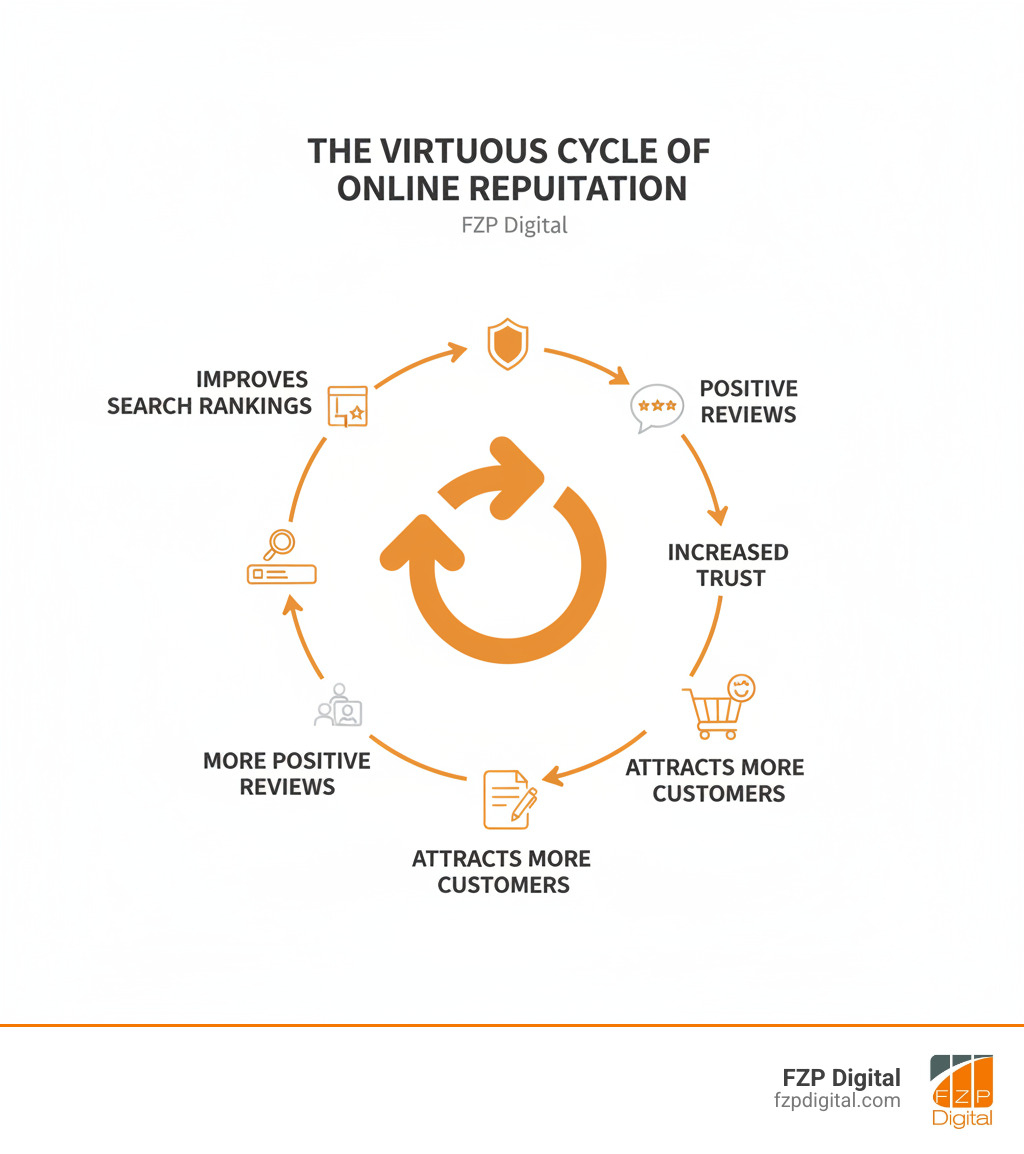
The long-term benefits of managing your reputation go beyond next quarter’s sales. You’re building a legacy. You create deeper customer loyalty, attract top talent, and get a goldmine of feedback you can use to improve your services. This creates a virtuous cycle: positive interactions lead to positive reviews, which attract more customers, who have more positive experiences. It’s compound interest for your brand, and that’s why I call it your most valuable asset.
Your Proactive Playbook: How to Manage Online Reputation and Reviews

This is where the magic happens, friend! We’re going to take control and build a positive presence from the ground up. This proactive approach is the heart of understanding how to manage online reputation and reviews effectively.
Step 1: Become a Digital Detective – Monitor Everything
You can’t fix what you don’t know is broken. Becoming a digital detective means keeping your finger on the pulse of every mention of your brand online—review sites, social media, forums, blogs, you name it.
The smartest move is setting up automated alerts. Set up Google Alerts for your business to get notifications about new content. Most review sites also offer email notifications, so subscribe to those. For social media, platforms like Hootsuite can help you monitor mentions, even when you’re not tagged.
Why is this so crucial? It gives you the power to react quickly, whether it’s amplifying a glowing review or handling a negative comment. Timely action is everything. Plus, it lets you watch your competitors and understand your market better.
Step 2: Plant Your Flag – Claim Your Digital Real Estate
Before you can manage reviews, you need to own your presence on the platforms where customers are already talking about you. Think of it as planting your flag in the digital landscape by claiming and optimizing your business profiles.
The absolute essentials are your Google Business Profile (formerly What is Google My Business?), Yelp for Business, and your Facebook Business Page. Depending on your industry, you might also need sites like TripAdvisor, Healthgrades, or HomeAdvisor.
After a quick verification, fill out every single detail. Ensure your Name, Address, and Phone Number (NAP) are consistent across all platforms. Add compelling descriptions, up-to-date info, and high-quality photos. This isn’t just for customers; it boosts your local SEO, as consistency signals trustworthiness to search engines.
Step 3: The Art of the Reply – Responding to Every Single Review
This step is where your reputation comes alive. Responding to reviews isn’t just good etiquette; it’s a powerful strategy. And yes, we mean every review!
When a customer praises you, don’t just say “thank you.” Personalize your response by mentioning what they liked. If they loved your staff, say, “We’re so glad our team made your visit enjoyable!” This reinforces the positive and shows you’re listening.
Now, for negative reviews. A consumer is 21% more likely to leave a review after a negative experience, but 39% of them just want an apology. A sincere response can actually improve your reputation.
When you get a negative review, take a breath and follow this approach: Acknowledge and apologize sincerely. Validate their concern with empathy. Then, offer a solution or a way to make it right, but take the conversation offline. Provide a direct email or phone number. This shows you’re committed to resolution without a public back-and-forth.
Timeliness matters. 53.3% of customers expect a response within 7 days, and on social media, 42% expect one within an hour! A delay makes it seem like you don’t care.
Here’s a quick comparison of how a response can make all the difference:
| Great Response to a Negative Review | Terrible Response to a Negative Review |
|---|---|
| “Thank you for sharing your feedback, [Customer Name]. We’re truly sorry your experience with [specific issue] didn’t meet your expectations. We’re always striving to improve, and your comments are valuable. Please contact us directly at [phone/email] so we can discuss this further and find a resolution.” | “That’s not what happened. You’re wrong. We don’t do business that way. Delete this review.” |
| Why it works: It’s empathetic, professional, addresses the specific concern, offers a solution, and moves the sensitive conversation offline. It shows care and responsiveness. | Why it fails: It’s defensive, accusatory, unprofessional, and likely to escalate the situation, damaging your reputation further. |
Responding to negative feedback is an opportunity to turn a detractor into a loyal customer and showcase your commitment to service for everyone else watching.
Step 4: Turn Happy Customers into Your Biggest Fans
You know that feeling when a customer is beaming with satisfaction? That’s your golden moment! 70% of customers will leave a review when asked. It’s really that simple! Many satisfied customers just need a little prompt.
If you get positive feedback in person, just ask! A simple, “We’re so glad you had a great experience! We’d truly appreciate it if you could share your thoughts on Google” works wonders.
Email and SMS campaigns are also powerful. Send a follow-up after a purchase with direct links to your review sites. The key is making it easy. For in-person requests, use QR codes on receipts or business cards. The fewer clicks, the better.
A pro tip: consider using a “review funnel” that sends happy customers to public sites and unhappy ones to a private feedback form. This gives you a chance to resolve issues before they go public. While asking, be mindful of platform-specific rules, but the goal is to consistently generate new, positive reviews to keep your online presence fresh.
Advanced Moves: Using Content and Social Media to Build a Fortress
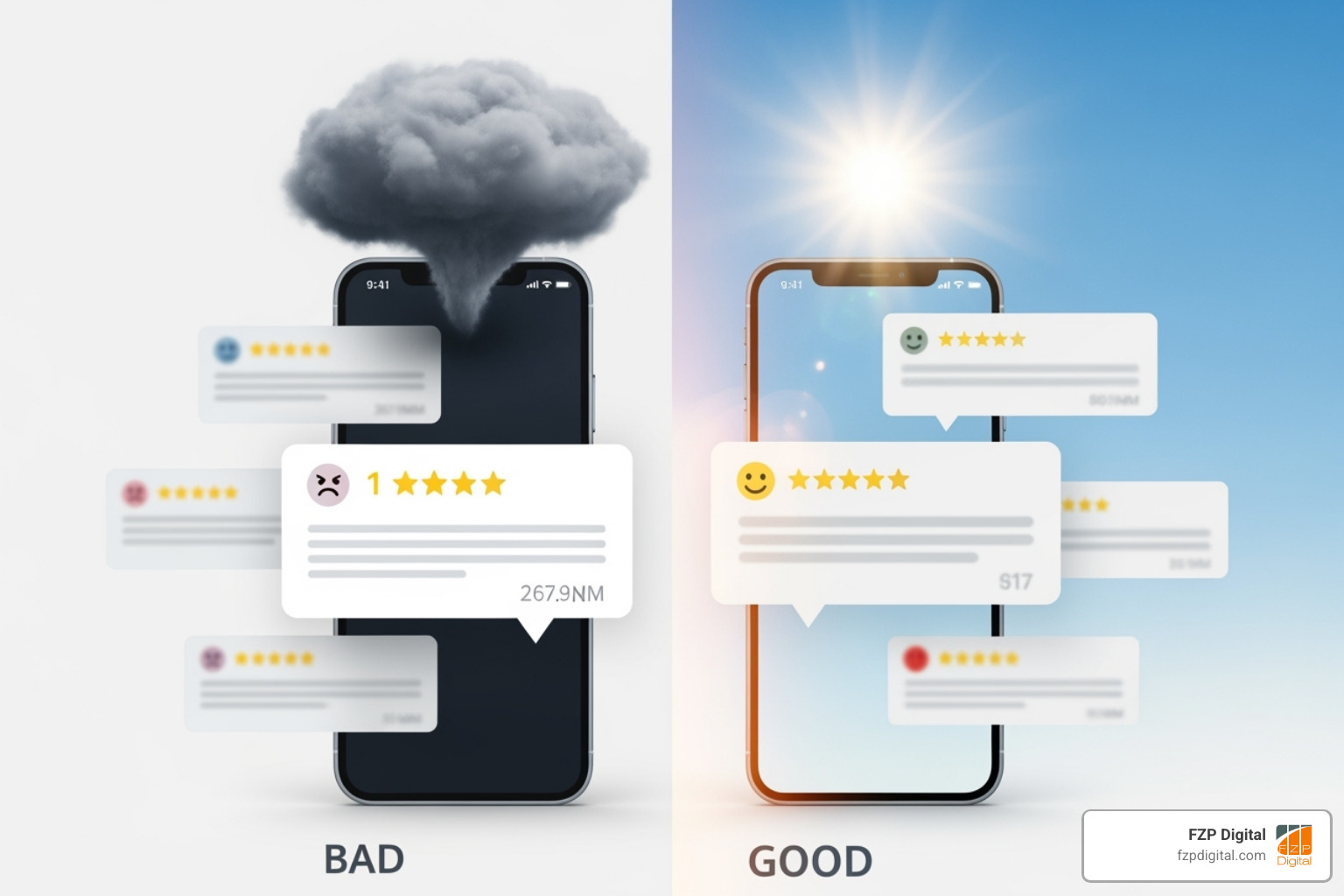
Ready to play offense? To truly master how to manage online reputation and reviews, we need to go beyond reacting. This is about proactively shaping your narrative and building a digital fortress around your brand.
How to manage online reputation and reviews with strategic content
Content isn’t just for marketing; it’s a powerful reputation management weapon. When you consistently publish high-quality content, you build authority and strategically push down any unflattering search results.
- Blogging for authority establishes you as a thought leader. When you answer common customer questions, your helpful articles can outrank old complaints.
- Case studies that shine provide concrete social proof of your value, resonating with customers who are on the fence.
- Press releases for exciting news can earn positive media coverage from reputable sites, adding layers of credibility to your brand.
Here’s the strategy: if an old negative article ranks high, creating a wealth of new, positive, keyword-rich content can gradually push it down. It’s about pushing down negative results with volume and quality. SEO is your best friend here. By optimizing your content, you increase its chances of ranking highly, ensuring people find your controlled narrative first. It’s a complex game, but we help businesses Improve Search Ranking by owning that first page of search results. The return on trust is immense.
How to manage online reputation and reviews using social media
Social media is a double-edged sword. It’s where complaints can go viral, but it’s also an incredible platform for building community and showing your brand’s personality.
First, understand that social media is about building a community, not just broadcasting. Respond to comments, answer questions, and share user-generated content to foster a sense of belonging. Your followers can become your biggest advocates.
This is also where you show your brand’s personality. Share behind-the-scenes glimpses and celebrate wins to humanize your business and build stronger connections.
Now, for handling complaints with grace. 42% of consumers expect a response on social media within an hour! Promptness is key. Never delete a negative comment (unless it’s spam). Instead, acknowledge it publicly, apologize, and offer to take the conversation private. This shows everyone you’re responsive and care.
One of the most powerful moves is turning customers into advocates. Encourage user-generated content by running contests or asking customers to share photos with your products. It’s authentic social proof that advertising can’t match.
Your social media presence is a real-time reflection of your brand. Managing it actively is complex work that requires constant attention, which is where having an expert in your corner makes all the difference.
The Long Game: Lasting Benefits and Protecting Your Brand

We’ve talked about the immediate wins, but managing how to manage online reputation and reviews is about building something lasting. It’s about ensuring your business thrives for years to come.
Increased sales and revenue are the most obvious benefits. When customers trust you, they buy from you. A positive image translates to more leads, higher conversions, and a healthier bottom line. Plus, you can command higher prices—remember, 63% of consumers will pay up to 15% more for a better experience.
But it goes beyond money. Stronger brand loyalty is where the real magic happens. When customers feel heard and valued, they become your champions. They’ll choose you every time, recommend you to others, and even defend you online.
Your reputation isn’t just for customers. Attracting top talent is easier when your business has a stellar online presence. Job seekers research you. A positive reputation on your site, social media, and Glassdoor signals that you’re a desirable place to work.
Every review is a gift—it’s free market research! Using feedback to improve is an underrated benefit. Monitoring what people say gives you invaluable insights to refine your products, services, and customer experience.
Now, let’s talk about protecting your brand name. It represents your values, quality, and promises. Protecting it means being consistent and ensuring your digital presence reflects who you are.
Have you thought about trademarking your brand? It’s crucial for long-term protection. Trademark your brand with the US Patent & Trademark Office to prevent others from hijacking your hard-earned reputation. It’s legal armor for your identity.
This is about building a legacy of trust and authenticity. When you invest in your online reputation, you’re ensuring its longevity. And if you’re feeling overwhelmed, our Digital Marketing Services are designed to help you build and protect your digital presence, so you can focus on running your business.
Conclusion
So, there you have it, friend! We’ve walked through the essentials of how to manage online reputation and reviews. From understanding its value to implementing proactive strategies, you now have a solid foundation.
Let’s recap the key takeaways:
- Monitor what’s being said about your brand.
- Engage with every review to show you care.
- Encourage happy customers to share their experiences.
- Create compelling content that puts your best foot forward in search results.
Here’s the thing, though—reputation management is a marathon, not a sprint. It’s an ongoing process that requires a dedicated strategy and expertise to keep up with new platforms, algorithm changes, and consumer behaviors. That’s a lot to juggle when you’re already running a business!
The digital world is always changing, and having an expert in your corner makes all the difference. You wouldn’t fix your car’s transmission without training, right? The same applies here. Professional guidance ensures your brand’s image is always working for you.
That’s where we come in. At FZP Digital, we help businesses in Philadelphia and Bucks County build reputations that drive real growth. We understand the nuances of local search, authentic engagement, and a holistic digital strategy.
This is about building a legacy. Your reputation isn’t just about today’s sales; it’s about creating a brand that thrives for years. Don’t leave it to chance. Let us help you craft a strategy that reflects the excellence of your business. See what our clients have to say about our results! We’re ready to help you shine online with our Digital Marketing Services.