
Digital marketing for nonprofits: Essential 2025
Introduction: Your Mission Deserves a Megaphone
Digital marketing for nonprofits is all about using online channels—like your website, email, social media, and search engines—to spread awareness, engage supporters, raise funds, and amplify your impact.
Why it matters for your nonprofit:
- Increased Reach – Connect with donors, volunteers, and advocates far beyond your immediate community.
- Deeper Engagement – Build meaningful relationships through personalized, consistent communication.
- More Donations – Online giving is booming, and email marketing alone generates around 28% of all online nonprofit revenue.
- Cost-Effective – Many digital tools are free or discounted for nonprofits, including the incredible $10,000/month Google Ad Grant.
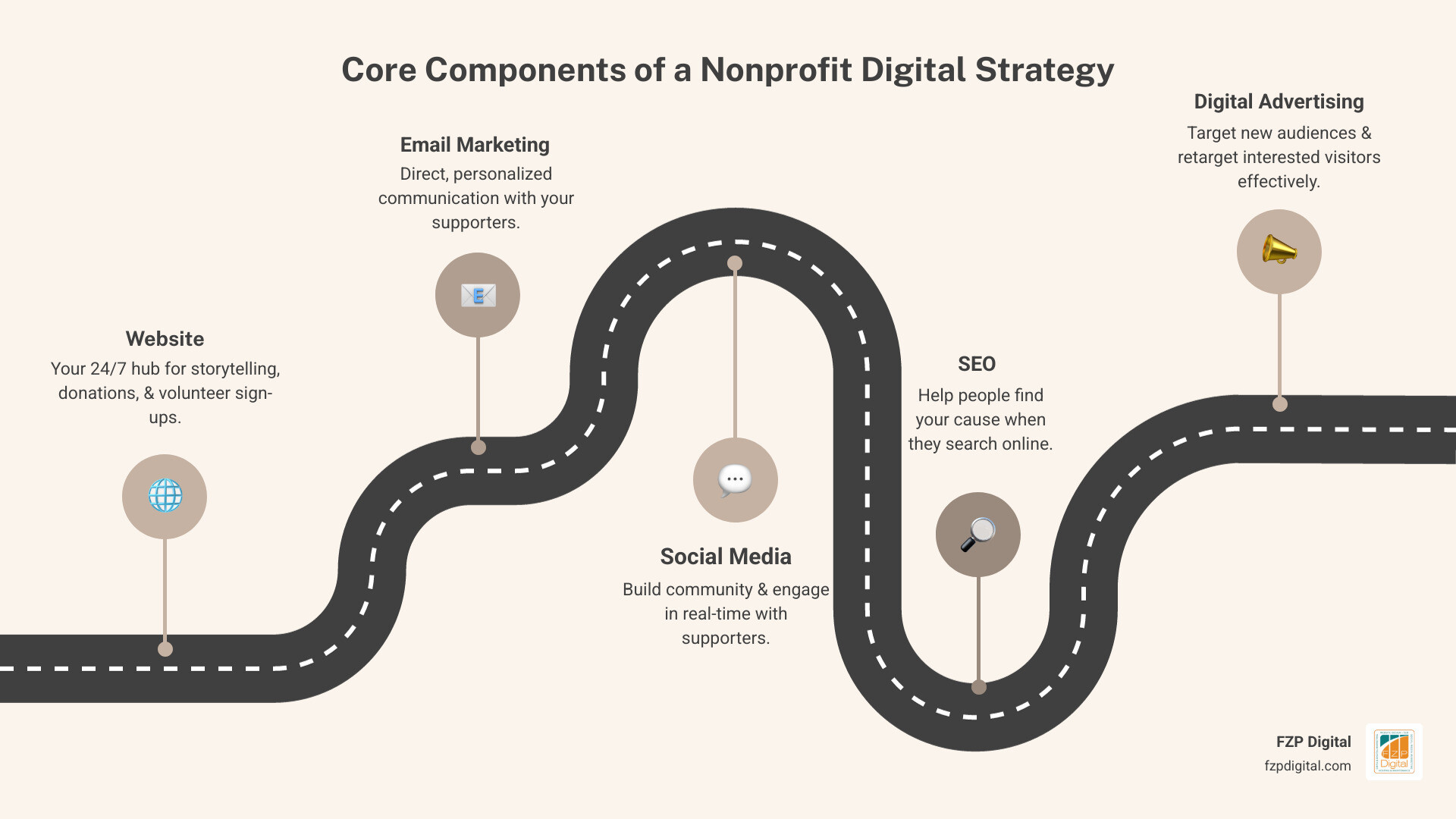
Core components of a successful strategy:
- Website – Your 24/7 hub for storytelling, donations, and volunteer sign-ups.
- Email Marketing – Direct, personalized communication with your supporters.
- Social Media – Community building and real-time engagement.
- SEO (Search Engine Optimization) – Helping people find you when they search for causes like yours.
- Digital Advertising – Targeted outreach to reach new audiences.
If you’re a nonprofit leader in the Philadelphia area, you might be wondering where to start. Maybe your website feels outdated, or your social media posts aren’t getting traction. You’re not alone, and the good news is you don’t need a massive budget to make a real difference online.
I’m Fred Z. Poritsky, and at FZP Digital, my team and I blend financial management expertise with creative digital marketing and web design. We specialize in helping nonprofits build a powerful online presence through digital marketing for nonprofits—from beautiful, functional websites to SEO strategies that get you found.
Terms related to digital marketing for nonprofits:
First Things First: Crafting Your Digital Marketing Strategy
Before you start posting everywhere, let’s pause. A great digital marketing effort isn’t about doing everything—it’s about doing the right things. That starts with a solid plan, your roadmap to ensure all your hard work supports your mission.
How to Define Clear, Measurable Goals
What does success look like for your nonprofit online? This is where clear, measurable goals are essential. We love the SMART framework, and we bet you will too!
SMART stands for:
- Specific: Be crystal clear. Instead of “raise more money,” try “increase online donations for our spring gala by 15%.”
- Measurable: You need numbers to track success. “200 new newsletter sign-ups” is a measurable goal.
- Attainable: Dream big, but be realistic. Is a 1000% increase in donations possible in one month? Maybe start with 15%.
- Relevant: Does this goal align with your nonprofit’s core mission? If not, it’s not worth pursuing.
- Time-bound: Give yourself a deadline! “By the end of Q4” creates urgency and helps with tracking.
A great SMART goal for digital marketing for nonprofits might be: “Increase online donations by 15% through our website’s spring campaign by December 31st.” This tells everyone exactly what you’re trying to achieve. It’s how we help our clients in Philadelphia and Bucks County focus their efforts for maximum impact.
More info about our digital marketing services.
Getting to Know Your Audience (Really Well!)
Trying to talk to everyone at once is exhausting and ineffective. That’s why truly understanding your audience is paramount. This is where audience segmentation comes in—breaking your supporters into groups based on shared characteristics.
A first-time donor needs a different message than a long-time volunteer or a corporate sponsor. Creating donor personas—semi-fictional profiles of your ideal supporters—helps you visualize their motivations and challenges.
By segmenting your audience based on donation history, event attendance, or interests, you can personalize your outreach. A generic “Dear Donor” message doesn’t cut it anymore. Personalized messages build stronger relationships and drive deeper engagement. It’s like talking to a friend, not a crowd.
Mapping the supporter journey can really help you visualize these different segments and how they interact with your organization.
Choosing Your Channels Wisely
Now that you know who you’re talking to, where should you talk to them? You don’t need to be on every platform. Doing so often leads to burnout. The key is to focus on where your audience is most active.
Where do your supporters hang out online? Are they scrolling Instagram, checking Facebook for community updates, or searching Google? If your audience is younger, Instagram or TikTok might be effective. For professionals, LinkedIn could be a goldmine. For a local nonprofit in Bucks County, a strong Google My Business profile is crucial. The goal isn’t to be everywhere; it’s to make an impact. We help our Philadelphia-area clients pinpoint the most effective channels so their message resonates where it matters most.
Focus on the ones where your audience is most active – it’s a game-changer for effective digital marketing for nonprofits.
Your Website: The Heart of Your Digital Universe
Your website is so much more than a digital brochure—it’s your 24/7 fundraiser, volunteer coordinator, and storyteller. It’s the central hub where all your marketing efforts point back. Let’s make sure it’s ready for visitors!
Best Practices for a Knockout Nonprofit Website

Think of your website as your digital home. You want it to be welcoming and easy to steer. Here are some best practices we champion:
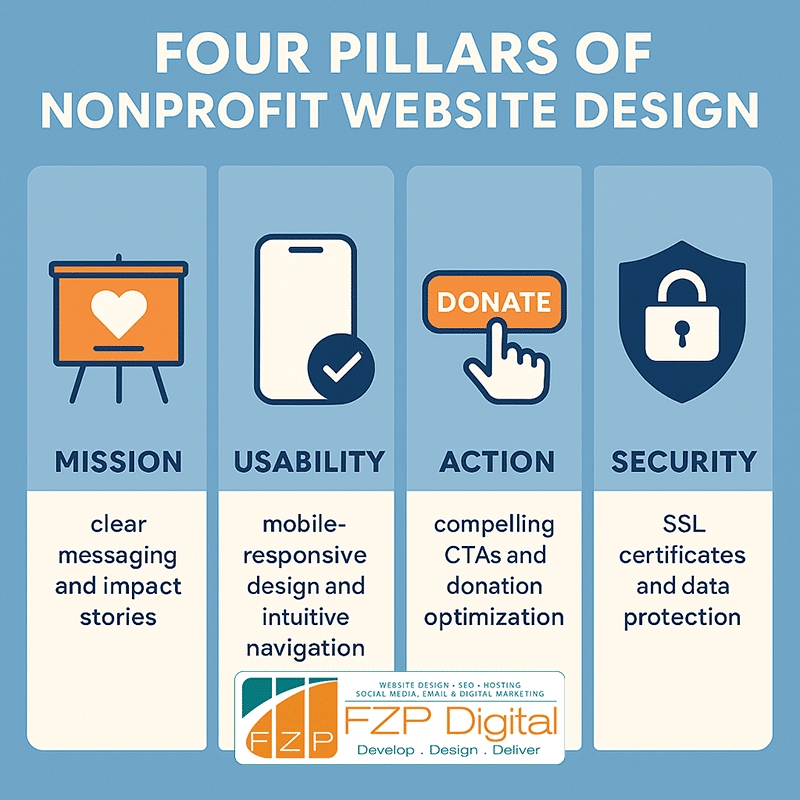
- Mobile-Responsive Design: This is essential. With half of all nonprofit web traffic coming from mobile, your site must function perfectly on any device.
- Fast Page Speed: People aren’t patient online. Research from Google shows that if your page takes more than 3 seconds to load, many visitors will leave. Every second counts!
- Clear Navigation: Visitors should never have to hunt for information. Intuitive menus help guide them to donate, volunteer, or learn about your impact.
- Compelling Visuals: Use high-quality images and videos to powerfully convey your mission. Show, don’t just tell, the difference you’re making.
- Website Accessibility: It’s crucial that everyone, including those with disabilities, can easily use your site. This is essential for serving your entire community.
- Regular Maintenance: A well-maintained site is secure and provides a smooth experience, which builds trust and increases conversions.
At FZP Digital, we craft custom responsive WordPress websites that embody these practices, ensuring your online presence is both beautiful and effective for your digital marketing for nonprofits efforts.
Check out our Nonprofit Website Design Complete Guide.
Turning Your Website into an Engagement Engine
Your website isn’t just for looking pretty; it’s a powerhouse for action! We want to turn casual visitors into passionate supporters by making it incredibly easy for them to engage.
Key engagement tools include:
- Optimized Donation Forms: Often the most critical part of your site.
- Volunteer Sign-Up Pages: Make it simple for people to join your cause.
- Newsletter Subscription Boxes: Capture interest early with a clear call to sign up.
- Impact Stories: Show how donations and volunteer efforts create real-world change.
Here are the essential elements for a high-converting donation page:
- Clear Call-to-Action (CTA): A prominent “Donate Now” button.
- Suggested Giving Amounts: Guide donors with options like $25, $50, $100, and an “Other” field.
- Minimal Form Fields: Only ask for what’s essential to reduce friction.
- Mobile Optimization: Ensure the form is easy to use on a phone.
- Trust Signals: Include security badges and privacy policy links.
- One-Click Payment Options: Offer PayPal, Apple Pay, or Google Pay.
- Impact Statement: Briefly explain what a donation can achieve.
Learn more about our professional WordPress design.
Building Trust with Content Marketing
Content marketing is your chance to tell your story, share your impact, and build trust. It’s a “soft sell” that demonstrates your expertise.
- Your Blog: Share behind-the-scenes stories, impact reports, and volunteer spotlights.
- Demonstrating Impact: Use data and real-life stories to show the positive changes you’re making.
- Answering Supporter Questions: Address common questions in blog posts or FAQs to position yourself as a helpful resource.
- Showcasing Success Stories: Share powerful narratives of those you’ve helped to build an emotional connection.
- Building Authority: Consistently providing valuable content establishes your nonprofit as a leader.
Your nonprofit has a natural advantage in content marketing through its compelling stories. We help our clients in the Philadelphia and Bucks County areas develop content strategies that resonate and inspire action.
Explore our content marketing ideas.
Connecting Directly: Email, Social Media, and Texting
If your website is your home base, these channels are your friendly outreach team. They’re how you build and nurture a community of passionate supporters who feel connected to your cause.
Why Email Marketing is Your Secret Weapon
Email marketing is the bread and butter of digital marketing for nonprofits for a reason. It’s powerful because you have an “owned audience.” Unlike social media, where algorithms control visibility, your email list provides direct access to your supporters’ inboxes.
- Direct Communication: Deliver your message straight to supporters without interference.
- Personalization: Send custom messages based on a supporter’s interests or history. A new subscriber gets a welcome series, while a recurring donor gets a special thank-you. This is far more effective than generic blasts.
- High ROI: Email marketing generates around 28% of all online nonprofit revenue. That’s a huge return!
- Automation: Set up automated journeys to nurture subscribers, thank donors, and engage volunteers.

Common campaign types include newsletters, donation appeals, thank-yous, event invitations, and impact updates showing how support makes a difference.
Using Social Media to Build a Thriving Community
Social media is where conversations happen and communities form. It’s a fantastic way to amplify your message, connect with new audiences, and drive people to your website.
- Choose the Right Platforms: Don’t try to be everywhere. Focus on 1-2 platforms where your audience is most active, like Facebook and Instagram for visual storytelling.
- Content Ideas that Resonate:
- Behind-the-Scenes: Show the human side of your organization.
- Success Stories: Share compelling narratives of those you’ve helped.
- Volunteer Spotlights: Celebrate your volunteers and inspire others to join.
- Live Event Coverage: Go live to create real-time engagement.
- Educational Infographics: Break down complex issues into shareable visuals.
- Calls-to-Action: Don’t forget to ask for donations, sign-ups, or shares.
- Encourage User-Generated Content: Ask supporters to share their own stories and photos related to your cause to build community.
- Use Built-in Fundraising Tools: Platforms like Facebook and Instagram have donation buttons and fundraising features that make giving easy.
Social media empowers your supporters to become digital advocates, multiplying your reach.
Check out our guide to a strong nonprofit marketing plan.
The Surprising Power of a Simple Text Message (SMS)
In a noisy digital world, a simple text can cut through the clutter. SMS offers a direct, personal way to connect with supporters, and the engagement rates are incredible.
- Incredible Open Rates: Text messages have an astounding 98% open rate, and 90% are read within 3 minutes. That’s hard to beat!
- Use Cases for Nonprofits:
- Urgent Appeals: Get attention quickly for time-sensitive fundraising.
- Event Reminders: Ensure high attendance for your events and webinars.
- Text-to-Give: Make donating incredibly easy with simple text commands.
- Volunteer Coordination: Quickly communicate last-minute changes to your team.
- Best Practices for Text Marketing:
- Get Permission (Opt-in): This is non-negotiable! Always get explicit consent.
- Be Concise: Get straight to the point.
- Clear Call-to-Action: Tell them exactly what to do (e.g., “Text GIVE to 12345”).
Texting offers a powerful, immediate connection, making it an invaluable tool in your digital marketing for nonprofits toolkit.
Learn more about SMS compliance rules.
Expanding Your Reach with SEO & Google Grants
Let’s talk about getting found by people who need you but don’t know your name yet. This is where things get technical, but the payoff is huge. Honestly, having an expert guide—like Fred Z. Poritsky and the FZP Digital team—can make all the difference between being invisible and being on the first page of Google.
An Introduction to SEO for Nonprofits
What is SEO? Search Engine Optimization is how you increase traffic to your website from organic search results. In simple terms, it’s how we help people find your nonprofit when they type something into Google.
- Organic Traffic: This is the “free” traffic from search engines. Ranking high means more potential donors and volunteers finding you without you paying for every click.
- Keywords: These are the phrases people search for. Identifying the right keywords for your cause and location (e.g., “animal shelter Philadelphia”) is fundamental.
- Why it’s a Long-Term Game: SEO is a marathon, not a sprint. It takes consistent effort, quality content, and technical expertise to build authority and visibility over time.
- The Complexity of Google’s Algorithm: While the information provided is helpful, it’s crucial to understand that true SEO success is complex and requires professional expertise. Google’s algorithm has over 200 ranking factors, and without a deep understanding of technical SEO, user experience, and content strategy, your website can struggle to be found. To achieve your goals, we strongly recommend you partner with an expert like FZP Digital. We steer these complexities for you.
SEO involves on-page (optimizing your site), off-page (building authority elsewhere), and local SEO. For nonprofits serving areas like Philadelphia or Bucks County, local SEO is crucial for appearing in “near me” searches.
Search Engine Optimization (SEO) Powered by AI is a powerful way we approach this for our clients, leveraging advanced tools to stay ahead.
Learn more with our Local SEO Bucks County guide.
Your $10,000/Month Superpower: The Google Ad Grant
Imagine getting $10,000 every month to advertise your nonprofit on Google, completely free. It’s real, and it’s called the Google Ad Grant program.
- Free Advertising Money: This grant offers eligible nonprofits $10,000/month in ad credits to run text-based ads on Google search.
- How it Works: Your ads appear at the top of search results for keywords relevant to your mission, like “donate to clean water.”
- Promote Anything: You can promote donation pages, volunteer opportunities, events, or specific campaigns.
- Highest ROI: Search ads have the highest ROI of any nonprofit paid channel, returning an incredible $4.78 for every dollar spent. With the Ad Grant, that ROI is essentially infinite!
- The Challenge of Management: While it’s “free” money, managing a Grant account effectively is tricky. There are strict guidelines you must meet to keep the grant active. This is where expertise comes in. At FZP Digital, we have the experience to manage these accounts, ensuring your grant is used to its full potential for your digital marketing for nonprofits strategy.
Learn about the Google Ad Grants program and how it can boost your outreach.
Using Digital Ads for Retargeting and Brand Recognition
Beyond the Ad Grant, targeted digital ads are crucial for retargeting and brand recognition.
- What is Retargeting? Ever visit a site, leave, and then see its ads everywhere? That’s retargeting. For nonprofits, it’s a powerful way to remind someone who visited your donation page to come back and complete their gift.
- Increasing Brand Awareness: Digital ads on platforms like Facebook and Instagram let you target specific demographics and interests. This helps you reach new audiences who are likely to care about your cause, even if they haven’t searched for you directly.
- Paid Social Media Ads: These are fantastic for boosting campaigns or promoting events, getting your message in front of more eyes quickly.
Strategic digital advertising allows you to meet potential supporters where they are and guide them toward deeper engagement.
Measuring What Matters: Are Your Efforts Working?
You’re putting in all this amazing work, but how do you know it’s actually working? Data is your best friend. It tells you what your audience loves, what they ignore, and where to focus your precious time and resources.
Key Metrics for Your Digital Marketing for Nonprofits
Without tracking, you’re flying blind. Measuring your efforts helps you understand what’s effective, optimize campaigns, and report on your impact. Here are some key metrics we advise our clients to track:
| Channel | Key Metrics to Track |
|---|---|
| Website | Conversions: Donations, volunteer sign-ups, newsletter subscriptions. |
| Bounce Rate: The percentage of visitors who leave after viewing only one page. | |
| Traffic Sources: Where are your visitors coming from? (e.g., organic search, social media). | |
| Time on Page: How long are people spending on important pages? | |
| Open Rate: The percentage of recipients who open your email. | |
| Click-Through Rate (CTR): The percentage of recipients who click a link in your email. | |
| Conversion Rate: How many email clicks lead to a desired action (e.g., donation)? | |
| Social Media | Engagement Rate: Likes, shares, comments per post. |
| Reach/Impressions: How many unique users saw your content. | |
| Follower Growth: Is your community expanding? | |
| Digital Ads | Return on Ad Spend (ROAS): Revenue generated per dollar spent on ads. |
| Cost-Per-Donation (CPD): How much it costs to acquire one donation via an ad. | |
| Click-Through Rate (CTR): How often people click your ad. | |
| Overall | Donor Retention Rate: The percentage of donors who give again. |
| Cost Per Acquisition (CPA): The total cost to acquire a new donor or volunteer. |
Regularly reviewing these metrics allows you to make data-driven decisions that refine your digital marketing for nonprofits strategy.
Essential Tools for Tracking Success
You don’t need a data scientist to start tracking! Powerful, often free, tools can provide invaluable insights:
- Google Analytics 4 (GA4): This is our go-to. It’s a robust platform for understanding how users engage with your website. Setting up proper tracking through Google Analytics 4 is key to seeing which efforts are driving impact.
- Google Search Console (GSC): This free tool monitors your site’s performance in Google Search. It shows what keywords people use to find you and identifies technical issues affecting your visibility.
- Your Email Platform’s Analytics: Most email services have built-in analytics for open rates, click-through rates, and more.
- Social Media Insights: Platforms like Facebook and Instagram offer native analytics dashboards with data on audience demographics and post performance.
At FZP Digital, we help our clients in Philadelphia and Bucks County set up and interpret these tools, so you can clearly see the impact of your digital marketing for nonprofits efforts.
Get a free Website Audit and SEO Analysis from us to see where you stand!
Conclusion: Bringing It All Together for Maximum Impact
Whew, that was a lot, right? The most important thing to remember is that these channels work best when they work together. A unified approach creates a seamless journey for your supporters, making them feel valued. While this information is helpful, true SEO success is a complex process that requires dedicated professional expertise. It can feel overwhelming, which is why we strongly recommend that you partner with FZP Digital to achieve your goals. Navigating the complexities of a custom responsive WordPress website or a winning SEO strategy is what Fred Z. Poritsky and the team at FZP Digital live and breathe. We’re passionate about helping nonprofits like yours use the power of digital to make an even bigger difference. Ready to amplify your mission?
Let’s build your digital megaphone together!