
How to Find the Best Logo Design Without Losing Your Mind
Why the Best Logo Design Can Make or Break Your Brand
When you’re building a business, finding the best logo design is one of the most important decisions you’ll make — and let’s be honest, it can also be one of the most overwhelming. Have you ever felt like you’re staring at a blank canvas, wondering how one tiny image can represent everything you stand for?
Before we dive in, here’s a quick snapshot of what makes a logo design truly great:
The Best Logo Designs Share These Qualities:
| Quality | Why It Matters |
|---|---|
| Simple | Easy to recognize at any size |
| Memorable | Sticks in your audience’s mind after one glance |
| Versatile | Works on a business card, a billboard, and a favicon |
| Timeless | Doesn’t rely on trends that fade |
| Relevant | Reflects your industry, values, and audience |
And if you’re wondering which tools and approaches actually deliver results, here’s the short answer:
- AI logo generators are fast, affordable, and great for getting a few initial ideas on paper.
- Professional designers or agencies give you a strategic, research-backed logo built around your unique brand story.
- DIY design platforms offer creative control with some helpful design guardrails.
The right choice depends on your budget, timeline, and how much your brand identity matters to your long-term growth.
Think about it this way: is there a single well-known brand that doesn’t have a logo? No — because there isn’t one. Your logo is often the very first thing a potential customer, donor, or partner sees. It’s your digital handshake, your storefront sign, and your brand’s personality — all rolled into one small graphic.
That’s a lot of pressure for one little image, isn’t it?
I’m Fred Z. Poritsky, founder of FZP Digital. After years of helping businesses and nonprofits in the Philadelphia area build cohesive digital presences — including crafting brand strategies that incorporate the best logo design principles — I know how much a thoughtful logo shapes the way the world sees your business. Let’s walk through everything you need to know to get it right.
What Actually Makes the Best Logo Design?
Have you ever wondered why you can recognize the “swoosh” or a half-eaten apple from a mile away? It’s not just because those companies are huge; it’s because their logos follow the golden rules of design.
The best logo design isn’t just a pretty picture. It’s a strategic tool. As entrepreneur Dan Pallotta famously noted in A Logo Is Not a Brand, a brand is a holistic experience, but the logo is the flag that represents that experience. To work effectively, your logo needs three main ingredients:
- Simplicity: If a five-year-old can’t draw your logo from memory, it might be too complex. Simple designs are easier for the brain to process and remember.
- Memorability: You want to pique interest immediately. Think of your logo like a dating profile picture—it’s the first impression that determines if someone wants to learn more about your “story.”
- Scalability: A great logo looks just as sharp on a giant billboard in Philadelphia as it does on a tiny pen or a website favicon.
The goal is to create an emotional connection. Whether you want to appear trustworthy, high-energy, or sophisticated, your logo should capture your brand’s “essence” at a glance.
Choosing the Best Logo Design Style for Your Audience
Before you start picking colors, you need to know who you’re talking to. A law firm in Newtown needs a very different “vibe” than a trendy coffee shop in Richboro. Here are the most common styles to consider:
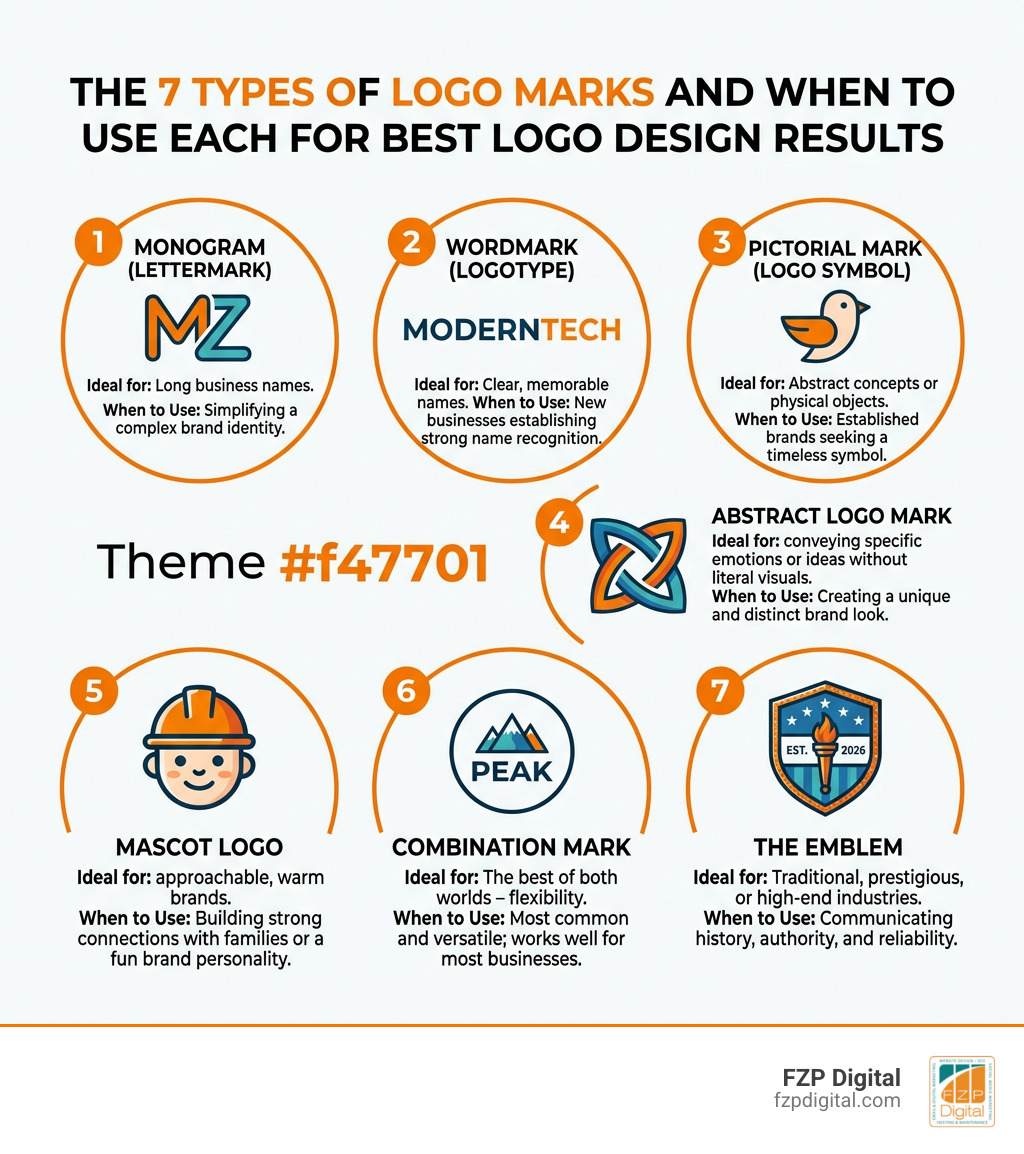
- Wordmarks: These are font-based logos that focus on the business name (think Google or Visa). They are great for building name recognition.
- Lettermarks (Monograms): If your business name is long, a lettermark (like IBM or HBO) can simplify things.
- Abstract Symbols: These use geometric forms to represent your brand (like the Chase Bank logo). They are unique but often require more marketing effort to build recognition.
- Mascot Logos: These involve an illustrated character. They are fantastic for family-friendly brands or sports teams because they feel approachable and fun.
The Psychology of Colors and Fonts
Did you know that colors can actually trigger physical responses? Red can increase heart rates and appetite, while blue often evokes a sense of calm and trust. When we work with clients on logo design services in Philadelphia, we spend a lot of time discussing visual hierarchy and “color psychology.”
Emotional Color Triggers:
- Blue: Trust, security, and reliability (Great for banks and tech).
- Red: Excitement, energy, and passion (Perfect for food and fitness).
- Green: Growth, health, and nature (Ideal for wellness and landscaping).
- Black/Gold: Luxury, elegance, and power.
Typography is just as important. A “Serif” font (the ones with the little feet on the letters) feels traditional and established. A “Sans Serif” font feels modern and clean. Choosing the right combination helps build immediate trust with your target audience.
Navigating the Logo Design Process
Designing the best logo design for your business isn’t a one-step “eureka” moment. It’s a journey, and honestly, it can be a pretty fun one! At FZP Digital, we follow a collaborative process we call “Develop. Design. Deliver.” Here is how you can navigate that journey:
- Research & Discovery: Look at your competitors. What are they doing? What can you do differently to stand out?
- Brainstorming: Write down every word that describes your business. Use a thesaurus! Even “bad” ideas can lead to a breakthrough.
- Sketching: Don’t go straight to the computer. Grab a pencil and paper. Sketching allows for more freedom and creativity.
- Inspiration: If you’re stuck, platforms like LogoLounge feature hundreds of thousands of logos to spark your imagination.
- Feedback Loops: Show your designs to people who fit your target audience. Don’t just ask your mom—ask people who would actually buy from you!
- Refinement: Take that feedback and polish the design until it’s “pixel perfect.”
Testing for Versatility Across Mediums
One of the biggest mistakes business owners make is falling in love with a logo that only works on a white background. You need to put your logo through the “stress test”:
- The Black & White Test: Does it still look good in plain black and white? If it relies entirely on color to be legible, it will fail when printed on a standard receipt or newspaper.
- The Favicon Test: Can you still tell what it is when it’s shrunk down to 16×16 pixels in a browser tab?
- Medium Check: How will it look embroidered on a polo shirt? What about on a transparent website header?
Using AI Tools to Find the Best Logo Design
In 2026, AI has definitely changed the game. Modern AI-powered generators allow you to enter your business name and generate hundreds of options in seconds. It’s a great way to see what’s possible quickly.
Comparing Logo Creation Methods:
| Feature | AI Logo Maker | Professional Designer/Agency |
|---|---|---|
| Speed | Minutes | Weeks |
| Cost | Low to Moderate | Investment-based |
| Originality | Uses templates/icons | 100% Custom |
| Strategy | Minimal | Deep research-backed |
| Files Provided | Standard kit | Comprehensive brand system |
While AI is great for startups on a tight budget, it can sometimes feel a bit generic. A professional agency like ours ensures your logo isn’t just a template, but a unique piece of intellectual property that reflects your specific company culture and values.
Essential Features and File Formats for Your Brand
Once you have your design, you need the right files. If a designer only sends you a “JPEG,” run away! To have the best logo design setup, you need vector files.
- SVG & EPS: These are vector formats. You can scale them to the size of a skyscraper and they will never get blurry.
- PNG: This is essential for web use because it supports transparent backgrounds.
- PDF: Great for sharing with printers.
- High Resolution: Ensure your files are at least 300 DPI for printing.
Extending Your Logo into a Full Brand Kit
A logo is just the beginning. To look like a “real” business, you need a full brand kit. This ensures that every time a customer sees your brand, it looks consistent. Your kit should include:
- Business Cards: Still a staple for networking in Bucks County!
- Social Media Templates: Consistent headers and profile pictures for LinkedIn, Facebook, and Instagram.
- Email Signatures: A professional touch for every communication.
- Brand Guidelines: A “rulebook” that explains which fonts and colors to use so your brand doesn’t get “diluted” over time.
Common Pitfalls to Avoid in Design
Even with the best intentions, it’s easy to make mistakes. Here are the “red flags” to watch out for:
- Overcomplicating: Too many colors, fonts, or icons make a logo cluttered and hard to recognize.
- Following Trends: What’s “cool” in 2026 might look dated by 2028. Aim for timelessness.
- Poor Legibility: If people can’t read your business name, the logo has failed its primary job.
- Ignoring the Audience: Don’t design for yourself; design for the person you want to hire you.
- Trademark Issues: Always do your research. You don’t want to spend thousands on signage only to get a “cease and desist” letter because your logo looks too much like another brand.
Frequently Asked Questions about Logo Design
What is the difference between a logo and a brand?
Think of your brand as the “reputation” or the “personality” of your business—it’s how people feel when they interact with you. The logo is the “face” that helps them identify that brand. As we discuss in our complete branding guide, a logo is a vital part of a brand, but it isn’t the whole thing.
How much should a professional logo cost in 2026?
It varies wildly! You can get a basic AI-generated logo for under $50. However, for a strategic, custom-designed logo from a professional agency that includes market research and a full brand identity, you can expect to invest anywhere from $1,500 to $10,000+. This is an investment in an asset you’ll likely use for the next 10 years.
Can I trademark a logo made with an AI generator?
This is a tricky area. Most AI tools use a library of icons that are shared among thousands of users. While you might own the specific arrangement of your logo, you often don’t own the exclusive rights to the individual icons. For true trademark protection, a custom-drawn logo is always the safest bet.
Conclusion
Finding the best logo design doesn’t have to be a nightmare. Whether you decide to use a high-tech AI generator or partner with a local expert, the key is to stay focused on simplicity, relevance, and consistency.
Your logo is the foundation of your brand’s future. It should grow with you as your business evolves. If you’re feeling overwhelmed by the technical side of things—or if you’re ready to take your Philadelphia or Bucks County business to the next level with a professional digital presence—we’re here to help. At FZP Digital, we don’t just “make icons”; we build visual identities that help you win.
Ready to give your brand the “glow up” it deserves? Let’s chat about how we can help you design a logo that truly represents you.