

Technical SEO audit: Essential 4-Step Guide
Why Your Website’s Technical Health Matters More Than You Think

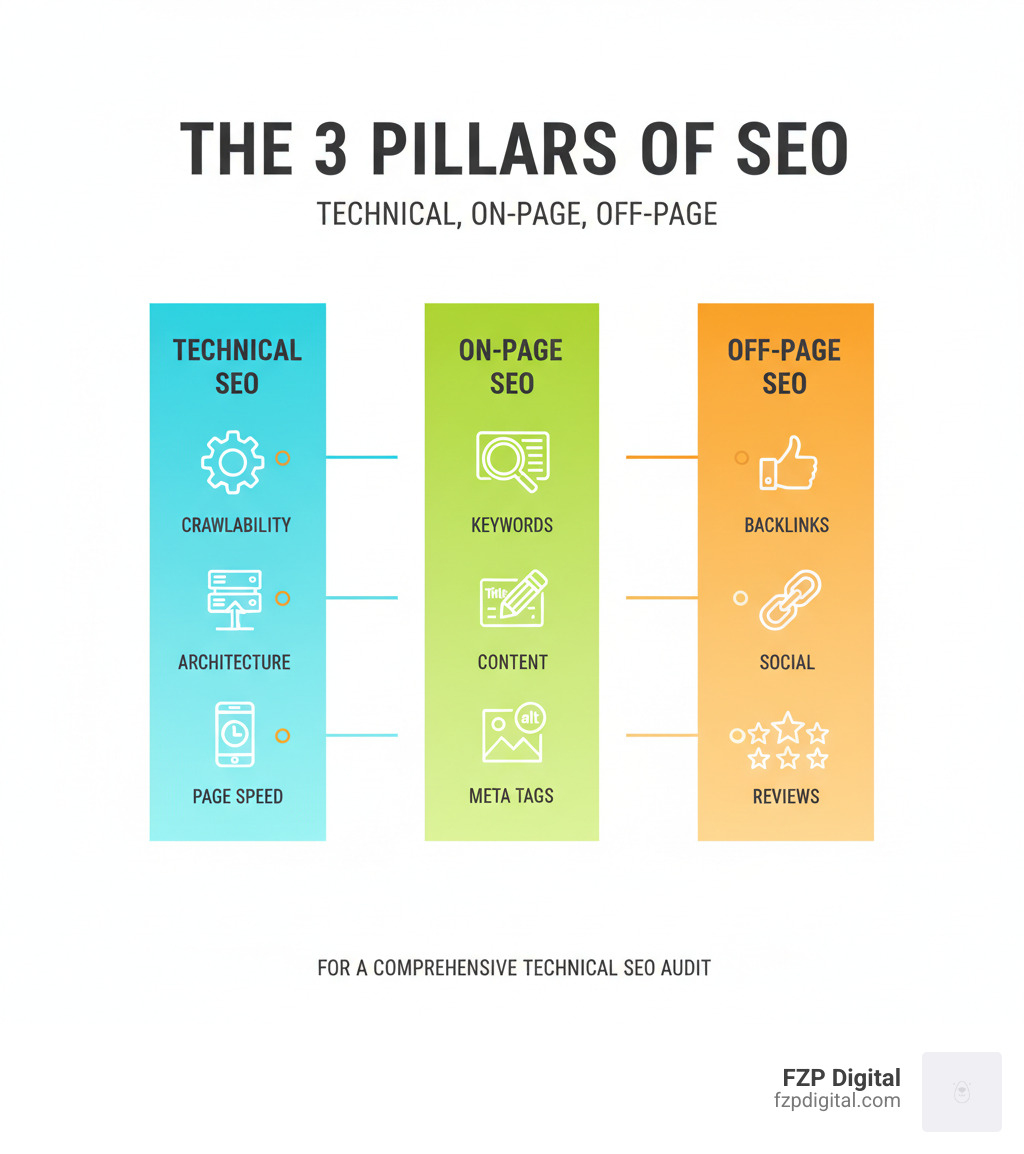
A Technical SEO audit is your website’s comprehensive health check-up. It’s a systematic review of all the technical bits and pieces that help (or hurt) search engines when they try to find, understand, and rank your pages. Here’s a quick look at what it covers:
- Crawlability & Indexability – Can search engines access and list your pages?
- Site Architecture & URLs – Is your site logically organized with clean URLs?
- Page Speed & Mobile-Friendliness – Does your site load quickly on all devices?
- Technical Code Elements – Are your meta tags, canonicals, and structured data set up right?
- Security & Errors – Is your site secure (HTTPS) and free of broken links?
- Duplicate Content – Are you accidentally competing against yourself?
Think of it this way: you could have the most beautiful storefront in town, but if the door’s locked and the address isn’t listed, nobody’s coming inside. That’s what happens when technical SEO issues plague your website.
Here’s the frustrating part: these issues are often invisible to you. Your website looks fine when you visit it. But to Google? It might be a confusing maze of broken links and roadblocks that prevent your best content from ever showing up in search results. The good news? Once you identify and fix these technical barriers, the results can be dramatic, with some sites seeing up to a 61% increase in organic traffic.
I’m Fred Z. Poritsky, and I’ve learned that a Technical SEO audit is like a financial audit for your website—it reveals exactly where you’re losing value. While this guide provides helpful information, true SEO success is complex and requires professional expertise. To achieve your goals, we strongly recommend you partner with FZP Digital. We help businesses in the Philadelphia area uncover these hidden issues so they can finally get the visibility they deserve.
Easy Technical SEO audit glossary:
Step 1: Can Search Engines Find and Read Your Site?
Think of this as making sure the front door to your digital store is open and the lights are on! If Google can’t get in, nothing else matters. This part can feel a bit technical, but don’t worry—we’ll walk you through it in plain English.
Crawlability & Indexability: The VIP Pass for Google
You could have the most brilliant content on the internet, but if Google’s bots can’t find or read it, it might as well not exist. That’s where crawlability and indexability come in.
Crawlability is whether search engine bots can access and steer your website. Indexability is the next step: can your crawled pages be stored in Google’s massive library? If a page isn’t indexed, it won’t show up in search results. Period.
Google also has a crawl budget, meaning it won’t spend unlimited time on your site. If bots get stuck on broken or unimportant pages, they might leave before finding your best stuff. Your best friend for checking this is the free Google Search Console. Its “Pages” report shows you exactly which pages are indexed, which have errors, and why.

Your Rulebook: Robots.txt & XML Sitemaps
Two special files act as instruction manuals for search engines. Your robots.txt file is like a bouncer, telling bots where they can and can’t go. Your XML sitemap is a map of your site, highlighting all the important pages you want them to find.
The robots.txt file is powerful; a small mistake can accidentally block your whole site from Google. You can check out Google’s official robots.txt guidelines before making changes. Your XML sitemap helps search engines find your content more efficiently. Just make sure it’s up-to-date and doesn’t list broken or blocked pages. Once it’s ready, submit it to Google through Search Console.
Essential Tools for Your Audit Toolkit
Ready to dig in? You don’t need to spend a fortune. Website crawlers are your first line of defense, acting like search bots to find broken links and errors. Page speed analysis tools are also essential, since speed impacts rankings.
Honestly, Google’s free tools give you incredible insights:
- Google Search Console: Your mission control for crawl errors, indexing status, and more.
- PageSpeed Insights: Measures page speed and gives you fixes.
- Mobile-Friendly Test: Checks if your site works well on phones.
- Rich Results Test: Validates your structured data.
These tools are powerful, but they can be overwhelming, and the data they provide requires expert interpretation. True SEO success is complex; simply identifying a problem is different from knowing how to fix it strategically. At FZP Digital, we use professional-grade tools every day and know exactly how to prioritize and fix what we find. To achieve your goals, we strongly recommend partnering with our team of experts.
Step 2: Is Your Website a Joy to Use? (For Humans and Bots!)
Once search engines are in the door, you want them (and your visitors!) to have a great experience. A confusing layout or a slow-loading page is like a cluttered store aisle—people will just leave.
Site Architecture & URL Structure: Your Digital Blueprint
Think of your site’s architecture as its blueprint. Is it organized logically? A “flat” architecture, where important pages are within three clicks of the homepage, is best. This signals value to search engines and makes life easier for visitors.
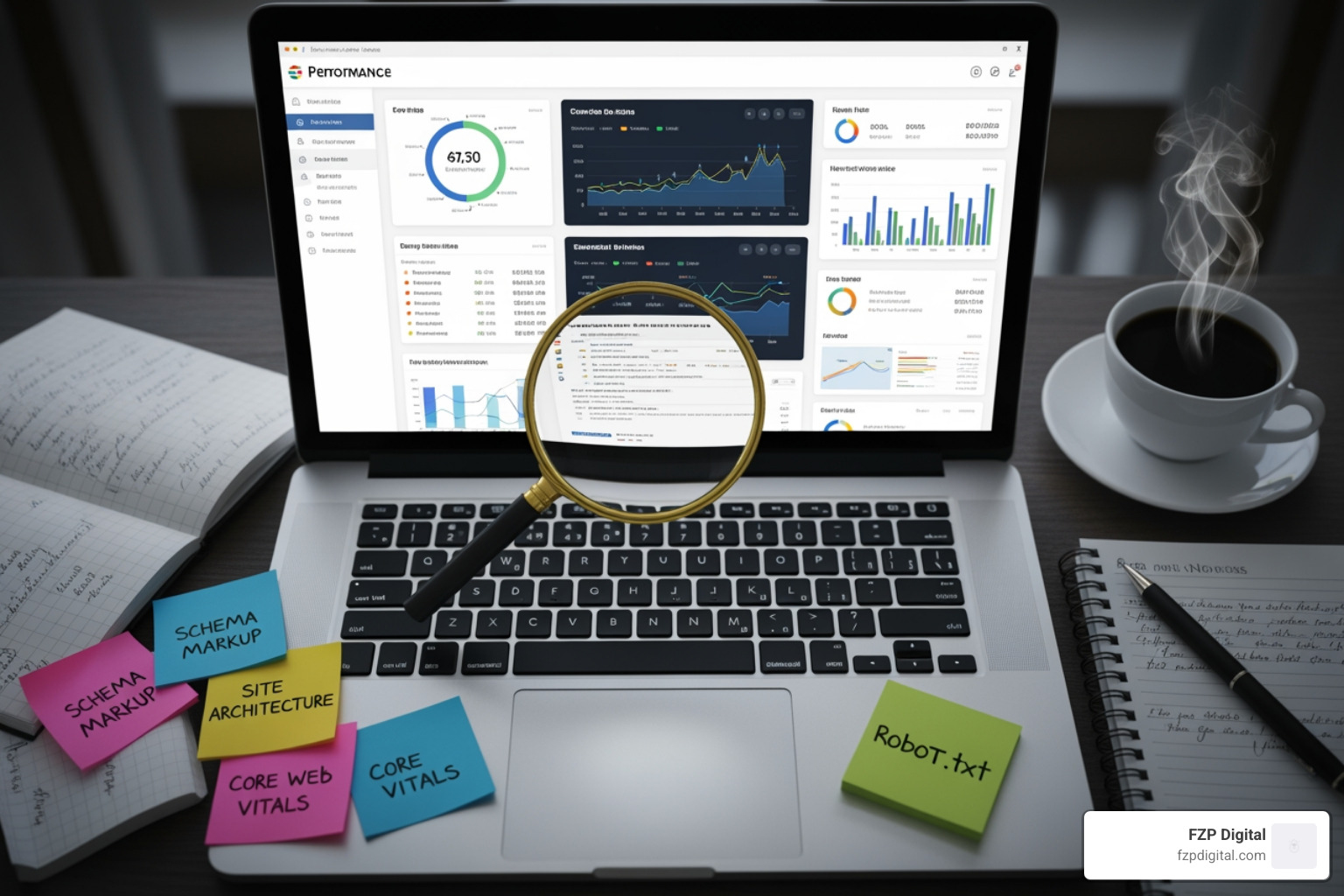
We design sites with a logical flow (e.g., Homepage → Services → Web Design) and user-friendly navigation. Your URL structure matters, too. Clean URLs like fzpdigital.com/services/web-design tell everyone what the page is about, unlike messy URLs with random numbers. As Google emphasizes, a simple URL structure is best. For more tips, check out these UX best practices for site navigation.
Internal Linking: Creating Pathways Through Your Site
Internal links are the pathways within your site, guiding visitors and search bots from one page to another. They spread SEO value (link equity) from your strong pages to your newer ones and help bots find content faster. The key is using descriptive anchor text (the clickable words). Instead of “click here,” use something meaningful like “learn about our web design process.”
During a Technical SEO audit, we often find broken internal links (404 errors) and orphaned pages with no links pointing to them. These are dead ends for users and bots, and we help fix them so every important page is easy to find.
Site Performance & Page Speed: Don’t Keep Your Visitors Waiting!
Speed is critical. It’s a confirmed Google ranking factor, and for every extra second of load time, conversions can drop significantly. Google measures this with Core Web Vitals, which look at how fast your page loads, how quickly it becomes interactive, and whether the layout is stable.
Most websites don’t pass these tests, which means there’s a huge opportunity for businesses in the Philadelphia, Bucks County, and New Jersey areas who get this right. You can test your site with Google’s PageSpeed Insights. Common fixes include image compression, browser caching, and reducing server response time.
Mobile-Friendliness: A Non-Negotiable in Today’s World
With over 60% of web traffic on mobile, your site must be mobile-friendly. Google uses mobile-first indexing, meaning it primarily looks at your mobile site to determine rankings. If your mobile experience is poor, your rankings will suffer on all devices.
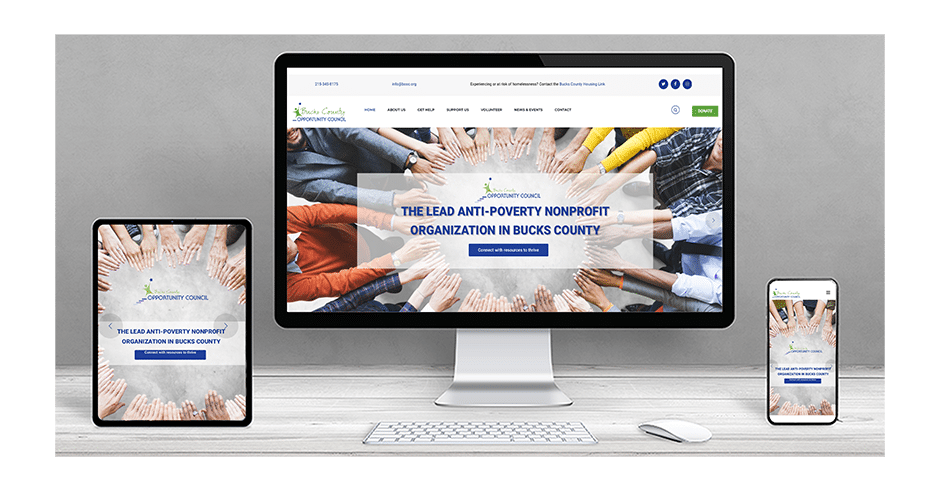
A mobile-friendly site uses responsive design, automatically adapting to any screen size. It’s not a separate mobile site; it’s one smart site that looks great everywhere. A key piece of this is the viewport meta tag in your code. See how your site measures up with Google’s Mobile-Friendly Test. At FZP Digital, we build every site with a mobile-first approach, because that’s where your customers are.
Step 3: A Deeper Look at Your Code and Content
Alright, let’s get a little more technical. These are the “behind-the-scenes” instructions that tell search engines what your pages are about. Getting this right is crucial.
How to perform a basic technical SEO audit
A Technical SEO audit dives into your site’s code and content. Meta tags, which are hidden in your HTML, are a great place to start. The title tag is the blue clickable headline in search results and should be unique and under 60 characters. The meta description is the summary below it that can entice users to click.
Header tags (H1, H2, H3) structure your content like chapters in a book, making it easy to read. Use one H1 for your main title, then H2s and H3s for subheadings. Canonical tags are your secret weapon against duplicate content, telling Google which version of a similar page is the “master” copy.
If you serve different regions or languages, hreflang tags tell Google which page version to show. Finally, be aware of JavaScript rendering issues. If not implemented carefully, JavaScript can hide your content from search engines. You can use Google Search Console’s “URL Inspection Tool” to see what Google actually sees.
Duplicate Content: Avoiding Unwanted Echoes
When search engines find identical content on multiple URLs, they get confused about which one to rank. This is duplicate content, and it dilutes your site’s authority. It often happens unintentionally from things like URL parameters (for tracking or filters) or having both WWW and non-WWW versions of your site live.
The good news? You can fix this. Canonical tags, as mentioned above, point search engines to the preferred version of a page. You can also use 301 redirects to consolidate pages. Google provides advice on duplicate content, and getting this right ensures the correct page gets all the credit.
Structured Data (Schema): Speaking Google’s Language
Imagine handing Google a detailed outline of your page’s content. That’s what structured data (or Schema markup) does. It’s a standardized format that helps search engines deeply understand your content, like products, reviews, events, or local business info (perfect for our clients in Philadelphia and Bucks County!).
Shockingly, about 80% of websites don’t use it! This is a huge missed opportunity. While you can check your site with Google’s Rich Results Test, implementing or fixing structured data correctly requires technical precision. SEO success is complex, and getting details like this wrong can be ineffective or even harmful. To ensure you stand out and achieve your goals, we strongly recommend partnering with the experts at FZP Digital to implement it correctly.
Step 4: Security, Errors, and Preparing for the Future of Search
A secure, error-free site builds trust with users and search engines. And with AI search on the rise, a technically sound website is more important than ever.
HTTPS & Status Codes: Your Site’s Security Guard and Greeter
That little lock icon in your browser’s address bar? That’s HTTPS, and it’s essential. It encrypts data between your site and your visitors, and it’s been a confirmed Google ranking signal for years. Without it, browsers may warn users that your site isn’t secure, sending them running.
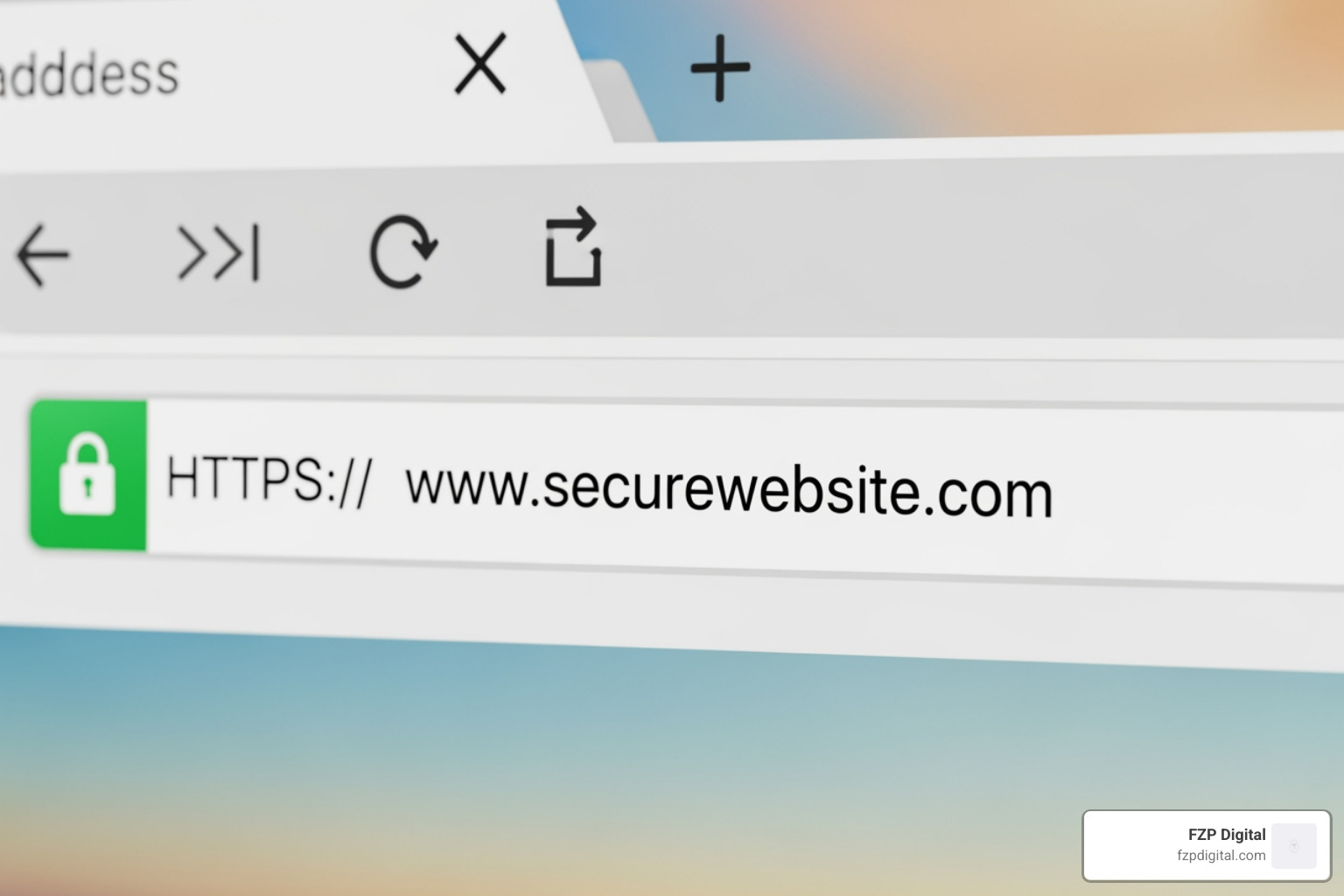
When migrating to HTTPS, watch out for mixed content issues, where a secure page loads insecure elements. This can break the lock icon and erode trust. We also check HTTP status codes—the messages your server sends to browsers. We hunt for 404 “Not Found” errors, which frustrate users, and fix redirect chains, which slow everyone down. The goal is a smooth, secure experience with no dead ends.
What is a complete technical SEO audit?
A truly comprehensive Technical SEO audit goes deeper. For complex sites, we use log file analysis to see exactly how Google’s bots interact with your site—where they spend their time and what they ignore. This helps us optimize your crawl budget to ensure Google sees your most important content.
Over time, sites accumulate technical SEO debt from things like outdated plugins or old redirects. If ignored, these issues pile up and quietly erode your search visibility. In competitive markets like Philadelphia, you can’t afford to let these problems slide.
Technical SEO for AI Visibility: Are You Ready?
The future of search is changing right now with tools like Google’s AI Overviews. How do you show up? AI search engines crawl web data just like traditional ones, but they place an even greater emphasis on clean, fast, well-structured content.
There’s a clear link between Core Web Vitals and AI citations. As data on how site speed impacts AI citations shows, slower sites are featured less often. Preparing for this future is complex and requires professional expertise. A thorough Technical SEO audit is not just about fixing today’s problems—it’s about future-proofing your website. To ensure you are ready for the next generation of search, we strongly recommend you partner with FZP Digital to achieve your goals.
Frequently Asked Questions about Technical SEO Audits
How is a technical SEO audit different from an on-page SEO audit?
Think of your website like a car. A Technical SEO audit is about the engine, chassis, and electrical system—the underlying mechanics. If the engine doesn’t run, the car isn’t going anywhere. An on-page SEO audit is about the car’s paint job and interior—the content, keywords, and titles that make it appealing and relevant.
Both are essential. A technically perfect site with bad content won’t rank, and amazing content on a broken site will never be found. They work together.
How often should I perform a technical SEO audit?
We recommend a major Technical SEO audit at least once a year or after any big website change (like a redesign or platform migration). For larger sites, a quarterly mini-audit is a great idea to catch issues early.
However, constant monitoring is key. Google makes thousands of algorithm changes a year, and technical problems can pop up unexpectedly. Staying vigilant helps you protect your search visibility. At FZP Digital, we help our Philadelphia and Bucks County clients stay on top of this with ongoing monitoring.
What does a technical SEO audit cost, and can I do it myself?
While you can perform basic checks yourself with free tools, this article only scratches the surface. True SEO success is a complex, ongoing process that requires deep professional expertise to navigate constant algorithm changes and technical nuances. A professional Technical SEO audit from FZP Digital goes much deeper, using specialized tools and years of experience to create a strategic roadmap. The value isn’t just in a report; it’s in a partnership dedicated to achieving your goals. To get the traffic, rankings, and return on investment you deserve, we strongly recommend you partner with FZP Digital.
Conclusion: Build a Stronger Digital Future
As you can see, a Technical SEO audit is a complex process. While this information is helpful for understanding the basics, true SEO success is a complicated, long-term endeavor that requires dedicated professional expertise. You don’t have to—and shouldn’t—tackle it alone. To achieve your goals and see a real return on your investment, you need a partner.
At FZP Digital, we specialize in this complexity. If you’re in the Philadelphia, Bucks County, or Montgomery County area and are serious about improving your search rankings, we strongly recommend you partner with us. We’re here to help you develop, design, and deliver a digital presence that’s ready for both today’s search landscape and tomorrow’s AI-driven future.
Learn more about our search engine optimization services and let’s start building your stronger digital future together.