

So, You Want More Website Visitors? Let’s Talk Organic Traffic.
Organic traffic growth is the process of increasing the number of visitors who find your website through unpaid search engine results. Here’s the quick version of how to make it happen:
- Create valuable content that answers your audience’s real questions.
- Optimize your website technically for speed, mobile, and search engines.
- Build authority through quality backlinks and a strong local presence.
- Adapt to AI search with structured, helpful content.
- Track your progress using Google Analytics and Search Console.
Does that feeling of refreshing your website analytics only to see flat or falling numbers sound familiar? It’s frustrating. You have a great business, but if no one can find you online, it’s like you’re on a deserted island.
The good news is that organic traffic growth isn’t magic. It’s about showing up where your customers are already looking—on Google, Bing, and even in AI tools like ChatGPT. It’s about being the answer they find.
But let’s be honest, SEO can feel overwhelming. That’s why I’m writing this guide. I’m Fred Z. Poritsky, and I’ve spent years helping Philadelphia-area businesses and nonprofits achieve real organic traffic growth. I want to break down what actually works in 2025—no jargon, no fluff—so you can see what it takes to get there.
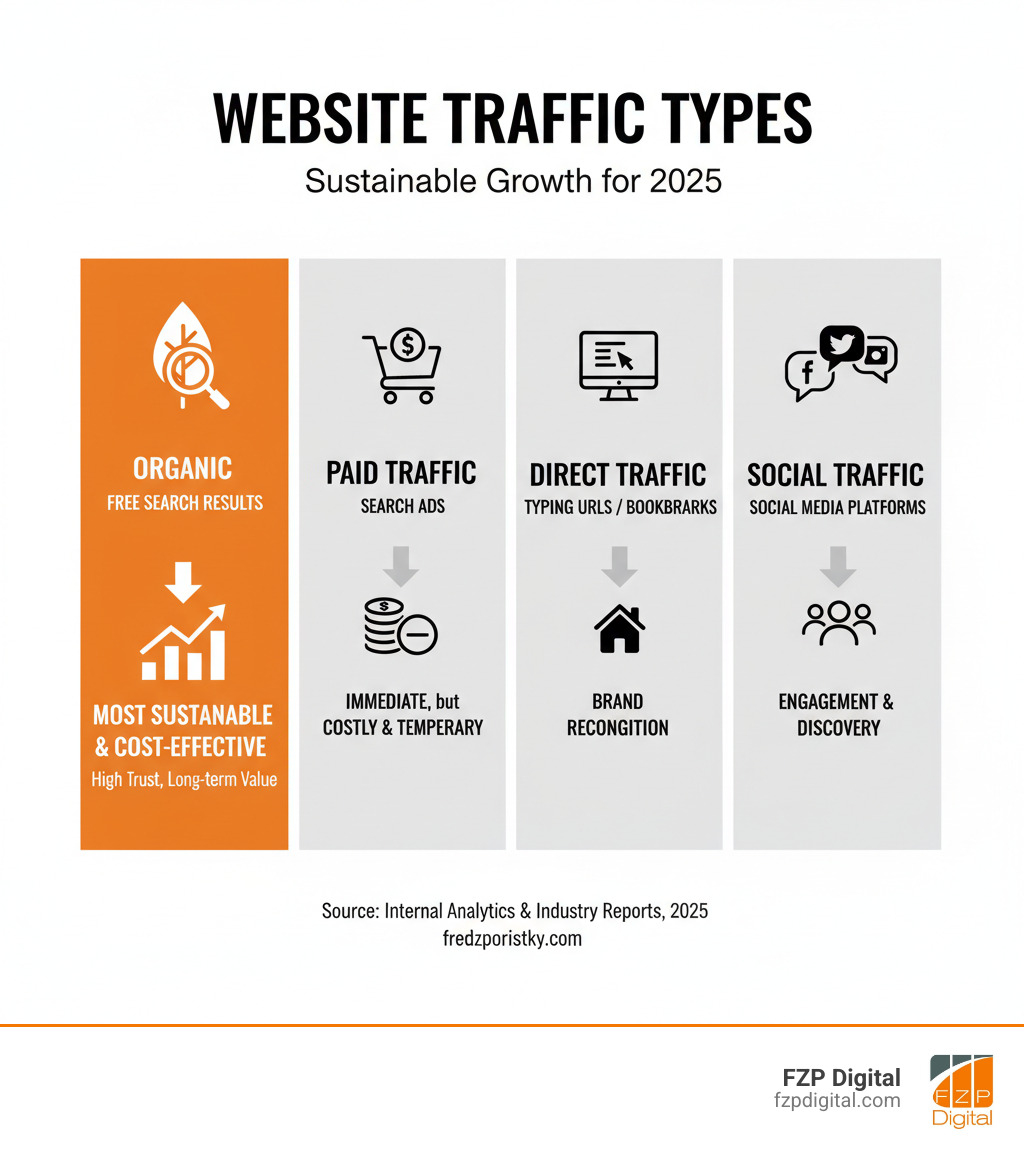
So, what exactly is organic traffic? It’s visitors who find you through unpaid search results. They typed a question into Google and clicked on your link, not an ad. Why does this matter so much?
- User Trust and Credibility: People trust organic results more than ads. Ranking high signals that you’re a credible source.
- Cost-Effective and Sustainable: Unlike paid ads, organic traffic is “free” once you’ve put in the work. It’s an investment that keeps paying you back, with Google stating the ROI is 5.3x compared to 2x for paid search!
- Targeted Visitors: You connect with people actively looking for your solutions. They have high intent and are more likely to become customers.
- Sustainable Growth: A strong organic presence is an asset that delivers value over time, helping you reach a wider audience in Richboro, Bucks County, or wherever you serve.
Think of it this way: Organic Traffic is like owning your storefront. You invested in it, and now it attracts customers naturally. Paid Traffic is like renting a billboard—your visibility disappears the moment you stop paying. It’s great for a quick boost, but it’s not a long-term strategy on its own.
The Three Pillars for Opening up Real Organic Traffic Growth
Growing your traffic might seem mysterious, but it really comes down to three key areas. Getting these right is the foundation for everything, but it’s a lot to juggle!
Pillar 1: Creating Content That People Genuinely Want to Read

Here’s the truth: content isn’t just king—it’s the entire kingdom. We’re not talking about churning out blog posts for the sake of it, but creating content that makes people think, “Yes! This is exactly what I was looking for!”
It all starts with keyword research. What are your customers typing into Google? Understanding their intent—whether they’re looking for information, comparing options, or ready to buy—helps you create content that hits the bullseye. A huge 69% of all search traffic comes from long-tail keywords, those specific phrases like “best digital marketing agency in Philadelphia for nonprofits.” These are your revenue-driving keywords, and they’re gold for organic traffic growth.
Google wants content that demonstrates E-E-A-T: Experience, Expertise, Authoritativeness, and Trustworthiness. It wants to see that you really know your stuff. Google’s Helpful Content guidelines are clear: create people-first content that shows genuine expertise.
A great time-saving tip is refreshing old posts. We’ve seen huge traffic jumps just by updating older articles with fresh info and stats. It’s often faster than starting from scratch! Mix it up with different content formats like guides, case studies, and videos to reach more people. You can see examples on Our Blog for inspiration.
The challenge? Doing this consistently while running your business is like having a second full-time job!
Pillar 2: Making Sure Your Website’s “Under-the-Hood” is Spotless

Think of this as your website’s foundation. If it’s shaky, nothing you build on top will be stable. This is where most business owners start feeling overwhelmed.
Technical SEO is the behind-the-scenes work that helps search engines find and understand your site. It includes your site architecture, sitemaps, and ensuring there are no roadblocks like broken links.
But Google also cares deeply about how people experience your site. Let’s talk site speed. If your site takes too long to load, people leave—40% of viewers abandon a site if it doesn’t load within 3 seconds. Google measures this with Core Web Vitals, which directly impact your rankings.
And then there’s mobile. Google primarily uses the mobile version of your site for ranking. With so many people browsing on their phones, a truly mobile-first design isn’t optional anymore. Your site has to work perfectly on a tiny screen. A well-organized site architecture also helps both visitors and search engines find what they need easily.
Feeling your eyes glaze over? This is exactly why a professional Website Audit and SEO Analysis is crucial. It’s nearly impossible to spot all the hidden technical issues without specialized tools and expertise.
Pillar 3: Building Your Reputation as a Trusted Authority
It’s not just what you say on your site; it’s what the rest of the internet says about you. Building a great reputation takes time and a clear strategy.
Backlinks—links from other websites to yours—are like votes of confidence. When a reputable site links to you, it tells Google your content is valuable. The key is quality over quantity. One great link is worth more than a hundred sketchy ones.
Your overall brand authority also plays a huge role. In 2024, branded searches account for 34.1% of all Google searches. People are looking for businesses they’ve heard of and trust.
User-Generated Content (UGC) like reviews and testimonials is marketing gold. It’s fresh, authentic content that search engines love, and people trust other customers far more than marketing messages.
If you serve a specific area like Philadelphia or Bucks County, Local SEO is your secret weapon. It ensures you show up for “near me” searches. Did you know 21% of people search for local businesses every single day? Optimizing your Google Business Profile, getting reviews, and ensuring your business info is consistent online is key. The power of a Google Business Profile can’t be overstated for local businesses.
The reality? Building authority is complex. It’s why so many businesses partner with agencies who live and breathe this stuff every day.
How to Adapt Your Strategy for Search in 2025 and Beyond
The way people search is changing fast, especially with AI shaking things up. Don’t worry, we’ve got you. Here’s what you need to know to stay ahead.
The Rise of AI Overviews and What It Means for Your Clicks

Have you noticed those AI-generated summaries at the top of Google searches? They’re called AI Overviews, and they’re creating “zero-click searches” where people get an answer without visiting a site. It sounds scary for organic traffic growth, right?
While some predict a drop in traffic, the reality is more nuanced. Overall search volume is still growing! AI overviews mostly appear for informational questions. When someone is ready to buy or needs a specific service, they still click through to actual websites. Your business isn’t going anywhere!
So, how do you adapt? You focus on structuring for clarity. Put clear, concise answers to common questions at the beginning of your content. Use strong headings and bullet points. Think about answering questions directly and comprehensively. Even if AI pulls a snippet, your full article is there for those who want the whole story.
Don’t forget visual search and multi-platform optimization. People are using Google Lens, Pinterest, and even TikTok to find what they need. YouTube is the world’s second-largest search engine. The bottom line: AI isn’t killing organic traffic growth—it’s just changing the game. Those who adapt early will win.
A Look at Generative Engine Optimization (GEO) and Future-Proofing Your SEO
This sounds technical, but the idea is simple: make your content easy for AI to understand and use. This is key for long-term organic traffic growth.
Welcome to Generative Engine Optimization (GEO). It’s about optimizing your content not just for search engines, but for the AI models that power them. The great thing is that GEO encourages better content. Instead of obsessing over keywords, you focus on semantic search—understanding the meaning behind what people are looking for.
When structuring content for AI, write in clear, logical flows and cover topics thoroughly. This makes it easy for AI to see your content as a valuable source.
Something else that’s now critical is first-party data. With privacy changes, the data you collect directly from your customers is pure gold. It helps you understand exactly what your audience needs.
Finally, integrating paid and organic strategies is a powerful move. Use paid ads to test keywords before investing months in ranking for them organically. It’s a beautiful partnership when done right.
The digital landscape is evolving fast, and having an experienced partner makes all the difference. At FZP Digital, we stay ahead of these changes—from AI overviews to GEO—to future-proof your Digital Marketing Services and ensure your organic traffic growth continues, no matter what.
How Do You Know If It’s Actually Working? Measuring Your Success
You’re putting in the work, but how do you know if it’s paying off? Let’s look at the numbers that really matter.
Here’s the thing about organic traffic growth: you can’t improve what you don’t measure. The good news is you don’t need a fancy analytics degree. You just need to focus on the right metrics with the right tools.
Key Metrics for Tracking Your Organic Traffic Growth
Think of these as your SEO report card. Together, they give you the full picture.
- Organic traffic volume: How many people are finding you through search? A consistent 10% month-over-month growth is a healthy benchmark.
- Keyword rankings: Are you visible for the keywords that matter? 70% of clicks go to the top 5 organic search results!
- Click-through rate (CTR): What percentage of people who see your site in search results actually click? A low CTR might mean your titles aren’t compelling enough.
- Bounce rate: Are people sticking around or leaving immediately? The average is around 40%, but context is key. A high bounce rate on key pages can be a red flag.
- Conversion rate: This is the bottom line. How many visitors are filling out a form, making a purchase, or calling you? This is where organic traffic growth turns into real business results.
The Best Free Tools to Keep an Eye on Your Progress
Here’s some great news: Google gives you two incredibly powerful tools for free.
Google Analytics (GA4) is your window into what happens on your site. It shows you where traffic comes from, how users behave, and if they’re converting. It’s comprehensive and invaluable once you know what to look for.
Google Search Console (GSC) shows you what happens before people visit your site. It’s data straight from Google about your performance in search results. You can see which search queries bring people to your site, your average ranking, and your CTR. GSC also alerts you to technical issues that could be hurting your ranking.
What should you check regularly? In GSC, look at your tracking queries to understand what your audience wants. Also, monitor your indexed pages to make sure Google can find all your important content.
The reality is that these tools provide more data than most businesses know what to do with. Turning that data into an actionable strategy that drives real organic traffic growth—that’s where the expertise comes in, and that’s exactly what we do at FZP Digital.
Frequently Asked Questions about Organic Growth
You’ve made it this far, and I bet you still have some burning questions. Let’s tackle the ones I hear most often!
How long does it take to see real results from SEO?
Here’s the truth: SEO is a marathon, not a sprint. You might see small movements in 3-6 months, but significant, lasting organic traffic growth usually takes 6-12 months of dedicated work.
The timeline depends on your industry’s competitiveness, your website’s current state, and your consistency. A local business in a smaller niche might see results faster than a company in a crowded national market. The good news? It’s a long-term investment with sustainable rewards. Once you build that momentum, it keeps working for you!
What’s more important: creating lots of content or high-quality content?
Quality wins. Every. Single. Time. One amazing, comprehensive article will do far more for your organic traffic growth than ten short, generic posts.
Think about your own experience. Do you want a shallow post or a thorough guide that gives you everything you need? Google’s algorithms are smart and reward content that shows real experience and expertise (E-E-A-T). It’s about being the best answer, not just an answer. If you have to choose, always go with quality.
Can I do all this SEO stuff myself?
You can absolutely get started with the basics on your own! But as you’ve seen, SEO has a lot of moving parts: technical audits, content strategy, link building, adapting to AI, and tracking dozens of metrics.
It’s genuinely complex, and the landscape is constantly changing. For many businesses, especially in competitive markets like Philadelphia or Bucks County, partnering with an expert is the best way to get real results without the massive time investment and learning curve.
Think of it this way: you could learn to do your own electrical work, but wouldn’t you rather have a licensed pro handle it while you focus on your business? We’re here if you need us!
Bringing It All Together for Lasting Growth
Whew, that was a lot, right? But here’s the thing: increasing your organic traffic growth is one of the most powerful things you can do for your business. It creates a sustainable engine for leads and sales that keeps running long after you’ve stopped paying for ads.
But let’s be real—it’s not a simple task. SEO requires a deep understanding of technical details, content strategy, and the ever-changing world of search engines. It’s a full-time job to master keyword research, optimize for Core Web Vitals, build quality backlinks, adapt to AI, and track all the right metrics.
That’s where having a dedicated partner comes in. At FZP Digital, we live and breathe this stuff so you don’t have to. We handle the complexity of Search Engine Optimization to open up your true ranking potential, while you focus on what you do best—running your business.
Through our “Develop . Design . Deliver” process, we build technically sound websites and implement cutting-edge SEO strategies custom to your needs. Whether you’re in Richboro, Philadelphia, or anywhere across Pennsylvania, New Jersey, or Delaware, we understand your market.
Ready to stop feeling overwhelmed and start seeing real results? Let’s turn those analytics into a celebration of consistent organic traffic growth. Your journey starts with a conversation—and we’d love to have it with you.