


How to Choose the Best WordPress Agency Hosting Without Breaking the Bank

Why Choosing the Right WordPress Agency Hosting Can Make or Break Your Business
If you’re managing multiple client websites, wordpress agency hosting is one of the most important decisions you’ll make for your business — and getting it wrong can cost you clients, time, and real money.
Here’s a quick look at the top WordPress agency hosting providers to help you compare at a glance:
| Provider | Starting Price | Sites Included | Best For |
|---|---|---|---|
| Hostinger | $24.99/mo | 100 sites | Budget-conscious agencies |
| Cloudways | $54/mo | Unlimited | Flexible cloud scaling |
| Flywheel | $135/mo | 30 sites | Creative agencies, white-labeling |
| Pressable | $135/mo | 20 sites | Automattic ecosystem, AI tools |
| WP Engine | $245/mo | 25 sites | Enterprise-grade, trusted platform |
| Kinsta | $284/mo | 20 sites | High-traffic, reliability-first |
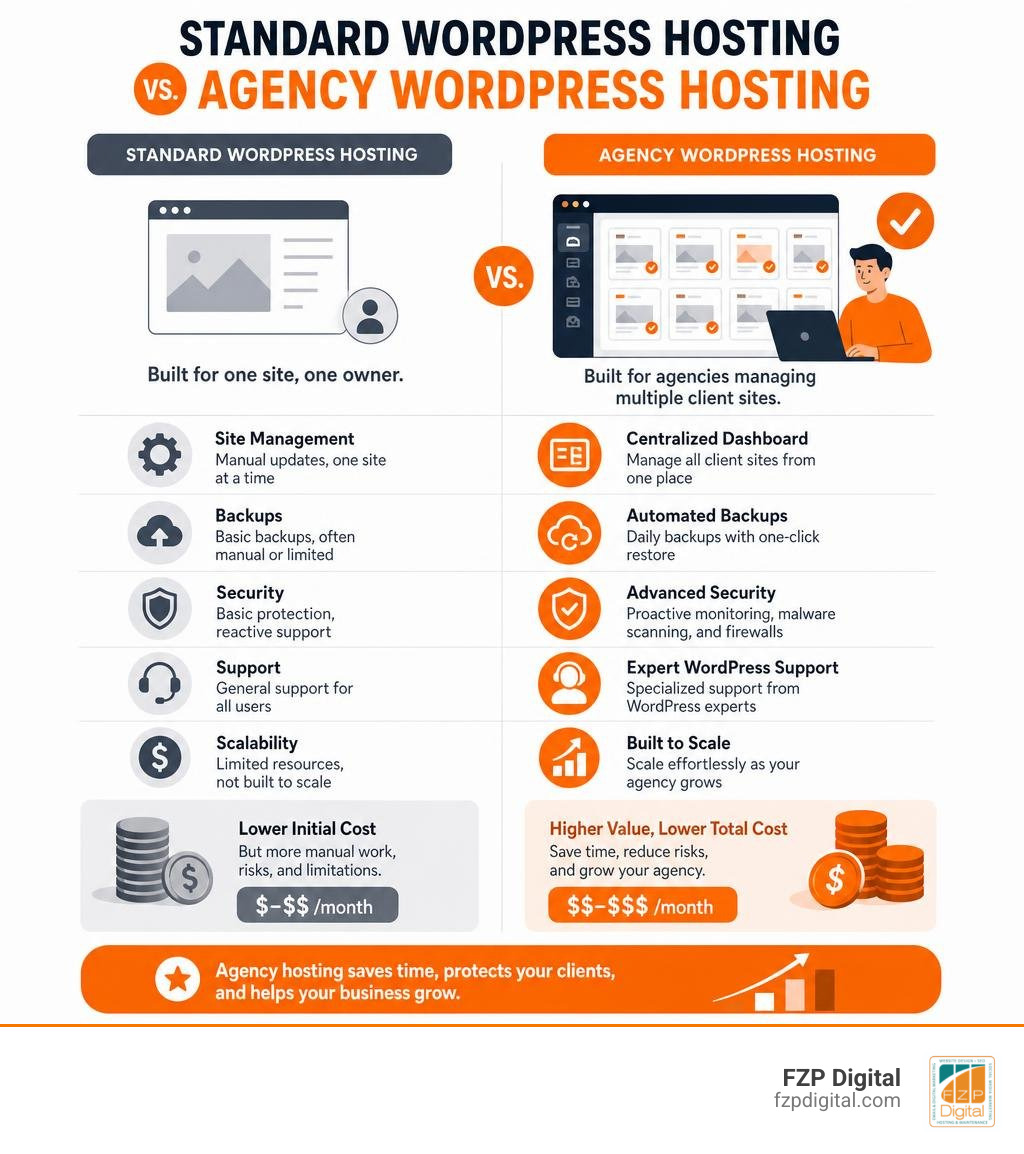
Standard web hosting is built for one site, one owner. Agency hosting is built for you — someone juggling 10, 20, or even 100+ client sites at once, all needing backups, updates, security, and stellar performance.
The difference isn’t just technical. It’s operational.
When a client’s site goes down at 11pm before a big product launch, you need a host that has your back — not a generic support queue staffed by someone who has never touched WordPress. That’s the gap agency hosting is designed to fill.
And with over 11,000 agencies already partnering with managed WordPress hosting providers like WP Engine alone, it’s clear this isn’t a niche concern — it’s become the standard for serious agencies.
I’m Fred Z. Poritsky, founder of FZP Digital, and after building WordPress sites for CPAs, attorneys, nonprofits, and businesses across Philadelphia, I’ve experienced how the right wordpress agency hosting setup transforms your workflow and protects your client relationships. Let’s break down what actually matters when you’re choosing a host that can grow with your agency.
What is WordPress Agency Hosting and Why Does Your Agency Need It?
Have you ever spent your Sunday afternoon manually updating plugins across twenty different client sites, only for one of them to crash because of a PHP conflict? It is an incredibly stressful situation that takes you away from your actual work—and your family.
When you run a growing digital agency in Philadelphia or Bucks County, your time is your most valuable asset. Standard shared hosting expects you to be the system administrator. It forces you to log into dozens of separate control panels, manage individual billing cycles, and manually handle security alerts.
On the other hand, wordpress agency hosting is a cohesive ecosystem designed to help you scale. It consolidates your entire portfolio under a single, unified dashboard. Instead of treating your websites as isolated silos, agency hosting views your collection of client sites as a unified network that should be easy to monitor, update, and secure.
This specialized hosting approach changes how you manage server resources. On standard shared hosting, a sudden traffic spike on one client’s site can exhaust server resources and take down all your other client sites. Agency hosting platforms use containerization or isolated resource allocation to prevent this. Each site gets its own dedicated environment. This means a viral marketing campaign for one client won’t disrupt the online presence of your other clients.
Choosing the right platform is critical for your long-term success. If you want to dive deeper into how the top teams leverage these systems, check out Pantheon’s guide on agency hosting to understand how centralized operations can transform your day-to-day web development work.
Key Features to Look for in WordPress Agency Hosting
When you are comparing different providers, it is easy to get lost in technical jargon. Let’s simplify things. Here are the core features that will actually make a difference to your business:
- Uptime Guarantees with Financial Teeth: Look for providers that offer a 99.95% or 100% uptime Service Level Agreement (SLA). If they don’t hit those numbers, they should credit your account.
- Proactive Security Protocols: Your host must provide a server-level Web Application Firewall (WAF), automatic malware scanning, DDoS protection, and free SSL certificates. If a client site gets compromised, you want a host that offers free malware cleanup.
- Server-Level Caching: Standard plugins are fine, but server-level caching (like Redis or Varnish) is incredibly fast. It dramatically reduces your Time to First Byte (TTFB), keeping your sites snappy and improving your Google search rankings.
- Scalable Resources: Your host should let you scale up CPU cores and RAM instantly during traffic spikes. This is especially important if you design e-commerce or high-traffic sites.
How Managed WordPress Agency Hosting Saves You Time and Money
Many agencies hesitate to pay for managed hosting because the starting price looks higher than cheap shared plans. But let’s look at the math.
If you spend just 5 hours a week manually running backups, updating plugins, troubleshooting server errors, and dealing with slow support queues, that is 20 hours a month. If your billable rate is $150/hour, you are spending $3,000 worth of your time on routine maintenance!
Managed hosting turns those manual tasks into automated, background workflows. Platforms like Truly Incredible WordPress Hosting By Pressable and Nexcess managed WordPress hosting handle automatic core updates, daily off-site backups, and server optimization for you.
Additionally, when something does go wrong, you get instant access to support teams who are genuine WordPress experts. You don’t have to explain what a database connection error is; they already know, and they are already fixing it. It is like having a dedicated systems engineer on your team for a fraction of the cost.
Comparing the Best Hosting Models for Your Agency
Not all agency hosting models are built the same way. The architecture you choose will dictate your performance, security, and monthly margins. Let’s compare the three primary hosting models available:
| Feature | Dedicated Server Hosting | Managed Cloud Hosting | Unlimited Shared Hosting |
|---|---|---|---|
| Resource Isolation | Complete (100% dedicated to you) | High (Isolated containers) | None (Shared with strangers) |
| Scalability | Hard (Requires manual upgrades) | Instant (Auto-scaling) | Poor (Strict physical limits) |
| Technical Overhead | Very High (Requires sysadmin skills) | Low (Managed by the host) | Medium (You handle site issues) |
| Pricing Model | High flat monthly fee | Pay-as-you-go or tier-based | Very cheap introductory rates |
| Best For | Massive enterprise client sites | Growing agencies with diverse clients | Small, low-traffic brochure sites |
Let’s look at each of these models in detail so you can choose the right fit for your agency’s workflow.
Dedicated Server Hosting
Dedicated hosting means you rent an entire physical server that is reserved exclusively for your agency. You have complete control over the operating system, server software, and resource allocation.
For large client sites that handle massive amounts of traffic, dedicated hosting offers unrivaled power and enterprise-grade security. Because you aren’t sharing the server with anyone else, there is zero risk of a “noisy neighbor” slowing down your sites.
However, dedicated hosting comes with high technical overhead. Unless you pay for a fully managed dedicated plan, your team will be responsible for patching the server operating system, configuring firewalls, and managing server hardware. For most creative and design agencies, this is a distraction from your core work of building beautiful websites and growing your clients’ organic search rankings.
Managed Cloud Hosting
Managed cloud hosting has quickly become the gold standard for modern digital agencies. Instead of relying on a single physical server, your websites are hosted on virtualized cloud networks powered by infrastructure giants like Google Cloud, AWS, or DigitalOcean.
Hosts like Kinsta, Cloudways, and Pressable use advanced container technology to isolate each WordPress site. This means each client site gets its own dedicated PHP workers, RAM, and CPU resources.
The biggest benefit of managed cloud hosting is its flexibility. If a client runs a major TV ad or a viral social campaign, the host can automatically scale up server resources to handle the traffic surge without any downtime. This pay-as-you-go model ensures you only pay for the resources your clients actually use, keeping your margins healthy.
Unlimited Shared Hosting
Unlimited shared hosting is the model most of us started with. It is incredibly cheap, often starting at under $5 a month, and promises “unlimited” websites, storage, and bandwidth.
But as any experienced agency owner will tell you, “unlimited” always comes with fine print.
On a shared server, your clients’ sites are packed onto the same physical hardware as hundreds of other websites. If another user’s site gets hacked or experiences a massive traffic spike, your clients’ websites will slow to a crawl or crash entirely.
While shared hosting can be a tempting budget option for very simple, low-traffic brochure sites, it is a risky foundation for a professional agency. The money you save on hosting fees will quickly be spent on unbillable support hours when clients complain about slow loading speeds or frequent downtime.
Essential Workflow Features That Make Agency Life Easier
When you are managing multiple client accounts, the quality of your hosting provider’s interface and workflow tools is just as important as server speed. You want tools that simplify your daily tasks and help you deliver projects faster.

If you want to speed up your local design process before pushing sites live, using the right local tools makes a massive difference. You can read our guide on local WordPress development tools to learn how to build offline and deploy seamlessly to your agency host with a single click.
Let’s explore the workflow features that save the most time for agencies.
White-Labeling and Client Billing Transfer
As a professional agency, you want to maintain a consistent brand experience for your clients. White-labeling allows you to customize the hosting control panel with your own logo, brand colors, and support links. When your clients log in to view their site analytics or submit a support ticket, they see your agency’s branding, which reinforces your value.
Another game-changing feature is client billing transfer. Providers like Flywheel and WP Engine allow you to build a client’s website in a free staging sandbox under your agency account. Once the site is approved and ready to go live, you can easily transfer the billing directly to the client.
The client enters their credit card information to pay for the hosting, while you retain administrative access to manage the site. This keeps your agency’s credit card free from ongoing hosting liabilities while ensuring you can still provide seamless maintenance services.
Staging Environments and One-Click Backups
We have all experienced that moment of panic when a plugin update breaks a live website. Staging environments eliminate this risk entirely.
A staging environment is a complete, private clone of your live website. With just one click, you can copy a client’s live site to a staging area, safely test new plugins, updates, or custom code, and make sure everything works perfectly. Once you’re happy with the changes, you can push them back to the live site with another click.
To make things even safer, professional agency hosts offer automated daily backups with one-click restores. If a client accidentally deletes an important page or breaks a layout, you can restore the site to its exact state from a few hours prior in minutes. This level of disaster recovery gives both you and your clients complete peace of mind.
Multi-Site Management and Centralized Dashboards
Logging in and out of twenty different WordPress admin panels to update core files and plugins is a massive waste of time. Centralized dashboards solve this problem by giving you a bird’s-eye view of your entire client portfolio from a single login.
From this master control panel, you can:
- See which sites have pending plugin or theme updates.
- Run bulk updates across multiple websites simultaneously.
- Monitor site performance, loading speeds, and uptime.
- Access database tools (like phpMyAdmin) and file managers without needing FTP credentials.
- Manage SSL certificates and domain settings.
This centralized approach makes it easy to offer ongoing website maintenance plans, creating a highly profitable, recurring revenue stream for your agency.
Frequently Asked Questions About WordPress Agency Hosting
Choosing a host is a big commitment. Here are clear answers to the most common questions agency owners ask when evaluating their options.
What is the difference between reseller hosting and agency hosting?
While they sound similar, reseller hosting and agency hosting are built for different business models.
Reseller hosting is designed for users who want to act as their own hosting company. The reseller buys a large block of server space and partitions it into smaller accounts to sell directly to their own customers. The reseller is responsible for setting up the control panels, managing the billing, and providing technical support to their end-users.
Agency hosting, on the other hand, focuses on workflow efficiency and developer collaboration. It provides advanced tools like staging environments, Git integration, team collaboration permissions, and client billing transfers. While you can still bundle hosting into your client retainer packages, the primary goal of agency hosting is to make it easier for your team to build, deploy, and maintain client sites.
How do staging environments protect my client sites?
Staging environments act as a safe testing sandbox for your websites. When you update a plugin, theme, or PHP version on a live site, you risk causing a conflict that could crash the site or break key features like contact forms or checkout pages.
By testing these changes in an isolated staging environment first, you can identify and fix any conflicts before your visitors ever see them. Some advanced hosting platforms even offer “visual comparison” tools. These tools automatically take screenshots of your site before and after an update, highlighting any layout changes so you can review them instantly.
Can I migrate my existing client sites for free?
Yes! Most premium managed WordPress hosts understand that migrating multiple client websites is a daunting task, so they offer free “white-glove” migration services.
When you sign up, their migration experts will handle the entire transfer process for you. They will copy your databases, files, and email settings to the new servers, test the sites thoroughly to ensure everything works, and help you update your DNS records with zero downtime.
If you want to handle migrations yourself or learn more about the process, check out our guide on WordPress migration services for tips on making the transition as smooth as possible.
Conclusion
At the end of the day, your hosting provider isn’t just a utility — it is the foundation of your digital agency. The right host keeps your clients’ sites running at lightning speed, protects them from security threats, and gives your team the workflow tools they need to work efficiently.
If you are currently managing your client sites on cheap shared hosting or struggling with slow support response times, upgrading to a dedicated wordpress agency hosting plan is one of the smartest investments you can make for your business.
At FZP Digital, we believe in a collaborative Develop . Design . Deliver process. We don’t just build beautiful, responsive WordPress websites; we ensure they are backed by world-class infrastructure that boosts organic search rankings and keeps your visitors engaged.
Whether you are a local business in Richboro, Newtown, or Downtown Philadelphia, navigating the complexities of web design, SEO, and hosting management can be challenging. You don’t have to do it alone. If you’re ready to take your digital presence to the next level with a partner you can trust, read our comprehensive WordPress Web Design Philadelphia Guide 2025 or reach out to us today. Let’s build something incredible together!