
What local SEO means for your business
Local SEO is the work of helping your business appear when people nearby search for what you offer. It can improve your visibility in Google Maps, the local map results shown in Search, and regular search listings. Unlike broader SEO, it focuses on people in a particular area who may be ready to call, visit, or book.
If you run a business or nonprofit in Philadelphia or Bucks County, that means helping the right people find accurate information about you when they need it.
I’m Fred Z. Poritsky. My background in nonprofit financial management led me into hands-on web design and marketing, and today I help organizations at FZP Digital turn questions like “what is local seo in digital marketing” into practical steps toward a stronger online presence.
Easy what is local seo in digital marketing word list:
What is local SEO in digital marketing?
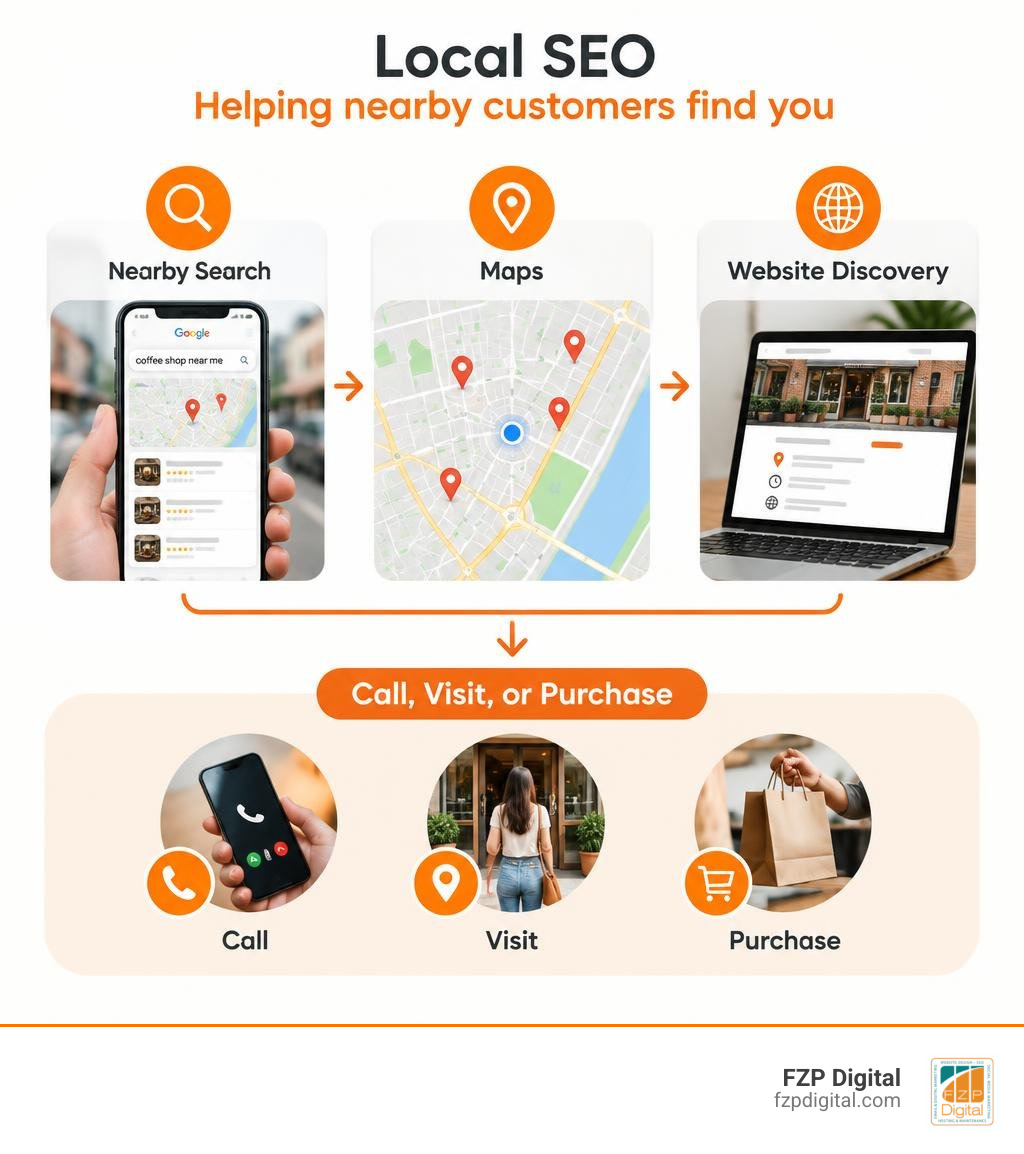
Think about the last time you searched for a coffee shop, a dentist, or a plumber. You probably didn’t want the best one in the country. You wanted the best one close to you. That’s local SEO in a nutshell: it’s the part of digital marketing that helps you show up for those nearby searches in the local pack (the short list of businesses with a map), Google Maps, and regular organic results.
The easiest way to see the difference is to compare it with traditional SEO.
| Traditional SEO | Local SEO | |
|---|---|---|
| Audience | National or global | People in a specific city, neighborhood, or service area |
| Key signals | Content, links, site quality | Google Business Profile, reviews, citations, proximity, location content |
| Results | Organic blue links | Local pack, Maps, and localized organic results |
If you want a broader foundation first, our guide on what SEO is and why you need it covers the basics.
What local SEO is in digital marketing, and who benefits
Local SEO helps any business that serves customers in a particular place. That includes storefronts like restaurants and shops, and service-area businesses like plumbers, electricians, and tutors. Dentists, mechanics, gyms, and even nonprofits with a physical presence benefit too.
Why does it matter so much? The numbers are pretty persuasive:
- About 30% of mobile searches are related to location, according to Google.
- 78% of people who search for something nearby on their phones visit the business within a day.
- 28% of nearby searches end in a purchase.
- 60% of smartphone users have contacted a business directly from local search results.
These are people with a need right now. If you’re not showing up, someone else is getting the call.
How local SEO in digital marketing helps nearby customers find you
Here’s something that surprises people: you don’t have to type “near me” for Google to treat a search as local. Search “hair salon” and Google will usually show stylists close to where you’re standing. That’s implicit local intent, and it’s why your location signals matter so much.
The same search can even change depending on where you are. Someone searching “pizza delivery” at the office will see different results than someone searching from home. Good local SEO puts you in front of those searchers, and they respond with calls, direction requests, and foot traffic. For a deeper walkthrough, see A Practical Guide to How Local SEO Works.
How Google Maps and local search choose businesses
Google uses a separate local system to decide who appears in the map results. Here’s the good news: a business can show up in the local pack and in the regular organic listings at the same time, which means double the visibility. Google explains the basics in its own guidance on improving local rankings.
There’s also no single “number one” spot. Results shift based on where the searcher is standing, so your goal is to be visible across the areas you serve.
How relevance, distance, and prominence shape local rankings
Google weighs three main things:
| Factor | What it means | What you can do |
|---|---|---|
| Relevance | How well your business matches what someone is searching for | Choose accurate categories, describe your services clearly, use local keywords |
| Distance | How close you are to the searcher or the location in their search | Keep your address accurate and use service areas honestly |
| Prominence | How well known and trusted you are | Earn reviews, links, and mentions; keep listings consistent |
Hours matter too. A business that’s closed at the moment of the search may rank lower than one that’s open. And while you can’t change where your building sits, you can strengthen relevance and prominence.
Interestingly, in a BrightLocal survey from 2021, 36% of SEOs named Google Business Profile as the most important factor for the map pack. For regular organic results, 34% pointed to on-page signals and 31% to links. Different results, different priorities.
How Google Business Profile supports local SEO
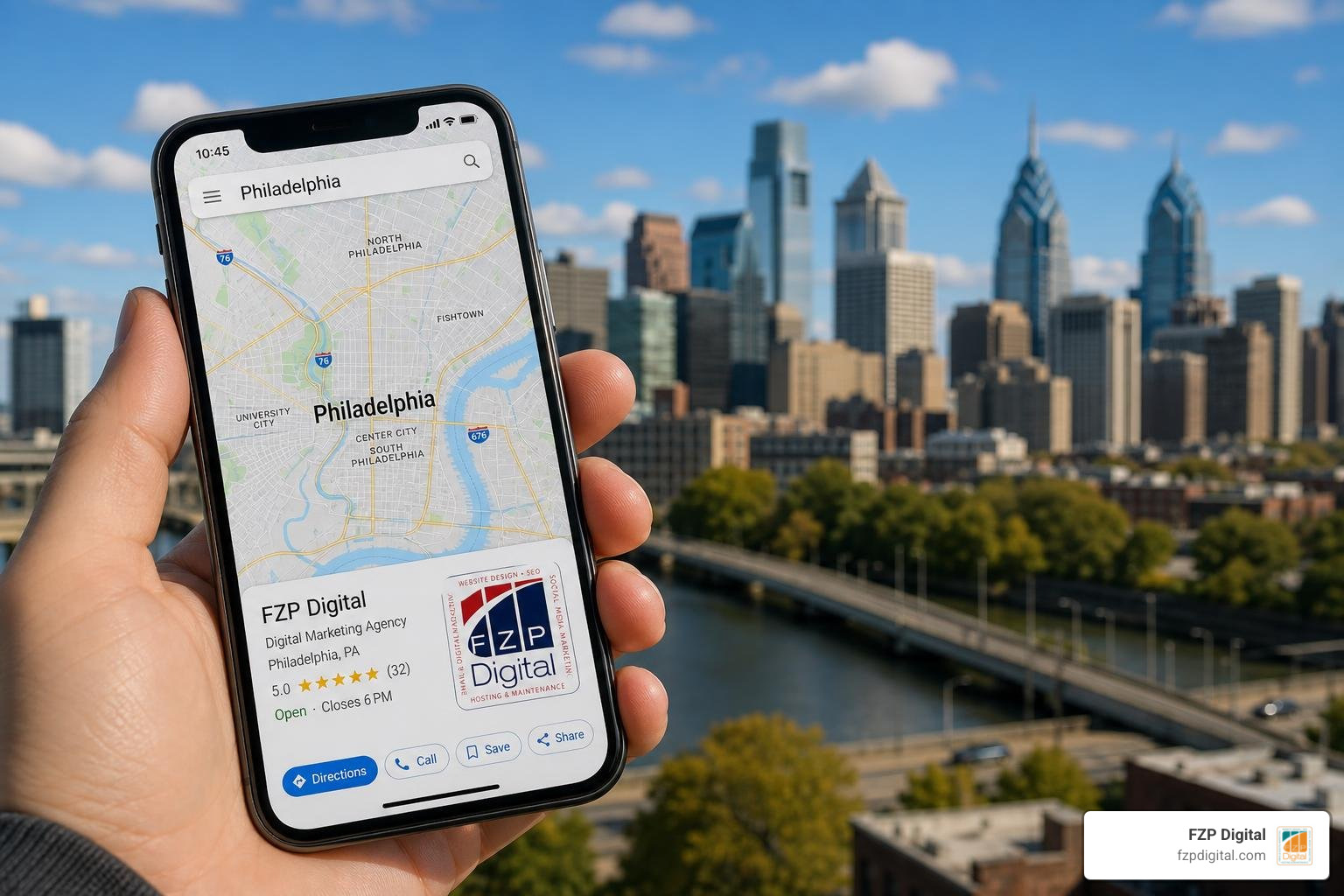
Your Google Business Profile (the free listing that powers much of what people see in Maps) is usually the fastest win. Claim it, verify it, and then fill out everything: your exact business name, a specific primary category, hours (including holidays), services, photos, videos, attributes, and a clear description. Posting updates about news, events, and offers keeps it fresh.
Is it worth the effort? According to Google, customers are 70% more likely to visit, and 50% more likely to consider buying from, businesses with a complete profile. Our guide to mastering your Google Business Profile walks through each field. And if you’re new to the name, here’s what Google My Business was before it became Google Business Profile.
Build a local SEO strategy that earns visibility
A solid local strategy has a few moving parts: keyword research, competitor gaps, helpful pages, consistent citations, genuine reviews, and local links. Set the foundation once, then keep improving it. Local SEO is ongoing maintenance, not a one-time setup. Our simple guide to winning at local SEO is a great companion read.
Find local keywords and create useful location pages
Start by brainstorming what you offer, then see how real people search for it. Type “best [your service] in” plus your town into Google and watch the Autocomplete suggestions. Google Keyword Planner can add ideas, and a look at what competitors rank for shows gaps you can fill.
A few tips:
- Prioritize specific, service-based phrases. They may have lower volume, but they attract people closer to hiring.
- Pay attention to local wording. One region says “HVAC repair” while another says “air conditioning service.”
- Include neighborhoods and landmarks, not just city names. Think Richboro, Newtown, or Center City for our area.
- Put location terms in title tags, meta descriptions, headings, and internal links, without stuffing them in.
If you have more than one location, give each its own page with real value: services offered there, local insights, directions, and testimonials. Skip generic copy that only swaps the city name. Also, put your address, neighborhood, hours, and local phone number on your site as text, not inside an image.
Keep citations consistent and earn genuine reviews
A citation is any mention of your business name, address, and phone number (NAP). Structured citations live in directories, while unstructured ones pop up in articles or blogs. The golden rule is consistency. “Joe’s Pizza” on one site and “Joe’s Pizzeria” on another confuses search systems, and so does a different phone number or a “Rd.” versus “Road.”
Make sure you’re listed on the big names, including Apple Maps, Yelp, Bing Places, and Facebook, plus industry directories. Watch for duplicate listings and clean them up. Our post on claiming every essential business directory shows where to start.
Reviews do double duty. They help your rankings and they build trust with people deciding whether to pick you. So:
- Ask happy customers, using a review link, a QR code on a card, or a small sign at the counter.
- Never pay for or offer incentives for reviews, and don’t only ask for the good ones.
- Reply to every review, positive or negative, in a friendly, professional tone.
Something small like a card on each table can bring in reviews on autopilot without making it a chore.
Build local links and make your site mobile-friendly
Links are votes of confidence. Local ones are especially useful. Think local press, community events, sponsorships, chambers of commerce, and partnerships with neighboring businesses. Even an unlinked mention helps search systems connect your brand to your location and category.
Since most local searches happen on phones, your site needs to be fast, easy to navigate, and have a tap-to-call button. Adding LocalBusiness schema (a bit of code that labels your name, address, hours, and more) helps search engines read your details clearly. It’s a technical step, and it’s one where we’re glad to help.
If you’re a plumber, electrician, or similar pro, check out local SEO for service businesses. And for general website best practices straight from the source, Google’s SEO Starter Guide is excellent.
Measure local performance, adapt to AI search, and avoid mistakes

You can’t improve what you don’t measure. The goal isn’t just rankings. It’s phone calls, direction requests, bookings, and qualified visits.
Measure rankings, calls, visits, and conversions
Start with a baseline so you can see progress. Then track:
- Google Business Profile Performance: views, website clicks, calls, and direction requests.
- Google Search Console: which searches show your site and how it appears.
- Google Analytics: how visitors behave and which channels send them.
- Rank tracking: positions by city or ZIP code, plus map-grid views that show how you rank around your location.
- UTM tracking: tags on your profile links so you can see which traffic came from Maps.
Track locally, not just nationally. National search volume can hide what’s happening in your own neighborhood.
Understand AI search and generative engine optimization
People now ask AI tools like ChatGPT, Perplexity, and Google’s AI Overviews things like “who can cater a party for 100 guests with dietary needs?” These tools lean on the same trust signals that help you in the local pack.
That’s good news, because you’re not starting over. Generative engine optimization (GEO) means making your business easy to understand and recommend. Here’s how:
- Keep your NAP identical everywhere, since it helps systems confirm they’re describing the right business.
- Keep your profile hours and details accurate.
- Earn reviews that mention your services and location in a natural way.
- Build helpful location pages with conversational FAQs and structured data.
Think of consistent information as your digital name tag.
Avoid local SEO mistakes that weaken trust
Even well-meaning businesses stumble. Watch out for:
- Keyword stuffing in your business name, titles, or descriptions.
- Fake or paid reviews, which break guidelines and erode trust.
- Duplicate profiles and inconsistent NAP.
- Thin location pages with nothing unique.
- Incorrect hours, which send customers away frustrated.
- Ignoring negative feedback.
- Skipping Google’s guidelines, which can lead to suspended profiles.
Frequently Asked Questions about Local SEO
How long does local SEO take to show results?
It depends. Google needs time to crawl and index changes, and your competition and profile completeness play a big role. Some tweaks show up within hours, others take months. Generally, give it several weeks, then keep testing and refining.
Can a service-area business use local SEO without a storefront?
Absolutely. Plumbers, cleaners, and mobile tutors do it all the time. You’ll need an eligible address, and you can hide it from the public if customers don’t visit you. Set accurate service areas, and remember that P.O. boxes and virtual offices don’t qualify.
How should a business respond to negative reviews?
Respond promptly and politely. Acknowledge the concern, offer to make it right, and take details offline if needed. Don’t argue, and don’t use review gating (only asking happy customers for reviews). A well-handled complaint can even win a customer back.
Conclusion
So, what does it all come down to? Consistent local signals, a complete profile, honest reviews, helpful pages, and steady improvements. Do those well, and nearby customers find you when it counts.
You don’t have to figure it all out alone, though. At FZP Digital, we love guiding Philadelphia and Bucks County businesses through each step with a collaborative approach. If you’d like a friendly partner, take a look at our affordable SEO services and let’s get your business on the map.