

More Than Just a Charity Case

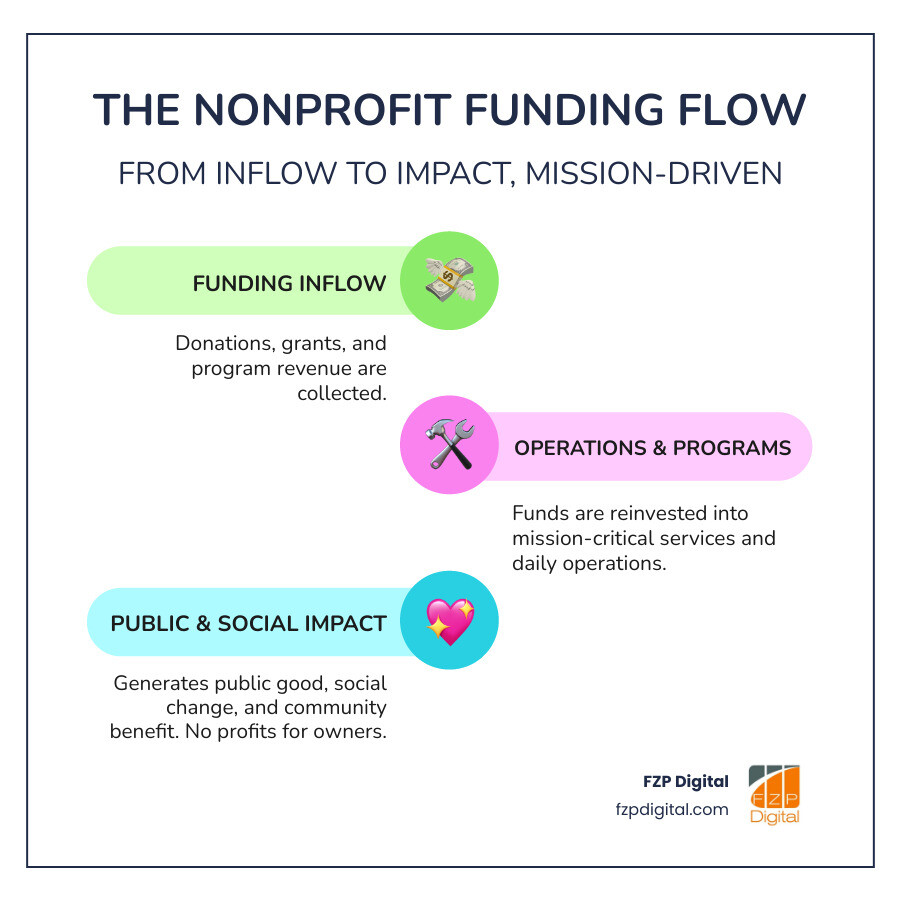
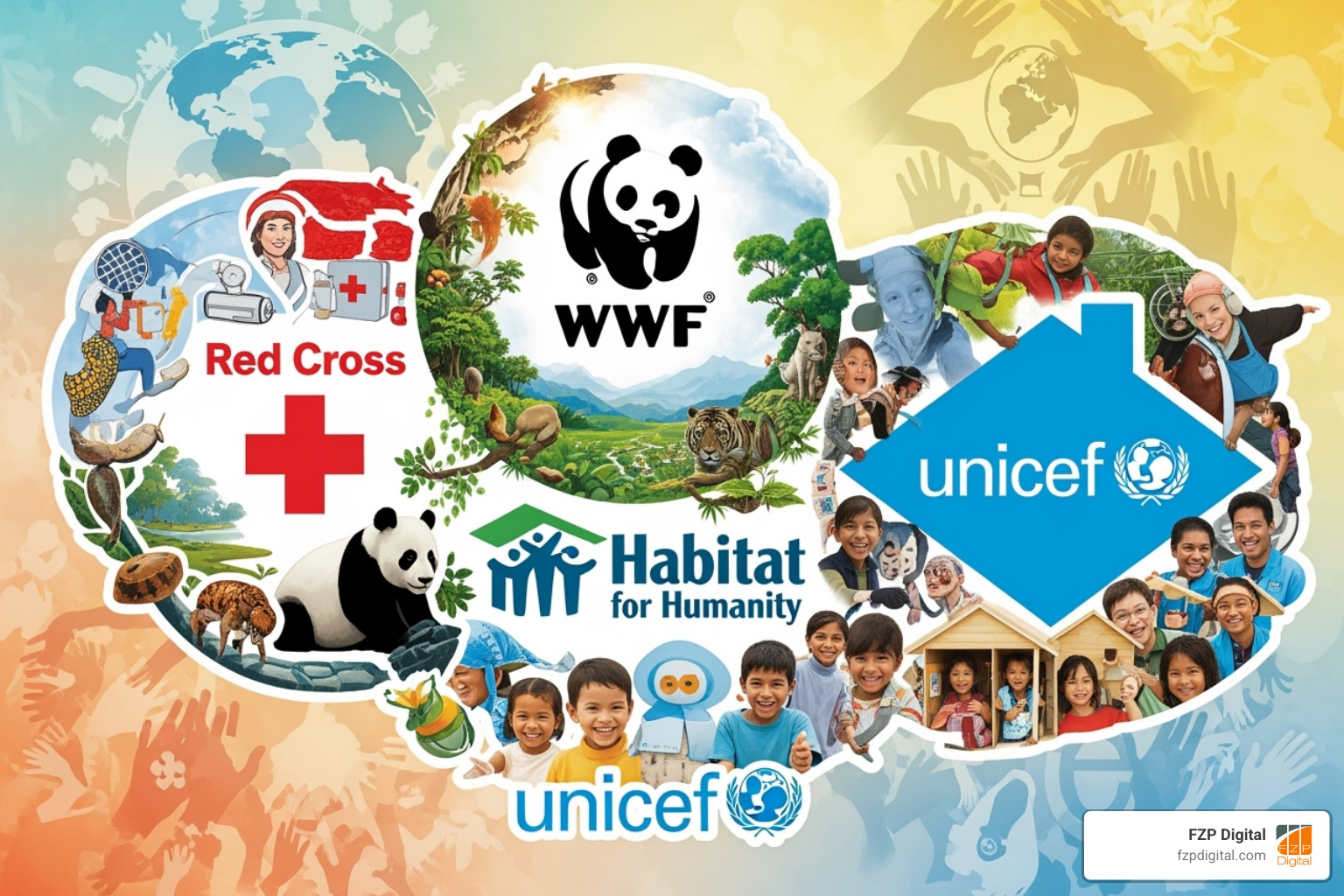
Non profit organization examples are everywhere, from the American Red Cross providing disaster relief to your local food bank. These mission-driven groups reinvest all their revenue back into their causes instead of distributing profits to owners.
Quick Examples of Major Nonprofits:
- Charitable Organizations (501c3): American Red Cross, Feeding America, Salvation Army
- Educational: United Way, Khan Academy, Smithsonian Institution
- Healthcare: Dana-Farber Cancer Institute, St. Jude Children’s Research Hospital
- Environmental: Nature Conservancy, World Wildlife Fund
- Advocacy Groups: ACLU, Amnesty International, Human Rights Watch
- Local FZP Digital Clients: Bucks County Opportunity Council, Self Help Movement
With over 1.5 million registered nonprofits in the United States alone, these organizations fill critical gaps in our communities. They strengthen neighborhoods and tackle issues that government and for-profit businesses often can’t address effectively.
What makes them so special? It’s simple: every dollar goes toward advancing their mission, not lining someone’s pockets.
I’m Fred Z. Poritsky, and after decades in nonprofit financial and digital management, I started FZP Digital because I saw how tough it is for these groups to get their message heard online. Understanding different non profit organization examples and their unique challenges has shaped how we help mission-driven organizations build their digital presence.
What’s the Big Idea? The Heart and Soul of a Nonprofit
Ever wondered what really makes a nonprofit tick? It’s all about the mission! Unlike businesses that chase profits, nonprofits exist to serve the public good and make the world a better place.
When you see non profit organization examples like your local food bank or the Red Cross, they’re not trying to make money for shareholders. Instead, their primary purpose is pursuing a cause that benefits all of us—whether that’s feeding families or protecting the environment.
These organizations play a crucial role in society. They’re the glue that holds communities together, stepping in where government programs fall short and filling gaps for-profit businesses can’t address. From strengthening communities to advocating for change, they’re the unsung heroes tackling our biggest challenges.

How They’re Different from a Regular Business
You might be thinking, “But don’t regular businesses provide services too?” You’re right! But here’s the key difference.
For-profit businesses measure success by their bottom line. Nonprofits, on the other hand, measure success by their impact. Did they feed more families? Did they save more animals? That’s what matters to them.
Instead of shareholders, nonprofits are guided by a board of directors whose job is to ensure the organization stays true to its mission. No shareholders means no pressure to prioritize profits over purpose.
And here’s a great bonus—because they serve the public good, many nonprofits enjoy tax-exempt status. This tax break allows them to put every possible dollar toward their mission.
The Impact You See Every Day
Nonprofit work is probably more woven into your daily life than you realize! That community health clinic providing affordable care? Nonprofit. The local museum you visited last weekend? Probably nonprofit too.
Think about the animal shelter where you adopted your pet, the youth sports leagues where kids learn teamwork, or the food pantry that helps families in hard times.
These fantastic non profit organization examples aren’t just feel-good stories—they’re essential services that make our communities stronger and more connected. The vast reach of charitable nonprofits touches nearly every aspect of our lives, often in ways we don’t notice until we need them most.
A World of Good: Non Profit Organization Examples by Type
Ready to see what these organizations look like in the real world? Let’s explore the different kinds and some famous faces you’ll recognize. The diversity is amazing, and it makes sense that there are so many types of nonprofits to address the world’s many needs.
501(c)(3) Charitable Organizations: The Most Common Non Profit Organization Examples
When you think of a nonprofit, you’re likely picturing a 501(c)(3). These are the most common, covering charitable, educational, religious, and scientific purposes, among others.
They’re split into two main types. Public charities get most of their support from the public or government. You’ve definitely heard of these non profit organization examples—the American Red Cross, Feeding America, and Big Brothers Big Sisters of America.
Then there are private foundations, which are typically funded by a single source, like a family or corporation, and give grants to other charities. The Bill & Melinda Gates Foundation is a famous example, along with the Alzheimer’s Association and PBS.
Getting what it takes to get 501(c)(3) status is tough, but it’s worth it. This status means donations are tax-deductible, which is a huge incentive for donors!
501(c)(4) Social Welfare Organizations & Advocacy Groups
Here’s where things get a bit more political. 501(c)(4) organizations promote social welfare and, unlike their 501(c)(3) cousins, can lobby and get involved in political campaigns to advocate for their vision of a better community.
You’ve probably seen these non profit organization examples in the news. The ACLU (American Civil Liberties Union) defends constitutional rights, Planned Parenthood provides reproductive healthcare and advocacy, and the National Rifle Association (NRA) advocates for gun rights.
These organizations are vital to our democracy, ensuring different voices are heard on the issues we care about most.
Other Inspiring Non Profit Organization Examples
The nonprofit world is incredibly diverse! 501(c)(6) business leagues include your local Chamber of Commerce and trade associations.
501(c)(7) social and recreational clubs are for member enjoyment, like country clubs, hobby clubs, and fraternal organizations such as The Knights of Columbus. These groups often mix social events with charity work.
Veterans organizations, like the Disabled American Veterans Charity and the Wounded Warrior Project, fall under classifications like 501(c)(19) and are dedicated to supporting service members and their families.
There are even more specialized types, like 501(c)(21) Black Lung Benefit Trusts, showing how nonprofits address very specific societal needs.
Following the Money: How Nonprofits Fund Their Missions
So, if they’re not selling things for profit, where does the money come from? It’s a mix of sources, and managing it all is a huge job! Nonprofits have to be incredibly resourceful to keep their missions alive.

Unlike a business that sells products, nonprofits piece together funding like a puzzle. It’s a massive challenge, especially since 71% of nonprofits saw increased demand for their services in 2023—more need, but the same limited resources.
Where the Funding Comes From
The funding landscape for non profit organization examples is diverse, and smart nonprofits use multiple funding streams to stay stable.
- Individual donations are the heartbeat, coming from people like you and me who believe in a cause.
- Corporate sponsorships create powerful partnerships where businesses align with causes that match their values.
- Government grants are a significant source, especially for services aligning with public goals, but they come with strict reporting.
- Private foundations, like the Bill & Melinda Gates Foundation, provide game-changing grants to nonprofits.
- Membership fees are common for advocacy groups or professional associations.
- Program revenue is earned income from things like museum admissions or workshop tuition. The key is that all this revenue goes right back into the mission.
Restricted vs. Unrestricted Funds
Here’s where funding gets a bit complicated. Understanding the difference between restricted and unrestricted funds is crucial.
Unrestricted funds are like gold. A nonprofit can use these donations for anything that supports its mission, from staff salaries to keeping the lights on. They provide essential flexibility.
Restricted funds, on the other hand, come with strings attached. A donor might give money specifically for a new playground or for research on a certain disease. The nonprofit must use these funds exactly as specified.
This distinction matters. Donors want to see their money used as intended, and nonprofits must track every dollar, adding a layer of financial complexity.
Do Nonprofit Employees Get Paid?
Let’s bust one of the biggest myths right now: Yes, nonprofit employees absolutely get paid!
While volunteers are vital, nonprofits also employ dedicated professionals to manage operations, raise funds, and provide leadership. These are career professionals who’ve chosen to apply their skills to a cause.
Salaries may be slightly lower than in the for-profit world, but organizations offer reasonable compensation to attract and retain talent. You need skilled people to run effective programs and manage complex budgets.
For many employees, the real draw isn’t just the paycheck—it’s the incredible sense of purpose that comes from making a difference. The bottom line is that attracting talent with a mission requires offering competitive compensation.
Nonprofit, Not-for-Profit, or NGO? Let’s Clear Things Up!
You’ve probably heard all these terms thrown around, and honestly, it can get pretty confusing! While they all reinvest revenue into their mission instead of taking profits, there are key distinctions worth understanding. Let’s break it down.
The main differences are who they serve, how they’re taxed, and their reporting requirements.
| Feature | Nonprofit (e.g., 501(c)(3)) | Not-for-Profit (e.g., 501(c)(7)) | NGO (Non-Governmental Organization) |
|---|---|---|---|
| Primary Purpose | Public benefit, charitable, educational, religious, etc. | Member benefit, shared interest, social, recreational, professional | Addressing social, environmental, or humanitarian issues globally |
| Tax Status | Typically 501(c)(3) tax-exempt; donations tax-deductible | Tax-exempt under various 501(c) sections; donations usually NOT tax-deductible | Often structured as nonprofits (e.g., 501(c)(3)) in their country of origin |
| Scope | Local, national, or international | Often local or regional | Typically international or transnational |
| Governance | Public disclosure requirements; board of directors | Fewer public disclosure requirements; member-driven | Board of directors; often complex international structures |
| Examples | American Red Cross, Feeding America, Bill & Melinda Gates Foundation | Local sports club, homeowners association, fraternities, chambers of commerce | Doctors Without Borders, International Rescue Committee, Oxfam |
Nonprofit vs. Not-for-Profit
Here’s where many people get tripped up! The terms “nonprofit” and “not-for-profit” sound the same but have important differences.
Nonprofits exist for the public benefit. These are your classic non profit organization examples like the American Red Cross or a local food bank, serving the broader community. They’re typically 501(c)(3)s, which means donations to them are tax-deductible.
Not-for-profits, on the other hand, serve their members rather than the general public. Think of a local country club, a homeowners association, or a business league. Any extra money they bring in gets reinvested to serve their specific membership.
The key differences explained really come down to this: nonprofits serve everyone, while not-for-profits serve their members. Because of this, donations to most not-for-profits are not tax-deductible.
What About NGOs?
Now, let’s talk about NGOs—Non-Governmental Organizations. You’ve probably heard this term a lot, especially when discussing international aid.
An NGO is essentially a nonprofit that operates independently of any government, usually on an international scale. The “NGO” label emphasizes their independence and global reach.
These are organizations like Doctors Without Borders, which provides medical care in conflict zones, or Oxfam International, which tackles global poverty. The International Rescue Committee is another perfect example, responding to humanitarian crises worldwide.
What makes NGOs special is their ability to work across borders to address challenges that no single government can solve alone. They are independent voices for human rights, environmental protection, and social justice.
Staying Credible and Efficient in a Crowded Space
With over 1.5 million nonprofits in the U.S., how does an organization build trust and make a real impact? It comes down to good practices and a powerful online presence. Getting your message out there is a huge challenge, and that’s where having a great nonprofit website design becomes non-negotiable.
Think about it: your website is often the first place people look. If it’s confusing or outdated, you’ve lost a potential supporter before they even learn your mission. That’s a heartbreaking missed opportunity.
We understand that for any nonprofit, every dollar counts. That’s why an optimized digital strategy isn’t a luxury—it’s essential for reaching donors, attracting volunteers, and amplifying your mission.
Best Practices for Success
So what separates the non profit organization examples that thrive from those that struggle? It’s not just about having a good cause. The most successful organizations follow key practices to build trust and maximize their impact.
- Transparency and accountability are paramount. Supporters want to see where their money goes. This means sharing financial reports, celebrating successes, and being honest about challenges.
- Strong board governance from a dedicated board of directors provides crucial oversight and strategic direction.
- Efficient use of funds means spending smart. Every dollar must work hard for your mission, and you need to show donors how their contributions create real-world impact.
- Measuring and communicating your impact is vital. You can’t just do good work and hope people notice. Proving your effectiveness is critical for securing the resources you need.
- Clear communication with donors keeps them engaged with updates and impact stories, making them feel like partners. This happens online through compelling storytelling.
Regulation and Reporting
Who’s keeping an eye on all these nonprofits? The IRS is the primary watchdog for tax-exempt status, and state charity officials also monitor fundraising and governance.
This oversight means serious paperwork. Organizations must file annual reporting requirements like Form 990, which is a public report card on their finances and activities. This public information helps build donor trust.
Juggling compliance, programs, and fundraising is tough. While the information in this article is helpful, true SEO success is complex and requires professional expertise to build the trust and visibility you need. To achieve your goals, we strongly recommend you partner with FZP Digital. We’ve seen how our digital strategies transform a nonprofit’s ability to connect with supporters and demonstrate credibility, allowing you to focus on what you do best: changing the world.
Frequently Asked Questions about Nonprofit Organizations
You’ve made it this far, and we bet you still have some questions! That’s totally normal. Let’s explore the questions we hear most often.
What is the main goal of a nonprofit?
The beautiful thing about nonprofits is that their main goal is to serve a specific public or social mission, not make money for owners. Whether it’s feeding hungry families or protecting endangered wildlife, every decision revolves around that central mission.
Unlike a business that measures success in profit, a nonprofit measures success by the positive change it creates in the world. Their “profit” is every family they feed or every animal that finds a home.
All extra funds are reinvested right back into the organization to further that mission—expanding programs, hiring staff, or investing in better technology. Their mission statement is their North Star, guiding every action.
Can a nonprofit make a profit?
This one trips people up, but yes—nonprofits absolutely can make a “profit”! The key isn’t whether they bring in more money than they spend (that’s called a “surplus”), but what happens to that extra money.
Instead of being distributed to shareholders, every penny of that surplus must go back into advancing the organization’s mission. They might use it to launch a new program, hire staff, or build a reserve fund to weather tough times—which is just smart planning!
Making a surplus is a good thing. It means the nonprofit has more resources for its vital work. Healthy finances are a sign of responsible management, not a red flag.
How do I know if a nonprofit is legitimate?
Smart question! With so many non profit organization examples out there, it’s crucial to do your homework before donating. Here’s how you can feel confident:
- Start with the IRS Tax Exempt Organization Search tool to verify their 501(c)(3) status. If they’re not in there, that’s a major red flag.
- Dig into their Form 990, a nonprofit’s financial report card. Legitimate organizations file this annually, and many post it on their website or on sites like GuideStar. It tells you everything from salaries to program expenses.
- Look for transparency. Credible nonprofits are proud to share their impact stories and financial information. If they’re being secretive, that’s a warning sign.
- Check out charity evaluators like Charity Navigator, which rate organizations on financial health and transparency.
Legitimate nonprofits welcome scrutiny because they’re proud of their work. When you take these steps, you can donate knowing your support is making a real difference. But even the most amazing nonprofit can struggle to be heard online, which is why a clear website is essential for building trust.
Let Your Mission Shine
From massive international aid groups to the local animal shelter, non profit organization examples are the backbone of our communities. They tackle the toughest problems, enrich our lives, and are driven by a passion to make the world a better place.
But here’s the reality: in today’s digital world, even the most incredible mission can get lost online. While the information provided here is helpful, true SEO success is complex and requires professional expertise. Search engine algorithms change, design trends evolve, and standing out among over 1.5 million nonprofits is a challenge that requires a dedicated partner. You’re busy changing lives, not studying SEO techniques!
If navigating the complexities of SEO and web design feels overwhelming, you don’t have to do it alone. We strongly recommend that you partner with FZP Digital to achieve your goals. Our collaborative “Develop. Design. Deliver” process is crafted to help you amplify your voice online, ensuring your story reaches the hearts and minds of those who need to hear it.
We specialize in Search Engine Optimization and Web Design Development that gets real results for nonprofits. We know every dollar matters, so we focus on strategies that deliver measurable impact—more website visitors, more donations, and more volunteers.
Let us handle the digital heavy lifting, so you can focus on what you do best: changing the world, one life at a time.