

SEO Competitive Analysis: A 7-Step Plan to Steal Their Rankings
Why Competitive SEO Analysis is Your Secret Weapon for Growth
Competitive SEO analysis is the process of researching the websites that outrank you in Google search results – examining their keywords, content, backlinks, and technical setup – so you can reverse-engineer what’s working and build a smarter strategy to outrank them.
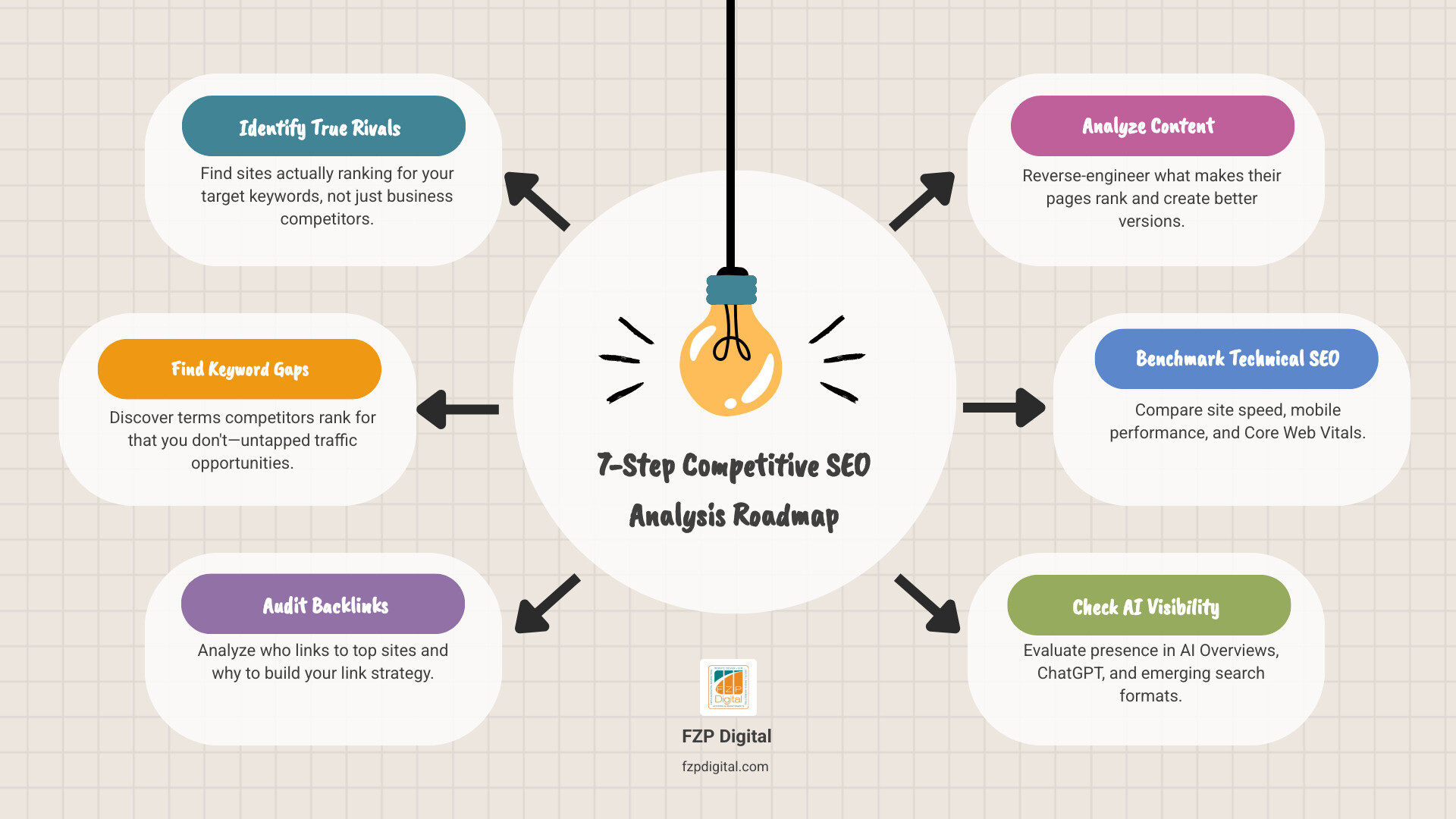
Here’s a quick snapshot of what it involves:
- Identify your true search rivals – the sites actually ranking for your target keywords (not just your business competitors)
- Find keyword gaps – terms your competitors rank for that you don’t yet
- Audit their backlinks – discover who’s linking to them and why
- Analyze their content – understand what makes their pages rank and how to do it better
- Benchmark technical SEO – compare site speed, mobile performance, and Core Web Vitals
- Check AI and SERP visibility – see how they appear in AI Overviews, ChatGPT, and Gemini
- Turn insights into action – build a prioritized growth plan with quick wins and long-term goals
Here’s a number that should stop you in your tracks: over 90% of web pages get zero organic traffic from Google. Zero. Not a trickle – nothing.
That’s not because those businesses aren’t trying. It’s because SEO isn’t just about what you do. It’s about what you do compared to everyone else competing for the same search results.
Think of it this way. Every spot on Google’s first page is already taken by someone. For you to show up, another site has to move down. That’s the reality of search – it’s a zero-sum game. And if you’re not watching what’s already working in your search results, you’re essentially trying to win a race with your eyes closed.
The good news? The sites ranking above you are leaving clues everywhere. Their keyword rankings, their content, their backlinks – it’s all publicly visible if you know where to look. A well-executed competitive SEO analysis turns that publicly available data into a clear roadmap for growth.
I’m Fred Z. Poritsky, founder of FZP Digital, and after years of helping small businesses and nonprofits in the Philadelphia area improve their digital presence, I’ve seen how a focused competitive SEO analysis can unlock opportunities that were hiding in plain sight. If you’re new to how search engines work, Google’s own SEO starter guide is a helpful outside resource that reinforces many of the same best practices we use when building a strategy.
Let’s walk through exactly how to do it.
Glossary for competitive seo analysis:
Ever feel like you’re doing everything right, but your website is still playing hide-and-seek on page five of Google? You aren’t alone! SEO can feel like a bit of a mystery, but here’s a secret: it’s actually a friendly competition. To get to the top, you just need to understand what the folks currently sitting there are doing better than you. Ready to dive in?
Understanding the Zero-Sum Nature of Search
Think of Google like a high-stakes game of musical chairs. There are only ten spots on that first page, and for you to sit down, another site has to move. We call this “ranking displacement.” By looking at the pages already winning in search, you can see exactly what it takes to earn your seat at the table.
When we talk about search as a “zero-sum game,” we mean that for every winner, another page loses visibility. If a new article climbs to the #1 spot, everyone else – including you – drops down a notch. This is why understanding Search Engine Optimization: What Is It and Why Do I Need It? is so vital. You aren’t just optimizing for an algorithm; you’re optimizing to be more helpful and relevant than the other results on the page.
Why Guessing is a Costly Strategy
Why wander around in the dark when the search results have already left a trail of breadcrumbs? Using data-driven decisions helps you spot patterns that work. It’s all about getting strategic clarity so you aren’t wasting time on things that don’t move the needle.
In our experience at FZP Digital, many businesses spend thousands of dollars on content that nobody ever sees. They guess at what their audience wants instead of looking at what Google is already rewarding. By performing a competitive SEO analysis, you can see exactly which topics drive traffic and which ones are a waste of time. This allows you to Improve Search Ranking by focusing your energy on high-impact opportunities that have already been proven to work in the real world.

Step 1 & 2: Spotting Your True Search Rivals and Finding the Gaps
The first mistake most people make is assuming their business competitors are their only SEO competitors. In the digital world, the rules are a little different!
Identifying Your Real Rivals for Competitive SEO Analysis
Did you know your biggest business rival might not be your biggest search rival? Let’s say you own a boutique bakery in Newtown. A shop a few blocks away may be a business rival, but when someone searches for “best chocolate cake recipe,” the pages showing up might be recipe publishers, food blogs, or national websites.
To find your true rivals, you need to look at the Search Engine Results Pages (SERPs). A “true” SEO competitor is a site that consistently appears for the keywords you want to rank for. Tools like Semrush or Ahrefs can help you find sites with a 40% or higher keyword overlap. These are the domains that are actually capturing the clicks you want.
Uncovering the 30-50% Untapped Keyword Gap
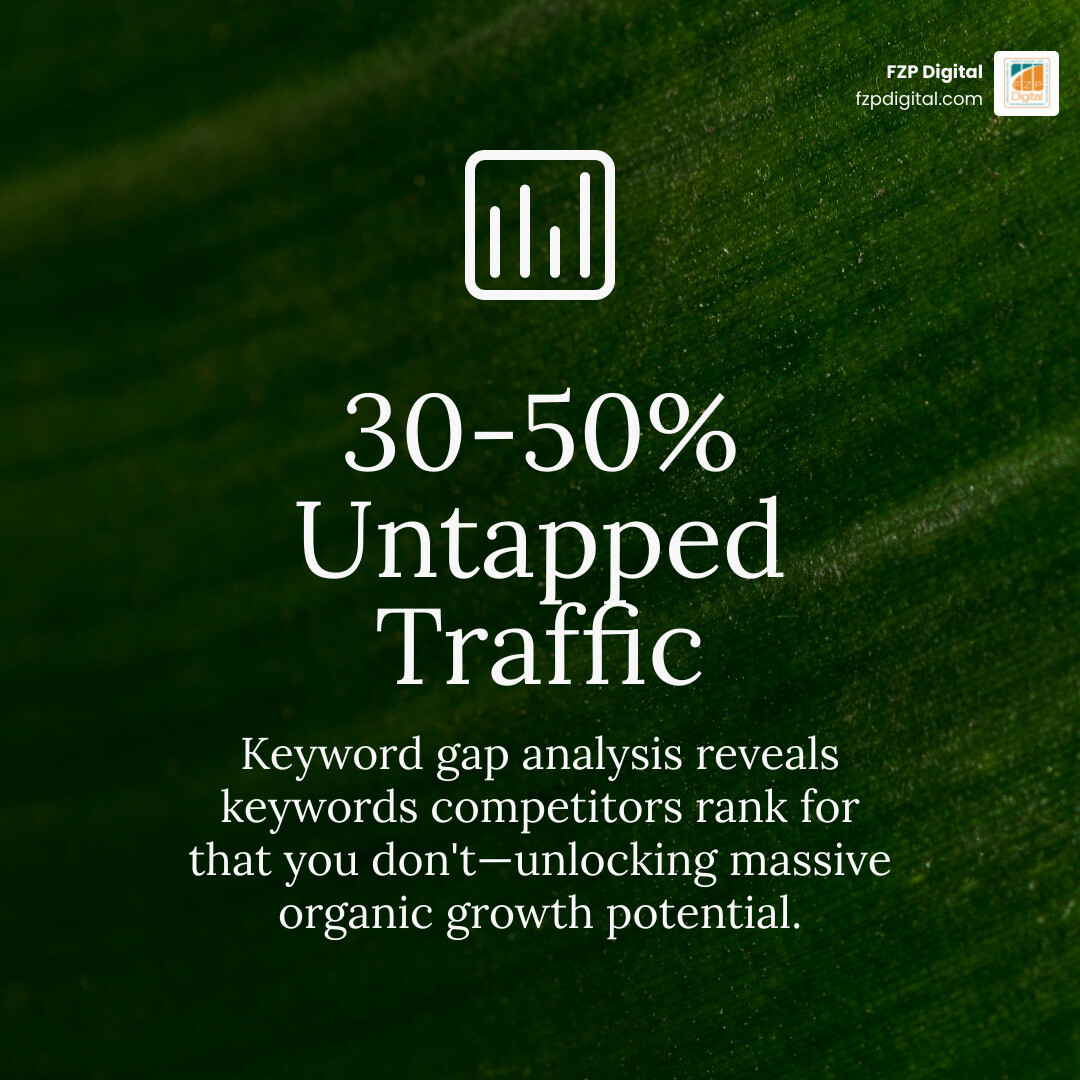
This is where the magic happens! A “keyword gap” is simply a list of words your customers are searching for that other ranking sites show up for, but you don’t – yet. Research shows that a thorough keyword gap analysis often reveals a 30-50% untapped opportunity for Organic Traffic Growth.
Imagine finding out that other top-ranking pages are getting 500 visits a month from a specific “how-to” guide that you haven’t written yet. That’s low-hanging fruit! By identifying these gaps, you can create a content plan that targets the exact terms your audience is already using. It’s like having a map to a hidden treasure chest – you just need to show up with a better key.

Step 3 & 4: Auditing Backlinks and Content Strategies
Once you know who you’re up against and what keywords they’re targeting, it’s time to figure out why Google likes them so much. This usually comes down to two things: authority and quality.
Reverse-Engineering the Authority of Top Performers
Think of backlinks like “votes of confidence” from other websites. If the top sites have a lot of high-quality “votes” from reputable sources like local news outlets or industry journals, you’ll need a plan to earn some too.
During a competitive SEO analysis, we look at a ranking site’s backlink profile to see its “link velocity” – how fast it is gaining new links – and the quality of its referring domains. We use a “link intersect” tool to find websites that link to several top-ranking sites but not to you. If a local Philadelphia business directory links to many of the sites showing up in your search results, there’s a very good chance they’ll link to you too! This is a core part of building a Content SEO Strategy that actually ranks.
Analyzing Content Effort and the 10x Principle
To beat the best, you have to be a little bit better. Pages ranking consistently at #1 tend to be dramatically better than #2-10 results – not just incrementally better. This is known as the “10x Content” principle.
When we audit a rival’s content, we look at their “effort.” Do they have a table of contents? Do they use original images and videos? Is their content 1,400 words while yours is only 500? We focus on “human novelty” and E-E-A-T signals (Experience, Expertise, Authoritativeness, and Trustworthiness) to show Google you’re the real deal. In 2026, Google is getting much better at spotting AI-generated fluff. Adding your unique perspective as a local expert in Bucks County or Philadelphia is your secret weapon to outshining generic content.
Step 5 & 6: Benchmarking Technical SEO and AI Visibility
You could have the best content in the world, but if your website is a technical mess, you’ll never reach the top. This is the “under the hood” part of the race.
Mastering Technical Factors in Competitive SEO Analysis
Is your site fast enough? Does it work perfectly on a phone? Since Google uses mobile-first indexing, the mobile version of your site is actually what determines your ranking. Google cares deeply about “Core Web Vitals,” which are specific metrics that measure how fast your page loads and how stable it feels to a user.
If another top-ranking site loads in under two seconds and yours takes six, Google will almost always favor them. As part of a Technical SEO Audit, we benchmark your site against other pages already winning in search. We look at site architecture (how easy it is for Google to “crawl” your pages) and “Interaction to Next Paint” (INP) to ensure your site feels snappy and professional.
AI and LLM Visibility: The New Frontier
The world of search is changing rapidly. By May 2026, AI Overviews and Large Language Models (LLMs) like ChatGPT and Gemini have fundamentally shifted how people find information. We don’t just look at traditional blue-link rankings anymore; we look at “Share of Model” or AI visibility.
Are AI tools citing your brand when someone asks for the “best digital marketing agency in Philadelphia”? We track how often other visible brands appear in AI-generated answers and look for ways to earn those mentions for you. This involves optimizing for “natural language” queries and ensuring your site has clear, structured data that AI can easily understand. It’s the new frontier of being found online, and staying ahead of 10 Important 2021 SEO Trends You Need to Know (and how they’ve evolved into 2026) is crucial for long-term success.
Step 7: Turning Insights into an Actionable Growth Plan
Data is great, but action is better! A spreadsheet full of competitor keywords won’t grow your business unless you do something with it. We take all these insights and turn them into a prioritized roadmap using a 3-Horizon Framework.
Your 2026 SEO Execution Roadmap
| Horizon | Timeline | Focus Area | Goal |
|---|---|---|---|
| Horizon 1: Quick Wins | 0-30 Days | Technical fixes & metadata | Stop the bleeding and fix easy errors. |
| Horizon 2: Content Gaps | 30-90 Days | New content & refreshes | Capture the 30-50% untapped traffic. |
| Horizon 3: Authority | 90-180 Days | Backlinks & Brand Building | Become the dominant voice in your niche. |
Whether it’s a “quick win” like optimizing your meta titles for a higher click-through rate or a long-term project like building a library of high-authority backlinks, our team at FZP Digital ensures you have a clear path forward. We don’t believe in “set it and forget it” SEO. We believe in Your Blueprint for Success: Navigating SEO Company Websites and following through until you see the results in your bottom line.
Frequently Asked Questions about Competitive SEO Analysis
How often should I conduct a competitor audit?
We usually recommend a deep-dive every quarter. The digital landscape moves fast – new sites launch, Google updates its algorithm, and rankings shift. A quarterly refresh keeps you proactive rather than reactive. For high-competition niches, a light monthly “check-in” on ranking changes is also a smart move.
Can I perform this analysis for local SEO in Philadelphia?
Absolutely! Local SEO is a different beast. Whether you’re in Richboro, Newtown, or Downtown Philly, we look at the “local search grid.” This means analyzing which businesses are winning the “Map Pack” and how many reviews they have. We also look at their local citations to make sure your business is listed everywhere it should be – and more.
What is the biggest mistake to avoid in competitor research?
The biggest mistake is blind imitation. Just because a page is ranking #1 doesn’t mean everything it does is right. It might be ranking despite a slow website because its content is so old and authoritative. If you just copy that slow website, you’re missing the point. The goal of competitive SEO analysis is to learn from what’s working, then do it better, faster, and more authentically.
What are the best tools for this?
While we use professional-grade tools like Semrush, Ahrefs, and SpyFu, you can start small. Even searching your main keywords in “Incognito Mode” can give you a lot of manual insight into who is winning and why. However, to see the “hidden” data like backlink profiles and keyword gaps, specialized tools are a must.
Conclusion
SEO doesn’t have to be a headache. It’s not about “tricking” Google; it’s about being the best answer to a user’s question. When you take the time to look at what your rivals are doing, you stop guessing and start growing.
At FZP Digital, Fred Z. Poritsky and our team take a collaborative approach. We don’t just hand you a report; we work with you to “Develop, Design, and Deliver” a digital presence that stands out. Whether you need a premium responsive WordPress site or a complete SEO overhaul, we’re here to help our neighbors in Philadelphia and Bucks County win.
Ready to see what your competitors are hiding? Let’s chat and turn their success into your roadmap!
Finding Your Perfect SEO Partner Explore our Affordable SEO Services