
NGO Website Shopping: Finding a Site That Actually Works

Why Your NGO Website Is Your Most Powerful Fundraising Tool
An ngo website is often the very first place a potential donor, volunteer, or partner encounters your mission — and that first impression can make or break their decision to get involved.
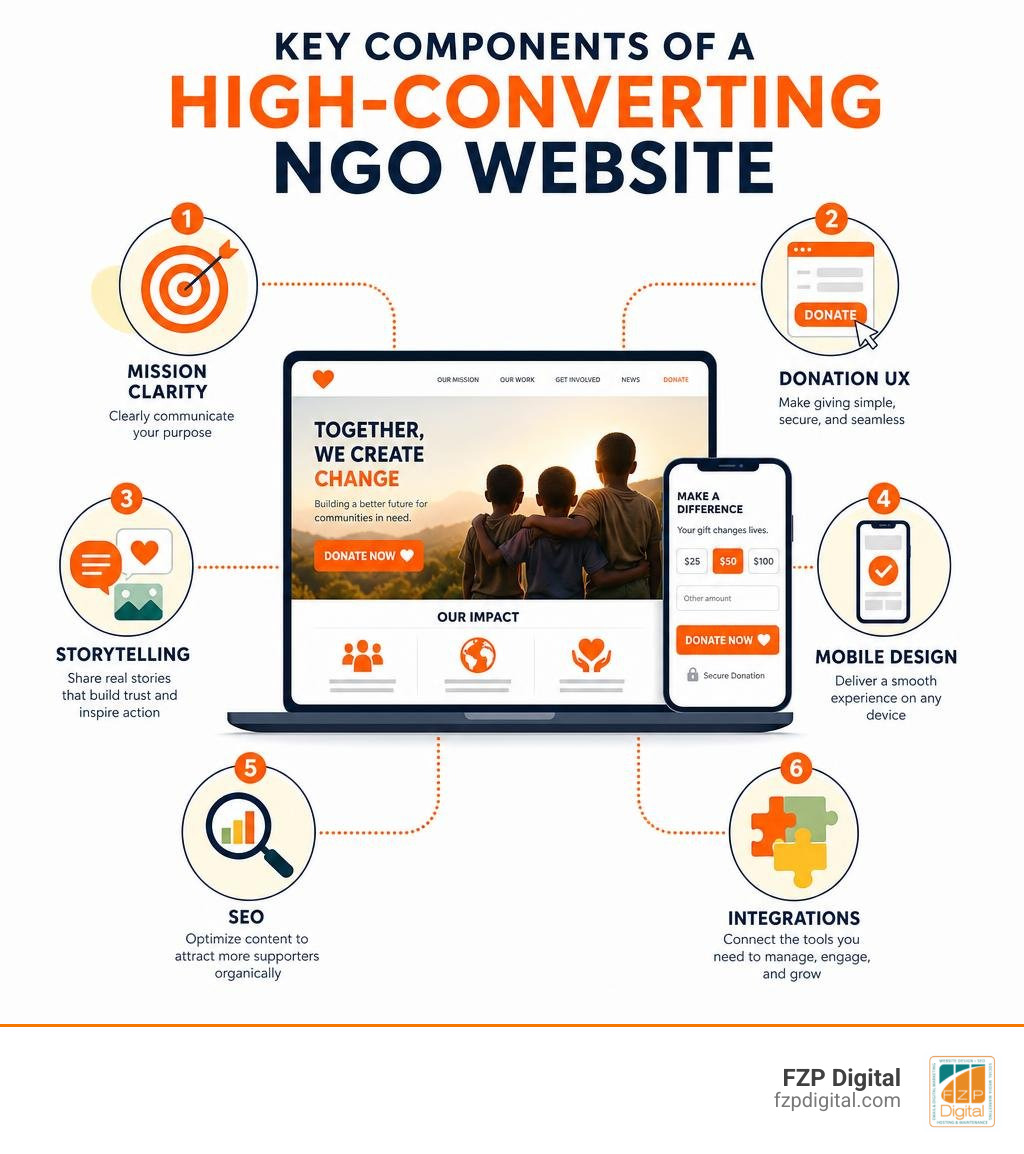
Here’s a quick overview of what a high-performing NGO website needs to succeed:
| Element | Why It Matters |
|---|---|
| Clear mission statement | Instantly communicates purpose to new visitors |
| Compelling donation form | Reduces friction and boosts conversion rates |
| Impact statistics & stories | Builds emotional trust with donors |
| Mobile-friendly design | Reaches supporters on any device |
| SEO-optimized content | Attracts new visitors through organic search |
| Third-party tool integrations | Connects CRM, volunteer management, and matching gifts |
| Accessibility compliance | Ensures all users can navigate and engage |
Think about organizations like CARE, which directs 90% of donations straight to lifesaving programs, or MSF, which logs over 16.5 million outpatient consultations annually across 75+ countries. Their websites don’t just inform — they inspire action.
The stakes are real. Whether you’re a small Philadelphia-area nonprofit or a growing regional organization, your website is working (or not working) for you 24 hours a day. A poorly designed site doesn’t just look bad — it actively loses you donors, volunteers, and credibility.
That’s where having the right web partner changes everything.
I’m Fred Z. Poritsky, founder of FZP Digital, and my background in nonprofit financial management gives me a uniquely practical perspective on what an ngo website actually needs to convert visitors into committed supporters. I’d love to help your organization find the right solution — so let’s break down exactly what to look for.
Ngo website basics:
What Makes a Great NGO Website Stand Out?
When you look at the digital landscape in June 2026, you quickly realize that the best websites don’t just sit there looking pretty. They are active engine rooms for change. A great ngo website combines a stunning visual identity with clear, intuitive user pathways. What does that mean for your organization? It means that when a visitor lands on your homepage, they shouldn’t have to guess what you do, why it matters, or how they can help.
To create an immediate impact, we focus on several core design elements. Your visual identity — your logo, typography, color palette, and imagery — must immediately convey professional credibility and emotional depth. Think of how UNICEF’s global initiatives are framed with iconic, high-contrast imagery that highlights real children and real solutions.
Once you have their attention, you must guide them. User pathways are the invisible signposts on your site. If a local business owner in Richboro or Newtown wants to sponsor an event, or a resident in Downtown Philadelphia wants to volunteer, can they find that option in under five seconds? If not, your design is getting in the way of your mission. For a deeper dive into making your platform pop, explore our stunning NGO website design tips to discover how to align visual hierarchy with user action.
Storytelling and Multimedia on Your NGO Website
Have you ever visited a site and felt completely unmoved by a wall of text? We all have. Humans are wired for stories, not spreadsheets. To build a true emotional connection and foster trust, your ngo website needs to showcase real-world impact through powerful storytelling and multimedia.
Consider how Human Rights Watch’s investigative reports use compelling, on-the-ground narratives, high-quality video content, and detailed witness testimonies to expose global issues. They don’t just state that they work in over 100 countries with staff representing 80 nationalities; they show the faces and voices behind those numbers.
When designing your website, we recommend using:
- High-impact video backgrounds on your hero sections to show your team in action.
- Before-and-after case studies that demonstrate the tangible change a donor’s dollar makes.
- Interactive storytelling elements, such as maps or timelines, that let supporters explore your programs at their own pace.
By elevating human voices over clinical data, you transform passive readers into active advocates.
Balancing Information with Clean Navigation
As an NGO, you do a lot of incredible work. You might run educational programs, coordinate local food drives, host fundraising galas, and publish research reports. But trying to cram all of that information onto your homepage is a recipe for user overwhelm. How do we solve this? By balancing comprehensive information with clean navigation and minimalism.
The secret lies in smart information architecture. We love using mega menus — large, organized drop-down navigation panels — to categorize complex resources into intuitive, bite-sized sections. This allows you to keep your homepage beautifully minimalist, focusing on a single, primary call-to-action (CTA), while still giving researchers, journalists, and major donors easy access to deep-dive pages.
By applying proven nonprofit website design best practices, we keep the cognitive load low and the user experience high. Remember: a clean, uncluttered website signals a well-run, professional organization.
Mobile-First Design and Accessibility Compliance
Did you know that more than half of your web traffic likely comes from mobile devices? If your donation form is impossible to fill out on a smartphone, or if your text is too small to read on a tablet, you are leaving valuable support on the table. In June 2026, mobile responsiveness is no longer optional; it is the baseline.
But mobile optimization is only one half of the coin. Your site must also be fully accessible to everyone, including individuals with visual, auditory, motor, or cognitive disabilities. This means designing with Web Content Accessibility Guidelines (WCAG) compliance in mind:
- Screen reader compatibility so visually impaired users can navigate your content.
- High color contrast to ensure text is legible against any background.
- Keyboard navigation for those who cannot use a standard mouse.
When we build premium nonprofit website designs, we make sure that accessibility is baked into the code from day one. An inclusive website doesn’t just expand your reach — it reflects the very core of your humanitarian values.
Optimizing the Donation Experience and Tech Integrations
Let’s talk about the lifeblood of your organization: funding. You can have the most beautiful storytelling in the world, but if your donation process is clunky, slow, or confusing, supporters will abandon the page before completing their gift. Optimizing this flow is where a professional website design pays for itself many times over. Check out our comprehensive charity NGO websites guide to see how a streamlined digital gateway can transform your fundraising capacity.
Structuring High-Converting Donation Forms
What makes a donation form convert? In our experience, it comes down to friction reduction. Every extra field you ask a donor to fill out decreases the likelihood that they will finish the transaction.
Here is how we structure high-converting donation forms to maximize your revenue:
- Offer Recurring Gifts Prominently: Encourage supporters to become sustaining partners by making “monthly giving” the default option.
- Use Suggested Gift Amounts: Instead of an empty text box, suggest specific amounts (e.g., $25, $50, $100) and tie them to tangible outcomes (e.g., “$50 feeds a family for a month”).
- Display Credibility Markers: Place trust seals, secure payment badges, and third-party ratings (like Charity Navigator or Candid) directly on or near the form to reassure donors that their financial data is safe.
- Provide Multiple Payment Methods: Integrate modern digital wallets like Apple Pay, Google Pay, and PayPal alongside traditional credit card options to make giving a one-click experience.
By studying the best practices for nonprofit website design, we help you build a seamless, secure, and reassuring giving experience that turns casual visitors into lifelong contributors.
Integrating Third-Party Tools into an NGO Website
Your ngo website shouldn’t exist in a vacuum. To run a highly efficient organization, your site needs to talk directly to the other software tools you use every day.
When we develop websites, we focus on seamless integrations that save your staff time and streamline your operations:
- CRM Integration: Automatically sync donor details from your website forms directly into CRMs like Salesforce, HubSpot, or Virtuous.
- Matching Gift Search: Integrate tools like Double the Donation so donors can instantly check if their employer will double or triple their contribution.
- Volunteer Portals: Allow local supporters in Philadelphia or Bucks County to sign up for shifts, track their hours, and access training materials online.
- Robust APIs: Connect your site to external databases or payment gateways to ensure smooth, real-time data transfers.
This focus on systems integration mirrors Doctors Without Borders’ operational transparency. By displaying real-time data and maintaining efficient backend systems, they prove to the world that they run a tight, highly accountable ship. When your website and your software work together, your team can spend less time on manual data entry and more time on the ground making a difference.
Driving Traffic and Measuring Website Performance
Building a world-class ngo website is a massive milestone, but it’s only half the battle. Once your digital home is ready, you have to invite people inside! Driving consistent, high-quality traffic to your site requires a smart mix of Search Engine Optimization (SEO), digital marketing, and data-driven performance tracking. To get a complete roadmap on this, check out our guide on essential marketing for nonprofits.
SEO and Content Strategies for Nonprofits
How do new supporters find you online? Most of the time, they type a question or a local need into Google. If you want to be the answer they find, you need a robust SEO and content strategy.
Effective search engine optimization isn’t about tricking search engines; it’s about providing genuine value. We help you identify the high-intent keywords your target audience is searching for—whether that’s “food pantry in Philadelphia” or “how to sponsor a child.”
Furthermore, did you know that eligible NGOs can access up to $10,000 per month in free search advertising through the Google Ads Grant program? We specialize in setting up and optimizing these accounts, aligning your paid ads with a highly structured, keyword-rich site navigation. When you combine this with custom WordPress development for nonprofits, you create a powerful, scalable framework that drives consistent organic and paid traffic to your most important pages.
Key Metrics to Track and Improve
Once the traffic starts flowing, how do you know if your website is actually doing its job? You have to look at the data. We don’t believe in tracking “vanity metrics” like raw page views just to feel good. Instead, we focus on the metrics that directly impact your mission’s bottom line.
Here are the key performance indicators (KPIs) we recommend monitoring closely:
- Conversion Rate: What percentage of website visitors actually complete a donation, sign up to volunteer, or join your mailing list?
- Bounce Rate: Are visitors leaving your site immediately after landing on a page? A high bounce rate often points to slow loading speeds or confusing layouts.
- Average Donation Value: Is your suggested gift strategy successfully encouraging donors to give larger amounts over time?
- User Engagement: How long are users staying on your impact stories, and which videos are they watching to completion?
By utilizing analytical frameworks and staying connected with industry standards, such as those offered by the Nonprofit Leadership Center’s resources, you can continuously refine your digital strategy, make data-backed adjustments, and ensure your website remains a high-yielding asset for your cause.
Frequently Asked Questions about NGO Websites
We know that navigating web design and digital marketing can feel overwhelming. Here are quick, straightforward answers to the questions we hear most often from organization leaders.
What are the most important features of a successful NGO website?
A successful website must instantly capture attention and convert that attention into action. The non-negotiable features include:
- A clear, emotionally resonant mission statement above the fold.
- A fast, secure, and highly optimized donation form with recurring giving options.
- Compelling, multimedia-driven storytelling that showcases real-world impact.
- Clean, intuitive navigation that helps different audiences (donors, volunteers, partners) find their specific pathways.
- Full mobile responsiveness and accessibility compliance.
By implementing charity website design best practices, you ensure that your site is built on a foundation of trust, speed, and usability.
How can smaller, local NGOs compete with large international organizations online?
You don’t need a multi-million dollar marketing budget to make a massive impact online. While global giants have massive reach, smaller, local NGOs have a secret weapon: deep, authentic community trust.
By focusing your SEO efforts on highly targeted, local search terms (e.g., supporting the Philadelphia Foundation’s community impact initiatives or connecting with local networks like the Newtown Community Foundation and Nonprofits and Charities in Richboro, PA | GreatNonprofits), you can dominate search results in your immediate geographic area.
Local donors love knowing exactly where their money is going. Highlight your local partnerships, show the specific neighborhoods in Philadelphia or Bucks County you are serving, and use your website to tell stories of immediate, grassroots change. When it comes to local giving, authenticity beats scale every single time.
Why is WordPress the preferred platform for building an NGO website?
We build almost all of our client websites on WordPress, and for very good reasons. WordPress offers an unbeatable combination of customization, scalability, and ease of use.
For NGOs, this platform is incredibly powerful because:
- It’s Easy to Update: Your staff doesn’t need to know how to code to add a blog post, upload a new impact video, or update an event page.
- Unmatched Integrations: WordPress easily connects with almost every major CRM, donation gateway, and volunteer database on the market.
- Scalability: Whether you’re a brand-new startup or a massive regional organization, WordPress can grow alongside you.
- Cost-Effective: Because it’s open-source, you aren’t locked into expensive, proprietary software fees.
If you are ready to take control of your digital presence, check out our guide on launching a nonprofit website with WordPress to see how easy and powerful this platform can be.
Conclusion
At the end of the day, your ngo website shouldn’t just be an expensive digital brochure. It should be a dynamic, hardworking member of your team—one that tells your story beautifully, attracts new supporters day and night, and makes the donation process as simple as a single click.
We believe that local organizations in Richboro, Newtown, and throughout Philadelphia deserve premium, responsive WordPress website designs that rival the absolute best in the world. But we also know that you have a mission to run, and you don’t have time to get bogged down in technical jargon.
That is why we emphasize our collaborative “Develop . Design . Deliver” process. We handle the heavy lifting—from custom coding and secure donation integrations to local SEO and accessibility compliance—while keeping you intimately involved every step of the way.
If you’re ready to stop shopping and start building a digital presence that actually works, we would love to be your partner. Let’s work together to amplify your voice, build deep community trust, and drive the funding your mission deserves.
Partner with FZP Digital for premium web design and development today. Reach out to Fred Z. Poritsky and our dedicated team in Bucks County and Philadelphia, and let’s craft something beautiful together!