

B2B Email Marketing Strategy: From Planning to Execution

Why Your B2B Email Marketing Strategy Is the Most Valuable Channel You’re Probably Underusing
A well-built B2B email marketing strategy can return as much as $44 for every single dollar you spend on it. That’s not a typo.
Yet so many small and mid-sized businesses in Philadelphia and beyond are either blasting the same generic newsletter to everyone on their list — or not emailing at all. Both approaches leave serious revenue on the table.
Here’s the quick answer if you want it:
What is a B2B email marketing strategy?
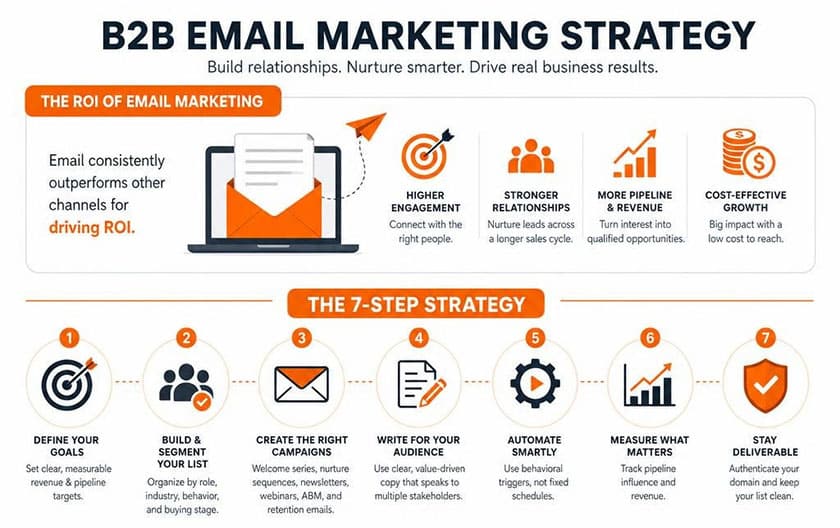
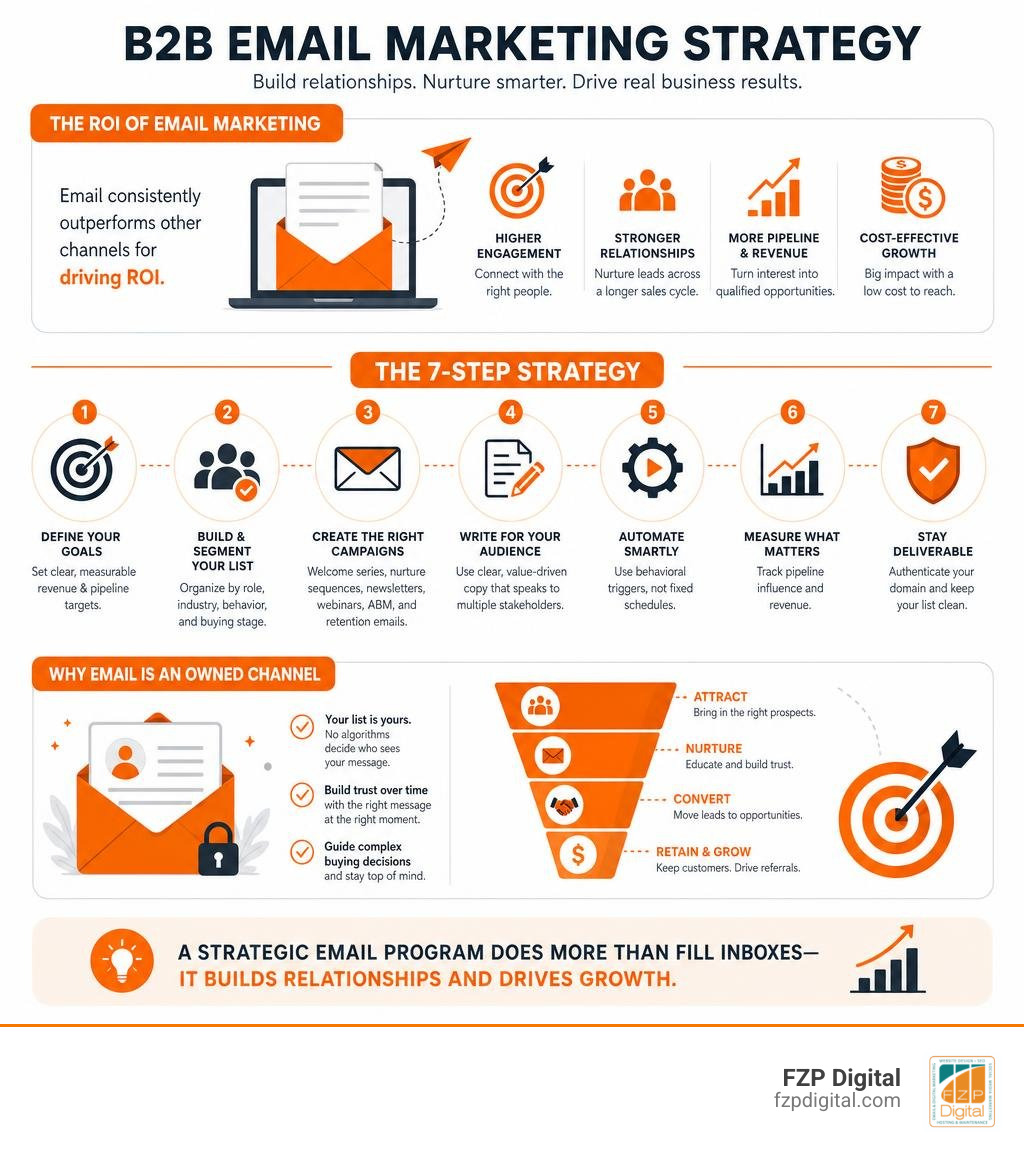
A B2B email marketing strategy is a structured plan for sending targeted, relevant emails to business decision-makers to generate leads, nurture prospects through a longer sales cycle, and retain customers over time. A strong strategy includes:
- Define your goals — Set specific, measurable revenue and pipeline targets.
- Build and segment your list — Organize contacts by role, industry, behavior, and buying stage.
- Create the right campaign types — Welcome series, lead nurture sequences, newsletters, webinar invites, ABM outreach, and retention emails.
- Write for your audience — Use logical, value-driven copy that addresses multiple stakeholders.
- Automate smartly — Use behavioral triggers instead of blasting on a fixed schedule.
- Measure what matters — Track pipeline influence and revenue, not just open rates.
- Stay deliverable — Authenticate your domain (SPF, DKIM, DMARC) and keep your list clean.
Unlike social media, where an algorithm decides who sees your content, email is an owned channel. Your list is yours. That’s a big deal.
And in B2B specifically, the stakes are even higher. You’re not selling a $30 pair of socks on impulse. You’re helping another business make a complex, expensive decision — often involving six to ten stakeholders and a sales cycle that can stretch from one month to well over a year.
That means your emails need to do more than look nice. They need to educate, build trust, and meet the right person with the right message at the right moment.
Sound complicated? It doesn’t have to be. This guide breaks it all down in plain language.
I’m Fred Z. Poritsky, founder of FZP Digital, and I’ve spent years helping CPAs, attorneys, nonprofits, and small businesses develop a B2B email marketing strategy that actually connects with the right people and drives real results — drawing on a background that blends financial management, creative thinking, and digital marketing. Let’s walk through everything you need to know to build an email program that works.
B2b email marketing strategy terms simplified:
B2B vs. B2C Email Marketing: Understanding the Core Differences
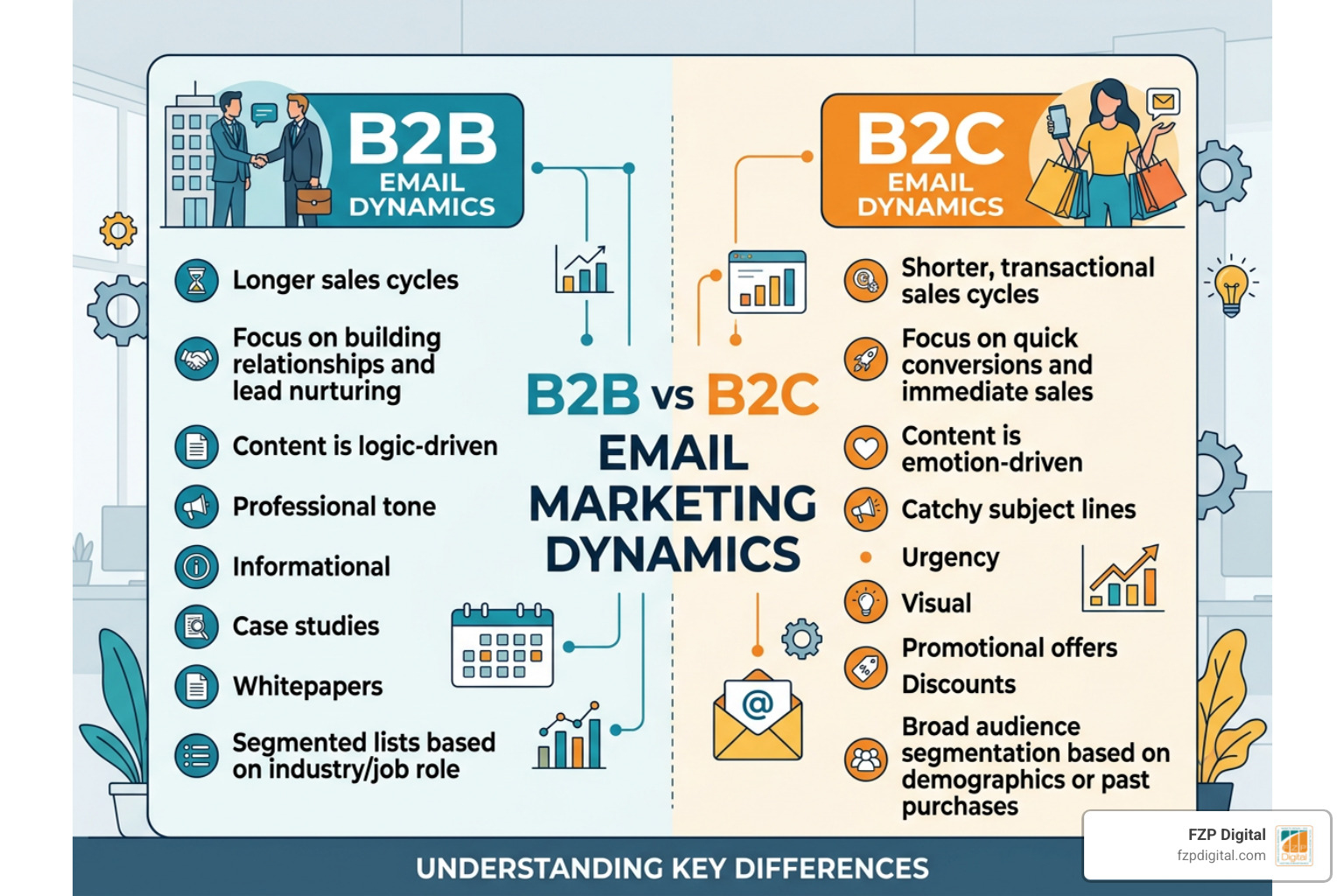
To build an email system that actually converts, we first have to understand who we are talking to. Too many businesses make the mistake of using B2C tactics in a B2B world. They try to create urgency with flash sales or emotional hooks. But let’s be honest: when was the last time you bought enterprise accounting software or hired a corporate law firm because of a “20% off today only!” email?
Probably never. B2B and B2C email marketing are two entirely different games.
In B2C, you’re usually speaking to a single consumer who is buying with their own money, often driven by emotion, entertainment, or immediate need. The buying cycle is incredibly short — sometimes just minutes.
In B2B, you are speaking to a professional who is spending company funds on company time. The purchase is an investment, which means they need to justify the timing, budget, and resources to a larger group. Here is how those dynamics shake out:
- Buying Committees: A typical B2B purchase in 2026 involves six to ten decision-makers. Your email might be read by a technical manager who cares about integrations, a CFO who cares about ROI, and an end-user who just wants their daily job to be easier. Your messaging has to address all of these perspectives.
- Longer Sales Cycles: According to industry benchmarks, the average B2B buying cycle takes between six to nine months to complete. Because of this, you can’t rely on immediate “buy now” calls-to-action. Instead, you need a steady, long-term conversation that proves you are the safest, most profitable partner.
- Logical Decision-Making: While B2C thrives on emotion, B2B is built on logic, efficiency, and return on investment. Your readers want to see case studies, data, and clear proofs of concept.
- Relationship Building: B2B email isn’t transactional; it’s relational. Your goal is to establish thought leadership and trust over time so that when they are finally ready to buy, your brand is the only logical choice.
If you want to dive deeper into how these dynamics shape modern B2B campaigns, check out the insights in B2B Email Marketing in 2026: The Complete Guide.
Why a B2B Email Marketing Strategy is Your Highest-ROI Asset
Why do we place such a massive emphasis on email? Why not put all our budget into social media ads or search engine optimization?
While we love SEO and web design at FZP Digital, we also know that email is the ultimate safety net for your traffic. Think of it this way: when you run paid ads or rely solely on social media algorithms, you are building your house on rented land. If an algorithm changes tomorrow, your reach can vanish overnight.
Email is owned media. Once someone opts into your list, you control the distribution. You have a direct, unmediated line to their inbox. That’s why email consistently delivers an average return of $30 to $40 for every dollar spent — and some reports place that return as high as $44.
Furthermore, email operates on permission-based engagement. These are people who have raised their hands and said, “Yes, I want to hear from you.” This makes them highly qualified.
However, lists don’t stay perfect forever. Your database naturally decays by about 25% annually as people change jobs, addresses, or roles. This makes a proactive re-engagement and list-building strategy essential to keep your pipeline healthy. For a complete blueprint on how to structure these direct campaigns, explore The Best Direct Email Marketing Strategy Guide.
High-Converting B2B Email Campaign Types

Now that we know the “why,” let’s talk about the “what.” If you want your b2b email marketing strategy to convert, you can’t rely on a single, recurring monthly newsletter. You need a mix of specialized campaign types, each designed to do a specific job at a specific stage of the customer journey.
Let’s look at the seven core campaign types every B2B company should have in their toolkit:
- Welcome Sequences: This is your first impression. When someone downloads a resource or signs up for your newsletter, send a 3-to-5-email welcome series. Introduce your brand, set expectations, and deliver immediate value. Transactional and welcome emails see open rates four to eight times higher than standard marketing sends, so make this space count!
- Lead Nurturing: These are automated drips that guide leads step-by-step through the buyer’s journey. Instead of pushing a sale, these emails focus on education, answering common objections, and sharing helpful frameworks.
- Webinar and Event Promotions: In B2B, webinars and virtual events are goldmines for lead generation. Use a sequence of three emails (invite, reminder, and last-chance) to drive registrations, followed by post-event recordings and next-step offers.
- Newsletters: A great B2B newsletter is the backbone of your brand awareness. Keep it consistent (bi-weekly or monthly), and focus on industry trends, curated resources, and unique points of view rather than self-promotion.
- Product Announcements and Feature Launches: When you roll out a new service or product feature, don’t just list the technical specs. Focus on the benefit — how does this update save your client time or make them more money?
- Customer Retention and Advocacy: It costs up to seven times more to acquire a new customer than to retain an existing one. Use customer-only emails to share advanced tips, product updates, and check-ins to reduce churn.
- Account-Based Marketing (ABM) Sequences: For your high-value target accounts, ditch the templates. Create hyper-personalized, plain-text emails tailored to the specific challenges of that exact company.
For visual examples of how these campaigns flow together, check out our guide on B2B Email Marketing Strategies and Examples for Success.
Nurturing Leads Through the Funnel
On average, a B2B prospect needs to receive at least seven touches before they are ready to make a purchase decision. Because B2B investments are significant, you cannot rush this process. You have to nurture them through the funnel:
- Early Stage (Problem Aware): The prospect knows they have a problem but doesn’t know how to solve it. Send educational content, industry trends, and thought leadership that helps them define their challenge.
- Mid-Stage (Solution-Aware): The prospect is researching different ways to solve their problem. Send case studies, white papers, and progressive profiling emails that ask simple questions to help you understand their specific needs.
- Late Stage (Vendor Evaluation): The prospect is ready to choose a partner. Send product comparisons, free trial invitations, and direct offers for a strategy consultation.
To build an email content engine that feeds this funnel efficiently, read through B2B Email Marketing: How to use email to drive B2B pipeline growth.
Customer Retention and Expansion
The work doesn’t stop once a lead becomes a client. In fact, a simple 5% increase in customer retention can boost your business’s profitability by 25% to 95%.
Once a client is on board, use automated onboarding emails to walk them through your process, ensuring they get value from day one. As the relationship matures, introduce expansion campaigns. If you’re a CPA firm in Newtown and you’ve been handling a client’s basic tax prep, a well-timed email highlighting your strategic business advisory services can naturally open the door to an upsell.
How to Build a Successful B2B Email Marketing Strategy
Ready to roll up your sleeves and build your system? A successful b2b email marketing strategy isn’t built on guesswork; it’s built on a structured, repeatable process. Whether you’re a legal practice in Downtown Philadelphia or an industrial manufacturer in Richboro, here are the steps to get your program off the ground:
- Set SMART Goals: Don’t just say, “I want more leads.” Set specific, measurable targets. For example: “Our email strategy will generate 15 new qualified sales meetings and influence 20% of our pipeline by the end of Q3.”
- Build Your List Organically: Never buy email lists. Purchased lists are filled with dead addresses and people who don’t know you, which is a fast track to the spam folder. Instead, offer high-value gated assets (like a guide, template, or local market report) on your website to build your database with real, engaged professionals.
- Maintain Strict List Hygiene: Clean your list at least once a quarter. Remove hard bounces, and set up a “sunset policy” to automatically unsubscribe contacts who haven’t opened or clicked an email in the last six months. A smaller, highly active list is infinitely more valuable than a massive, unresponsive one.
If you’re starting completely from scratch, our step-by-step guide on How to Build an Email List from Scratch will give you the exact tools to grow your audience safely and organically.
Segmenting and Personalizing Your Audience
If you send the exact same email blast to everyone on your list, your engagement will tank. Marketers who segment their lists see up to 760% more revenue from their email campaigns compared to those who send one-size-fits-all blasts.
In B2B, segment your list by:
- Firmographics: Company size, industry, and geographic location (e.g., targeting businesses specifically in Bucks County vs. Philadelphia).
- Buyer Personas: Segmenting by role (CFO vs. IT Manager) so you can speak directly to their unique pain points.
- Behavioral Triggers: Has a lead visited your pricing page three times this week? That’s a trigger to send a high-intent evaluation email.
Personalization goes far beyond just using a merge tag to say “Hi [First Name].” True personalization means delivering dynamic content blocks based on their industry or past interactions. In fact, emails with personalized subject lines are 26% more likely to be opened. To see how to apply these rules to your campaigns, read the advice in Proven B2B Email Marketing Strategies for 2026.
Best Practices for Design, Copywriting, and CTAs
When writing and designing your emails, keep these five golden rules in mind:
- Keep Subject Lines Short: Keep them under 50 characters, and make sure they promise value rather than using clickbait.
- Optimize for Mobile: Over 60% of business professionals read their emails on mobile devices. If your email layout is a complex multi-column HTML template that doesn’t render correctly, it will be deleted in less than three seconds.
- Test Plain-Text vs. HTML: While beautifully designed HTML templates work well for newsletters, simple plain-text emails often achieve much higher reply rates for sales outreach and nurturing because they feel like a personal note from a colleague.
- Use a Single, Clear CTA: Don’t confuse your readers with five different links. Focus on one primary action per email. For mid-funnel content, use low-friction buttons like “Read the Case Study” or “Get the Checklist” rather than “Book a Call.”
- Write Like a Human: Ditch the stuffy corporate jargon. Write at a 7th-grade level with short sentences and plenty of whitespace to make your content easy to scan.
Integrating Your B2B Email Marketing Strategy with Other Channels
Your email strategy shouldn’t live in a silo. To get the best results, integrate it with your broader go-to-market motion.
For example, when a target account engages with your LinkedIn ads, you can trigger a coordinated email nurture sequence. Sync your marketing automation platform with your CRM so your sales reps can see exactly which emails a prospect has opened before they make a call. This kind of full-funnel orchestration ensures your marketing and sales teams are always singing from the same sheet music.
Measuring Success: Metrics, Deliverability, and the Tech Stack
How do you know if your email strategy is actually working? If you’re only looking at open and click rates, you’re only seeing half the picture.
To prove the real value of your email program to your leadership team, you need to connect your email metrics directly to your pipeline and revenue.
| Metric Category | Vanity Metrics (Good for diagnostic checks) | Revenue Metrics (What actually matters) |
|---|---|---|
| Primary Focus | Open Rate, Click-Through Rate (CTR) | Pipeline Sourced, Revenue Influenced |
| Value | Tells you if your subject line and design are working. | Tells you if your emails are actually driving business growth. |
| How to Measure | Tracked directly inside your Email Service Provider (ESP). | Requires CRM integration and UTM tracking parameters on every link. |
By tracking these deeper metrics, you can easily calculate your exact revenue per email and build clear attribution models that show how email accelerates your sales cycle. To learn how to build a converting system that prioritizes these high-value metrics, explore B2B Email Marketing Strategy: How to Build a System That Actually Converts Prospects.
Essential Tools and the Automation Stack
To run a modern, automated email program, you need a solid tech stack. This typically includes a reliable Marketing Automation Platform (MAP) like HubSpot or ActiveCampaign, integrated bidirectionally with a CRM like Salesforce.
If you want to take your efficiency to the next level, you can also leverage artificial intelligence. AI is incredibly helpful for analyzing user behavior, predicting optimal send times, and generating personalized content variations at scale. To find the right tools for your business, check out our curated guide to The Best AI Email Marketing Tools to Automate Your Success.
Navigating Deliverability and New Sender Guidelines
You can write the most brilliant email copy in the world, but if it lands in the spam folder, it won’t make you a dime. Deliverability is the foundation of email success.
To ensure your messages reach the inbox, you must set up proper domain authentication:
- SPF (Sender Policy Framework): Specifies which mail servers are authorized to send email on your behalf.
- DKIM (DomainKeys Identified Mail): Adds a digital signature to your emails, proving they weren’t altered in transit.
- DMARC (Domain-based Message Authentication, Reporting, and Conformance): Tells receiving servers how to handle emails that fail SPF or DKIM checks.
Additionally, keep your spam complaint rates strictly below 0.1% (and never let them cross 0.3%). If you send bulk emails to personal Gmail or Yahoo accounts, these authentication protocols are now mandatory. Keep your lists clean, avoid spam trigger words, and always use permission-based lists to keep your sender reputation pristine.
Frequently Asked Questions About B2B Email Marketing
How often should you send B2B marketing emails?
For most B2B companies, sending two to four emails per month is the sweet spot. Weekly newsletters are perfectly fine as long as they provide high-value, actionable insights. Always prioritize quality over quantity — if you don’t have something genuinely useful to say, don’t send the email.
What is a good open rate for B2B email campaigns?
The average B2B open rate sits around 40%, though highly targeted, segmented programs can easily exceed this. That Apple’s Mail Privacy Protection (MPP) can inflate open rates by 10% to 15% by pre-loading email images. Because of this, focus on click-through rates, reply rates, and pipeline influence as your primary signals of engagement.
How do you prevent B2B emails from going to spam?
First, ensure your sending domain is fully authenticated with SPF, DKIM, and DMARC. Second, never use purchased email lists. Third, clean your database quarterly to remove inactive subscribers. Finally, monitor your deliverability metrics closely — if you notice a sudden drop in open rates, it could be a sign that your emails are being filtered.
Conclusion
Building a high-performing b2b email marketing strategy doesn’t happen overnight. It takes careful planning, deep audience segmentation, and a commitment to providing real, educational value to your subscribers. But when you treat email as a connected lifecycle system rather than a series of one-off blasts, the returns are unmatched.
At FZP Digital, we believe in a collaborative “Develop . Design . Deliver” process. We work closely with small businesses, professional service firms, and nonprofits throughout Newtown, Richboro, and the greater Philadelphia area to build premium, responsive WordPress websites, design memorable logos, and increase organic search rankings that feed your email database with high-quality leads.
Whether you need help setting up your technical email authentication, designing high-converting landing pages, or aligning your SEO with your email campaigns, we are here to help you navigate the digital landscape and achieve real, measurable results.
Ready to turn your email list into a predictable revenue engine? Get in touch with us at FZP Digital today to schedule a strategy consultation!