


The Best AI Email Marketing Tools to Automate Your Success
Are You Getting the Most Out of Every Email You Send?
The best AI email marketing tools available right now can turn a basic newsletter into a smarter, more personalized revenue engine – and the good news is, you don’t need to be a tech expert to benefit from them.
So how do you figure out which kind of tool actually makes sense for your business? If you’re running a local shop in Richboro, growing a company in Newtown, or managing marketing for a Philadelphia brand, the right answer depends on your goals, your audience, and how much automation you really need.
In this guide, you’ll get a practical, no-hype look at what today’s AI email marketing tools can do, which features matter most, and how to choose an option that fits your workflow and budget.
Seven out of ten marketers are already using AI in some form, according to Statista. But that doesn’t automatically make every platform a good fit for you. Some are built for advanced automation. Others are better for simpler campaigns, faster drafting, or leaner teams that want to save time without adding complexity.
That’s exactly what this article is here to help with.
We’ve cut through the noise to focus on what actually matters in 2026: personalization, automation, deliverability, usability, and long-term value. Whether you’re trying to improve customer retention, recover abandoned carts, or simply send better emails more consistently, you’ll walk away with a clearer path forward.
I’m Fred Z. Poritsky, founder of FZP Digital, and my background in both financial management and digital marketing gives me a practical, numbers-driven perspective on evaluating AI email marketing tools for real businesses. At FZP Digital, we help businesses build stronger digital systems that don’t just look good – they perform. In the sections below, I’ll walk you through what to look for so you can make a smart, confident decision.
Ai email marketing tools terminology:
What AI Email Marketing Really Means in 2026
When we talk about ai email marketing tools in 2026, we aren’t just talking about robots writing your sentences. We’re talking about a fundamental shift in how you connect with your audience. Traditional email marketing is manual; you pick a group of people, you write a message, and you hit “send” at a time you think is good.
AI turns that on its head. It uses machine learning to look at real-time data and make decisions for you. Instead of guessing, the AI knows exactly when a specific subscriber is most likely to check their phone. It doesn’t just send an email; it sends the right email based on what that person just did on your website.
How ai email marketing tools differ from traditional platforms
The biggest difference lies in the workflow. Traditional platforms require you to build every path manually. If a customer buys a shirt, you have to remember to set up a “Thank You” trigger. With modern AI tools, the system identifies these behavior triggers automatically.
Machine learning algorithms analyze millions of data points to provide “predictive” insights. While traditional tools might tell you what happened yesterday, ai email marketing tools tell you what is likely to happen tomorrow—like which customers are about to stop buying from you (churn prediction) so you can reach out before they leave.
The biggest use cases for ai email marketing tools
How are our neighbors in Philadelphia and Bucks County actually using this tech? Here are the heavy hitters:
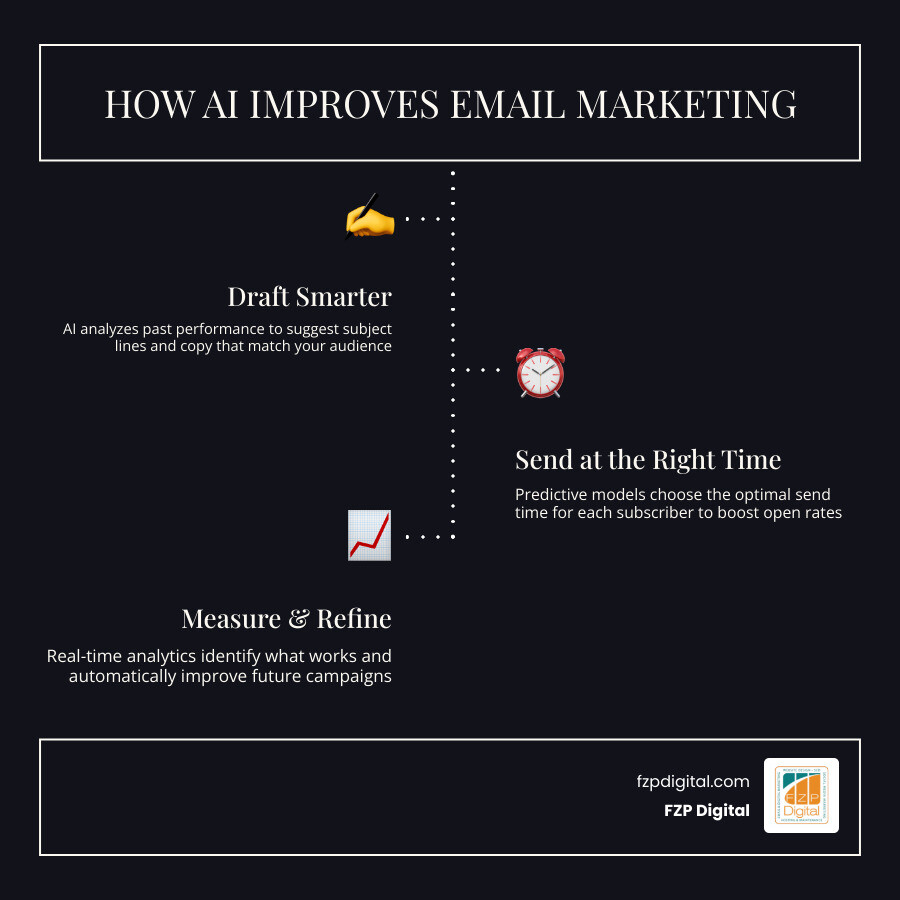
- Subject Line Optimization: AI analyzes what has worked in the past to suggest subject lines that actually get opened.
- Personalized Content: Imagine an email where the product images change based on what the reader recently browsed. That’s 1:1 personalization.
- Send-Time Optimization: No more “Tuesday at 10 AM” for everyone. The AI sends the email to Sarah at 8 AM and to John at 6 PM because that’s when they actually engage.
- Natural Language Segmentation: You can simply type, “Show me customers in Newtown who haven’t bought in six months,” and the AI builds the list for you instantly.

Where humans still matter most
Don’t worry—AI isn’t taking your job! In fact, the human element is more important than ever. You are the keeper of your brand voice. While AI can write a draft, you’re the one who ensures it feels like “you.” You handle the high-level strategy, fact-checking, and final approvals. AI is the engine, but you’re still the driver.
For more on how this tech is changing the game, check out our Category: AI for deeper insights.
The Best AI Email Marketing Tools: What to Look For Before You Choose
Choosing a platform is a big decision, isn’t it? At FZP Digital, we always encourage clients to look past flashy “AI” labels and focus on what will actually help them day to day. A tool can sound impressive on paper, but if it doesn’t fit your workflow, connect with your systems, or support your growth, it’s probably not the right choice.
Must-have AI features that actually improve results
If you’re shopping for ai email marketing tools, here are the core capabilities worth prioritizing:
- Predictive Sending: This helps your message arrive when each subscriber is most likely to engage.
- Dynamic Content Blocks: These automatically swap text, offers, or images based on audience data.
- Churn Risk Scoring: This helps you spot subscribers or customers who may be about to disengage.
- Smart A/B Testing: Instead of manually reviewing every test, the system can identify top-performing versions faster.
- Natural Language Segmentation: Some platforms let you build audience segments using plain-English prompts, which can save a lot of time.
Integrations, compliance, and deliverability checks
Your email platform shouldn’t work in isolation. It should connect smoothly with the tools you already rely on, whether that’s your ecommerce store, payment system, CRM, or analytics setup. If your data is scattered or outdated, the AI won’t have much to work with.
Deliverability matters just as much. Even the most polished email won’t help if it lands in spam. That’s why it’s smart to look for platforms that support SPF, DKIM, and DMARC setup, offer clear sending guidance, and help you maintain strong list hygiene. You should also make sure the platform supports compliance with GDPR and CAN-SPAM requirements. For a broader overview of the technical side, you can read Salesforce’s guide to AI in email marketing.
General AI writers vs dedicated email platforms
This is where a lot of businesses get stuck. A general AI writing tool can be incredibly helpful for brainstorming, refining tone, or getting past a blank page. But a dedicated email platform usually goes much further.
- General AI Writers: Best for drafting copy, rewriting subject lines, and generating content ideas.
- Dedicated Platforms: Better for managing segmentation, timing, automation, personalization, reporting, and lifecycle campaigns all in one place.
So which do you need? Sometimes the answer is both. If you’re still getting comfortable with the basics, our guide on What is ChatGPT? is a helpful place to start.
Best AI Email Marketing Tools by Business Type
Not every tool fits every business – and honestly, that’s a good thing. A neighborhood bakery in Richboro doesn’t need the same setup as a software company or a fast-growing online store. The smartest choice is the one that matches your business model, your team size, and the kind of customer journey you’re trying to improve.
Best for SaaS and product-led growth teams
For software companies and product-led businesses, the most valuable features usually revolve around behavior-based automation. That means sending onboarding emails when a user signs up, nudging trial users when they stall, and reactivating customers when usage drops.
If you’re in SaaS, look for a platform that can track in-app actions, trigger lifecycle emails based on real user behavior, and support multistep journeys without becoming difficult to manage. The goal is simple: help the right user take the right next step at the right time.
Best for ecommerce brands and retention marketing
If you run an online store, your priorities are usually different. You’ll want strong catalog sync, abandoned cart recovery, customer segmentation, product recommendations, and retention workflows that help bring buyers back.
AI can be especially useful here because it can help surface likely repeat buyers, identify high-value customer groups, and personalize product blocks based on browsing or purchase behavior. If you’d like a broader look at how AI is shaping ecommerce-focused email strategy, this research on AI in ecommerce marketing offers helpful context.
Best for small businesses, creators, and lean teams
You don’t need a huge budget or a giant marketing department to benefit from ai email marketing tools. In fact, many small businesses do best with simpler platforms that focus on ease of use, clean templates, light automation, and manageable pricing.
If you’re just getting started, here are a few things to look for:
- Free plans or low-cost starter tiers
- Beginner-friendly editors
- Basic automation for welcomes, follow-ups, and promotions
- AI writing help for faster drafting
- Clear reporting that doesn’t overwhelm you
For many small businesses in Philadelphia and Bucks County, speed and simplicity matter just as much as advanced features. That’s something we see all the time at FZP Digital – the best tool isn’t always the most complex one; it’s the one your team will actually use consistently.

AI Email Marketing Tools Comparison: Features, Pricing, and Fit
Let’s talk about what really matters when you’re comparing options: pricing, ease of use, automation depth, and how well the platform fits your business. In 2026, some tools still price primarily by contact count, while others also factor in email volume, premium automation, or AI usage.
Rather than chasing every shiny feature, it’s smarter to compare platforms based on your actual needs.
| Category | What to Compare | Why It Matters |
|---|---|---|
| Pricing | Free plans, starter tiers, contact limits, monthly send limits | Helps you understand true entry cost and future scalability |
| AI Features | Predictive sending, subject line help, dynamic content, segmentation | Shows whether the AI is actually useful or just marketing language |
| Integrations | Ecommerce platforms, CRMs, payment tools, analytics, Zapier | Better connected data usually means better automation |
| Ease of Use | Editor quality, templates, onboarding, reporting clarity | A simpler platform often gets used more consistently |
| Best Fit | Ecommerce, SaaS, creators, local businesses, service brands | Keeps you focused on what matches your workflow |
Which tools are most affordable to start with?
If you’re building your email list from scratch, it often makes sense to begin with a platform that offers a free plan or an affordable entry tier. That gives you room to test your strategy before committing to a more advanced setup.
When comparing affordability, don’t just look at the monthly price. Ask yourself:
- How many contacts are included?
- Are automations limited on the starter plan?
- Do AI features require a higher tier?
- Will pricing jump quickly as your list grows?
Those details can make a big difference over time.
Which tools are strongest for advanced automation?
If your business depends on multistep customer journeys, lead qualification, or lifecycle campaigns tied to behavior, you’ll want a platform with stronger automation depth. Look for conditional logic, event tracking, CRM syncing, and flexible workflow builders.
This is especially important for businesses with longer sales cycles or multiple customer touchpoints. Advanced automation can save your team hours – but only if it’s set up strategically. That’s one reason many businesses turn to experienced partners like FZP Digital to help connect the technical side with real-world business goals.
Which tools are easiest for teams that need speed and simplicity?
Maybe you don’t need enterprise-level complexity. Maybe you just want to create better emails faster. If that sounds like you, focus on platforms with intuitive editors, strong templates, easy segmentation, and AI features that work in plain English.
A good lightweight solution should help you:
- Generate email drafts quickly
- Build campaigns without a steep learning curve
- Launch automations fast
- Understand reporting without digging through endless dashboards
For many small and mid-sized businesses, that’s the sweet spot. And if you’d like more guidance on choosing a simpler platform, our 2025 review of email marketing for small business is a great next read.
How AI Improves Opens, Clicks, and Conversions
At the end of the day, this is the question you probably care about most: does AI actually help your emails perform better? In many cases, yes – but only when it’s used thoughtfully.
AI isn’t magic. It won’t fix a weak offer or a confusing message. What it can do is help you make smarter decisions faster, personalize at scale, and reduce a lot of the manual guesswork that slows teams down.
The optimization tactics that move the needle
Here are some of the biggest ways ai email marketing tools can improve results:
- Subject Line Testing: AI can suggest stronger phrasing and identify patterns that tend to improve open rates.
- Send-Time Optimization: Instead of blasting everyone at once, the system can send based on likely engagement windows.
- Personalized Content: Different readers can see different products, messages, or calls to action based on behavior.
- Frequency Control: AI can help reduce over-emailing by identifying when subscribers are becoming less responsive.
- Resend Logic: Some tools can automatically resend to non-openers with a revised subject line or timing.
Real-world benefits and possible downsides
The benefits are easy to see. You save time, move faster, and make your campaigns more relevant. For busy teams, that’s a huge win.
But there are also risks if you rely on automation too heavily. AI-generated copy can sound flat, miss nuance, or occasionally make factual mistakes. Over-automation can also create list fatigue if subscribers start receiving too many emails that feel generic or repetitive.
That’s why human review still matters so much. Your team – or a strategic partner like FZP Digital – brings the judgment, brand understanding, and quality control that AI simply can’t replace.
Future trends shaping AI email marketing
We’re moving toward a future where email tools do more than assist with writing. They’ll help plan campaigns, identify trends, recommend next steps, and support more personalized customer journeys across channels.
A few trends to watch include:
- Agentic marketing workflows
- More advanced 1:1 personalization
- AI-assisted design and layout generation
- Better multilingual campaign support
- Smarter analytics that explain performance in plain language
Of course, all of this still depends on one thing: clean, reliable data. Without that foundation, even the smartest platform won’t perform at its best. If you want to keep exploring where things are heading, you can read more in these AI-based marketing insights.
Frequently Asked Questions About ai email marketing tools
Can you use AI for email marketing without losing your brand voice?
Yes, absolutely. Most modern ai email marketing tools let you guide tone, style, and messaging so the output feels consistent with your brand. That said, AI works best when you give it direction and still review what it produces. A strong draft plus human editing is usually the sweet spot.
Are there free ai email marketing tools for small businesses?
Yes. Many email platforms offer free plans or low-cost starter tiers that are useful for small lists and basic automations. Just keep in mind that the more advanced AI features are often limited until you upgrade. If you’re not sure when it’s worth paying more, that’s exactly the kind of practical decision FZP Digital helps clients think through.
How reliable are AI-generated emails, really?
They can be very helpful for structure, brainstorming, and speeding up production, but they still need a human review before sending. You should always double-check dates, pricing, claims, links, and compliance language. For a broader look at how to use these tools wisely, read How Can You Use AI in Your Business?
Conclusion: Choose the Right Tool, Then Let Strategy Do the Heavy Lifting
Choosing from the many ai email marketing tools is just the beginning. The real magic happens when you combine these powerful features with a solid business strategy. Whether you’re looking to build an email list or optimize a complex B2B funnel, the right tool will act as a force multiplier for your efforts.
At FZP Digital, we specialize in helping businesses in Philadelphia, Newtown, and across Bucks County navigate these technical challenges. From WordPress design to advanced SEO, we’re here to ensure your digital presence is as smart as it is beautiful.
Ready to take your marketing to the next level? Let’s chat about how we can help you implement the right AI strategy for your unique goals. Contact us today at fzpdigital.com!