


How to Use Schema Markup to Win at SEO
What Is Schema Markup for SEO (And Why Should You Care)?

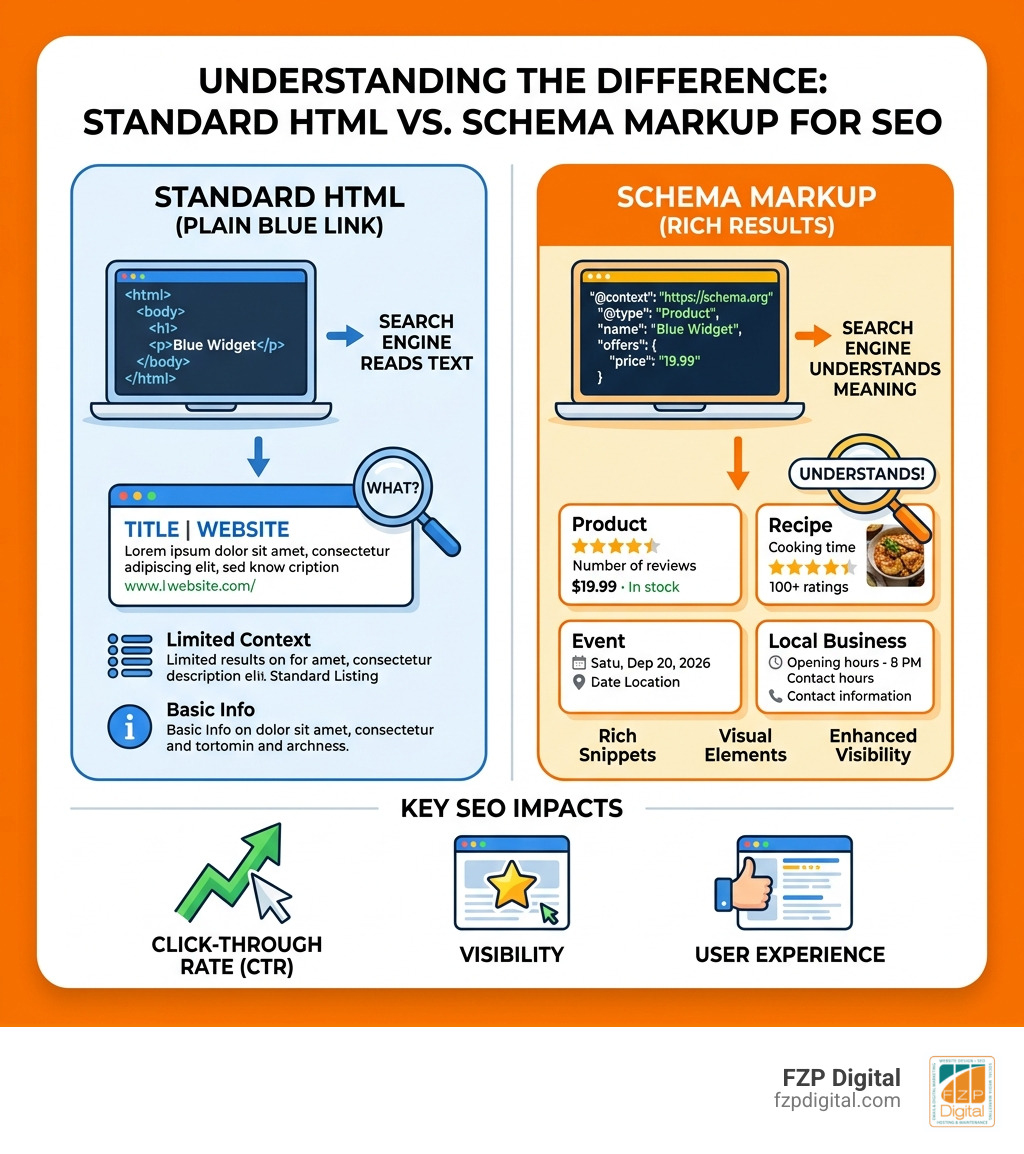
Schema markup for SEO is structured code you add to your website’s HTML to help search engines understand exactly what your content means — not just what it says.
Here’s a quick breakdown of what that looks like in practice:
| What Schema Markup Does | Without Schema | With Schema |
|---|---|---|
| Describes your content | Search engine guesses | Search engine knows |
| Search result appearance | Plain blue link | Rich result with stars, prices, dates |
| Click-through rate | Baseline | Up to 82% higher (Nestlé/Google) |
| AI search visibility | Limited | Stronger citation potential |
| Local business info | Scattered | Consolidated in Knowledge Panel |
Think of it this way: your HTML tells a browser how to display your page. Schema markup tells search engines what your page actually means.
That difference is huge.
Without it, Google is making educated guesses about your content. With it, you’re handing Google a clear, machine-readable roadmap — and that can translate directly into more clicks, more visibility, and more business.
Only about one-third of websites currently use schema markup. That means implementing it correctly is still a genuine competitive advantage for small and medium-sized businesses.
I’m Fred Z. Poritsky, founder of FZP Digital, and after years of helping Philadelphia-area businesses build stronger digital presences through web design and SEO — including hands-on work with schema markup for SEO — I’ve seen how this one technical step can separate businesses that get found from those that get overlooked. Let’s walk through exactly how to use it.
Schema markup for seo terms simplified:
Why Schema Markup for SEO is Your Secret Weapon in 2026
If you’ve ever searched for a new restaurant in Philadelphia or a plumber in Bucks County and seen those fancy star ratings, price ranges, or event dates right in the search results, you’ve seen schema markup for seo in action. These are called “Rich Results,” and they are absolute click magnets.
In 2026, the digital landscape has shifted. It’s no longer just about ranking #1; it’s about owning the “real estate” on the screen. When your listing includes helpful details like “In Stock,” “4.8 Stars,” or “Next Event: May 12th,” you aren’t just a blue link anymore—you’re a destination.
The Power of Rich Results and CTR
The data is hard to ignore. According to industry research, pages enhanced with structured data can see a 25% to 82% higher click-through rate (CTR) compared to plain listings. For example, Nestlé found that their rich result pages performed 82% better than their standard ones. When you Improve Search Ranking, you want those rankings to actually turn into visits. Schema is how you make that happen.
Feeding the AI Engines
Beyond traditional search, schema markup for seo has become the primary language for AI. Whether it’s Google’s AI Overviews, ChatGPT’s search features, or Perplexity, these systems rely on structured data to “ground” their answers in fact. By using schema, you’re essentially giving these AI tools a high-quality transcript of your business details, making it much more likely they will cite you as a trusted source.
Dominating the Knowledge Graph
Have you noticed the big info boxes on the right side of a Google search? That’s the Knowledge Graph. By using Organization and LocalBusiness schema, we help Google connect the dots between your website, your social media profiles, and your physical location in Newtown or Richboro. This builds massive brand authority before a user even clicks your site.
| Benefit | Impact on Your Business |
|---|---|
| Higher CTR | More Organic Traffic Growth without paying for ads. |
| AI Readiness | Better chance of being cited in AI-generated answers. |
| Brand Trust | Visual cues like star ratings build immediate credibility. |
| Reduced Bounce Rate | Users know what’s on the page before they click, leading to better leads. |
The Most Important Types of Structured Data to Prioritize
With over 790 types of schema available at Getting Started – schema.org, it’s easy to feel overwhelmed. But you don’t need all of them. For most businesses in our area, focusing on a core group of 5-10 types will yield 90% of the results.
Here is our “Essential List” for 2026:
- Organization: Tells search engines who you are, your logo, and your social links.
- LocalBusiness: Crucial for anyone with a physical footprint in Philly or Bucks County.
- Product: Displays price, availability, and reviews for e-commerce.
- Article/BlogPosting: Helps your news and guides stand out.
- FAQ: Adds expandable questions directly to your search listing.
- BreadcrumbList: Shows the path to the page, improving site navigation in SERPs.
Boosting Local Visibility with Schema Markup for SEO
If you’re running a business in Philadelphia, Downtown Philadelphia, or Newtown, Local SEO Bucks County is your bread and butter. The LocalBusiness schema (or more specific types like Dentist, Attorney, or RealEstateAgent) is a game-changer.
It allows you to explicitly state your NAP (Name, Address, Phone number) data. Consistency is king here. When your website’s schema matches your Google Business Profile, search engines feel confident showing you in the “Local Pack” or on Google Maps. We always recommend our clients check out our Local SEO Philadelphia Complete Guide to see how schema fits into a broader local strategy.
Enhancing Content with Article and Product Schema Markup for SEO
For our friends who are content creators or shop owners, Article and Product schemas are non-negotiable.
- Article Schema: Using
NewsArticleorBlogPostinghelps Google understand the headline, author, and date published. This is especially important for E-A-T (Expertise, Authoritativeness, Trustworthiness). To learn more, check out Learn About Article Schema Markup | Google Search Central. - Product Schema: This allows you to show off your hard work. Imagine a user searching for a product and seeing your price and “In Stock” status right there. It cuts through the noise and drives high-intent buyers to your site. This is a key part of Search Engine Optimization (SEO) Powered by AI.
How to Implement and Validate Your Code Step-by-Step
Don’t let the word “code” scare you! While schema markup for seo sounds technical, it’s actually quite manageable, especially with the tools available today.
Step 1: Choose Your Format (Hint: It’s JSON-LD)
In the past, people used “Microdata” (tagging individual bits of text in your HTML). Today, Google explicitly recommends JSON-LD. It’s a clean block of code that sits in the “head” of your webpage, separate from your visible content. It’s easier to read, easier to change, and much less likely to break your site’s design.
Step 2: Generate the Code
You don’t have to write this from scratch. You can use Google’s Structured Data Markup Helper. You simply paste your URL, highlight the name, address, or price on the page, and the tool spits out the code for you. If you’re on WordPress, plugins like Yoast SEO or Rank Math do a lot of this heavy lifting automatically for your basic pages.
Step 3: Add it to Your Site
Once you have your JSON-LD script, you need to place it on the relevant page. For a local business, this might go on your “Contact” or “About” page. For a blog post, it goes on that specific post. If you’re not comfortable touching code, this is where a Technical SEO Audit from a partner like FZP Digital can save you a lot of headaches.
How to Audit Your Schema Markup for SEO Performance
Implementation is only half the battle; you have to make sure it actually works! Google is very picky about syntax. One missing comma can invalidate the whole block.
- Rich Results Test: This is your best friend. Paste your URL into Google’s official tool, and it will tell you exactly which schema types it found and if there are any errors.
- Schema Markup Validator: Use this for a deeper dive into the “semantic” correctness of your code—ensuring you’re following the official schema.org rules.
- Google Search Console: Check the “Enhancements” tab regularly. Google will send you alerts if it detects that your schema has become “invalid” (for example, if a price is missing from a product page).
Regularly performing a Website Audit and SEO Analysis ensures that as you update your site, your schema stays healthy and keeps performing.
Frequently Asked Questions about Schema
We get a lot of questions about the “magic” of schema. Here are the answers to the big ones we hear at our Philadelphia and Newtown offices.
Is schema markup a direct ranking factor?
Technically, no. Google has stated that structured data is not a “direct” signal that moves you from page 2 to page 1. However, it is an indirect powerhouse. By earning rich results, you increase your CTR. When more people click your site and stay there, Google sees that your page is relevant and high-quality, which does lead to better rankings. Think of it as the ultimate assist in your quest to Improve Search Ranking.
Which format is best: JSON-LD, Microdata, or RDFa?
As we mentioned earlier, JSON-LD is the undisputed champion. It’s what Google prefers, it’s what AI systems find easiest to parse, and it keeps your website code clean. Unless you have a very specific legacy reason to use Microdata, stick with JSON-LD. You can find more technical details on the Getting Started – schema.org page.
Does schema help with AI-driven search results?
Absolutely. In 2026, we call this “AEO” (Answer Engine Optimization). AI models like ChatGPT and Google’s Gemini don’t just “read” your site; they “digest” it. Schema markup for seo provides the context these models need to understand that “FZP Digital” isn’t just a string of letters—it’s a Service provided by an Organization located in Philadelphia. This context grounding is vital for being cited in AI-generated summaries. For a deeper look, check out our piece on Search Engine Optimization (SEO) Powered by AI.
Conclusion
At the end of the day, schema markup for seo is about communication. It’s about making sure that when a search engine—or an AI—looks at your website, there is zero confusion about who you are, what you sell, and why you’re the best choice for the job.
Whether you’re a boutique shop in Newtown or a large firm in Downtown Philadelphia, implementing structured data is one of the most cost-effective ways to boost your digital presence. But we know it can be a bit daunting to dive into script blocks and JSON-LD syntax on your own.
That’s where we come in. At FZP Digital, we live for these technical challenges. Our founder, Fred Z. Poritsky, leads our team with a collaborative “Develop . Design . Deliver” process. We don’t just “fix” your SEO; we partner with you to understand your business goals and build a website that reflects your excellence.
If you’re ready to stop guessing and start winning at SEO, we’re here to help. From premium WordPress design to advanced technical audits, we’ve got the tools to help you dominate the local search results. Why not reach out to the experts at one of our Graphic Design Companies in Philadelphia partners today? Let’s make sure your business doesn’t just get seen—it gets chosen.