

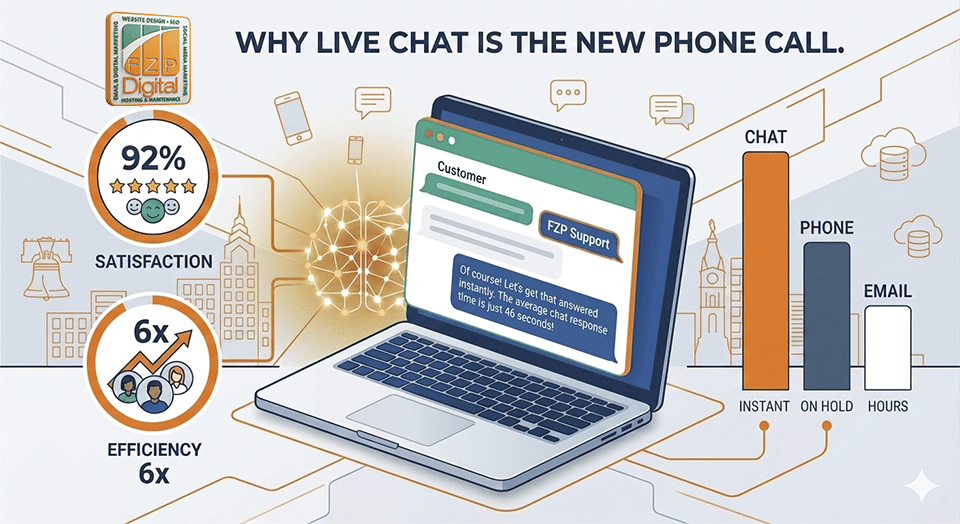
Why Live Customer Service Chat is the New Phone Call
Why Live Chat Customer Service Is Replacing the Phone Call
Live chat customer service is a real-time, text-based support channel that lets your customers get instant answers directly on your website — no hold music, no email threads, no waiting.
Here’s a quick snapshot of what it is and why it matters:
| What It Is | Why It Matters |
|---|---|
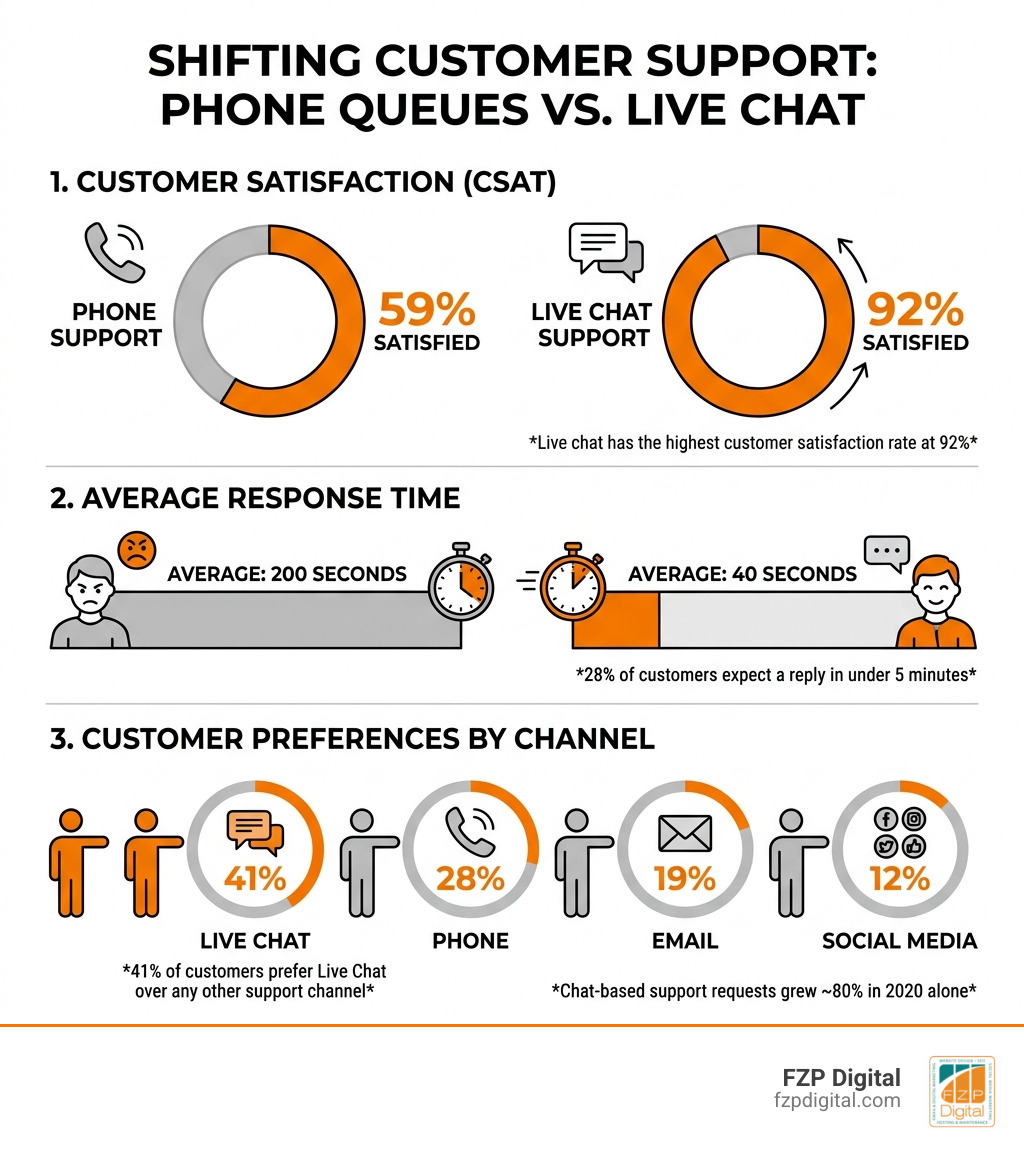
| Instant, 1:1 messaging on your website | 28% of customers expect a reply in under 5 minutes |
| Session-based (starts and ends with the conversation) | Live chat has the highest customer satisfaction rate at 92% |
| Can be human-led, AI-powered, or both | Chat-based support requests grew ~80% in 2020 alone |
| Works alongside email, phone, and social media | 79% of companies saw increased sales after implementing it |
| Available 24/7 with chatbot support | 41% of customers prefer it over any other support channel |
Think about the last time you had to call a company’s customer service line. You waited on hold. You got transferred. You repeated yourself three times. You hung up frustrated.
Now think about the last time a little chat bubble appeared on a website just as you were about to leave — and someone (or something) answered your question in 30 seconds flat.
That’s the difference live chat makes.
For small and medium-sized businesses, this isn’t just a nice-to-have anymore. It’s quickly becoming the baseline expectation. According to Gartner research, 89% of companies expect to compete primarily on the basis of customer experience — and your chat window is often the first place that experience either wins or loses a customer.
I’m Fred Z. Poritsky, founder of FZP Digital, and while my background spans nonprofit financial management, accounting, and digital marketing, I’ve worked hands-on with businesses across Philadelphia helping them build websites and digital strategies — including implementing live chat customer service tools that actually convert visitors into clients. Let’s walk through everything you need to know to make it work for your business.
Live chat customer service vocab to learn:
What is Live Chat Customer Service and Why Does it Matter?
At its core, live chat customer service is about meeting your customers exactly where they are: on your website. Unlike email, which can feel like shouting into a void, or phone calls, which require undivided attention and often long wait times, live chat is a session-based, 1:1 interaction. It allows for real-time problem solving while the customer is still actively browsing your products or services.
One of the biggest reasons it has become so vital is the sheer efficiency it offers. Have you ever tried to handle six phone calls at once? It’s impossible. But with live chat, an experienced agent can comfortably manage four to six conversations simultaneously. This multitasking capability is a game-changer for small teams in Bucks County or Philadelphia looking to scale their support without exponentially increasing their headcount.

The demand for this channel is skyrocketing. In 2020 alone, chat-based support requests increased by about 80%. Why? Because we live in an era of instant gratification. If you’re curious about how to get started without breaking the bank, check out our guide on how to get premium features with a free web chat tool.
The Business Benefits of Live Chat Customer Service
If you’re looking at your bottom line, live chat customer service is one of the best investments you can make. It’s not just about “support”; it’s a powerful sales tool. When a customer has a question during the checkout process and gets an immediate answer, they are far more likely to complete the purchase.
In fact, businesses have reported a 30% increase in customer conversion rates after implementing a chat solution. It also helps with “upselling.” By guiding a customer through their options in real-time, companies have seen a 25% increase in average order value. Tools like HubSpot’s free live chat allow you to engage visitors the moment they land on your page, helping you qualify leads before they ever reach your inbox.
How Live Chat Customer Service Improves the Customer Experience
We often tell our clients at FZP Digital that “customer wow” starts with a simple conversation. When you provide instant answers, you aren’t just solving a problem; you’re building brand loyalty.
Statistics show that 28% of people expect a reply on chat in under five minutes. When you meet that expectation, satisfaction scores soar. A Zendesk study found that live chat boasts a 92% satisfaction rate, significantly higher than voice support (88%) or email (85%).
| Channel | Average Response Time | Customer Satisfaction |
|---|---|---|
| Live Chat | 46 Seconds | 92% |
| Phone | 2-5 Minutes (on hold) | 88% |
| 12-24 Hours | 85% |
Boosting Sales and Satisfaction with Real-Time Support
The proactive nature of live chat customer service is what truly sets it apart. Instead of waiting for a customer to get frustrated and leave, you can set up proactive greetings. Imagine a visitor has been lingering on your pricing page for three minutes. A small bubble pops up: “Hi there! Do you have any questions about our Philadelphia web design packages?”
This type of personalized attention reduces cart abandonment and makes the user feel like a priority. If you’re interested in taking this a step further, you can learn how to turn your chatbot into a lead generating machine to capture data even when you’re offline.
Turning Conversations into Conversions
Every chat is an opportunity to learn about your customer’s buying journey. By providing tailored product recommendations right in the chat window, you’re essentially acting as a digital personal shopper. This moves people through your sales funnel much faster than traditional methods. Whether you’re a retail shop in Newtown or a professional service provider in Richboro, those real-time revenue streams are waiting to be tapped.
Nurturing Long-Term Customer Relationships
Great live chat customer service isn’t just a one-and-done interaction. Modern platforms allow for “asynchronous communication.” This means a customer can start a chat on their desktop at work and finish it on their phone while riding the SEPTA later that day.
By integrating your chat with a CRM, your agents can see a customer’s entire history—what they’ve bought, what they’ve complained about, and what they’ve browsed. Platforms like Freshchat provide this unified workspace, ensuring your team always has the context they need to deliver a personalized experience.
Best Practices for Implementing Your Chat Strategy
Setting up a chat widget is easy, but doing it well requires a bit of strategy. First, you need to ensure the widget matches your brand’s look and feel. It should be visible but not intrusive—think of it as a helpful shop assistant, not a pushy salesperson.
To keep things moving quickly, we recommend using “canned responses” or message templates for frequently asked questions. Another pro tip is using “message sneak-peek,” which lets your agents see what the customer is typing before they even hit send. This gives your team a few extra seconds to find the right answer. For a step-by-step walkthrough, see our 5-minute guide to setting up your WordPress live chat widget.
Leveraging AI and Automation
You don’t need a massive team to provide 24/7 coverage. AI chatbots can now handle up to 80% of basic support tasks, like tracking an order or resetting a password. This frees up your human agents to handle the complex, emotional cases that require a “sympathetic ear.” Think of AI as your “Copilot”—it handles the repetitive busy work so you can focus on the high-value interactions.
Essential Features to Look For
When choosing a live chat customer service software, don’t just look at the price tag. You want a tool that offers:
- Omnichannel Support: Bring in messages from WhatsApp, Facebook, and Email into one place.
- File Sharing: Let customers send screenshots of their issues.
- Mobile Accessibility: Your agents should be able to answer chats from their phones.
- Security: Ensure the platform is compliant with GDPR and PCI DSS, especially if you’re handling sensitive data in the healthcare or legal sectors.
Managing Staffing, Costs, and Common Challenges
One question we often get at FZP Digital is: “How many people do I need to staff this?”
For a new agent, handling one or two chats at once is a good start. Experienced pros can handle up to six. To manage costs, you can use “staffing prediction” tools built into many chat platforms that analyze your peak hours and tell you exactly when you need more hands on deck.
In-House vs. Outsourcing
Should you keep your chat in-house or outsource it? Here’s a quick breakdown:
In-House Support
- Pros: Deep product knowledge, better brand voice control, direct feedback loop.
- Cons: Higher overhead, difficult to provide 24/7 coverage, requires management time.
Outsourced Support
- Pros: Lower cost, instant 24/7 coverage, easy to scale up or down.
- Cons: Less control over “vibe,” potential for generic responses, requires rigorous training protocols.
Measuring Success with Key Metrics
To know if your live chat customer service is actually working, you need to track the right data. Don’t just look at the number of chats. Look at:
- First Response Time: Aim for 10–15 seconds.
- Resolution Rate: How many issues were solved without needing to “call back”?
- CSAT (Customer Satisfaction Score): What do people say right after the chat ends?
- ROI Tracking: Are people who chat actually buying more?
Frequently Asked Questions about Live Chat
How does live chat differ from messaging apps like WhatsApp?
Live chat is typically session-based and happens on your website. Once the window is closed, the session usually ends. Messaging apps like WhatsApp are “persistent,” meaning the conversation history stays there forever, and the customer can message you back days later in the same thread.
Can live chat really help my small business increase sales?
Absolutely. By answering questions at the “moment of truth”—when a customer is looking at your product—you remove the friction that causes people to bounce. Many of our local Philadelphia clients have seen an immediate uptick in leads just by adding a simple chat bubble.
Is it difficult to set up a chat widget on my existing website?
Not at all! If you’re using WordPress, it usually involves installing a plugin and pasting a small piece of code. Most platforms offer a “launch in seconds” experience. If you get stuck, that’s exactly where an expert partner like FZP Digital comes in.
Conclusion
At the end of the day, live chat customer service is about creating that “customer wow” moment. When everyone is busy, providing a fast, helpful, and human connection can be your biggest competitive advantage.
Whether you’re in Downtown Philadelphia, Newtown, or Richboro, your digital presence is the front door to your business. At FZP Digital, we specialize in a collaborative “Develop. Design. Deliver.” process to ensure your website isn’t just a digital brochure, but a high-performing sales and support engine.
Complex topics like SEO and integrated chat strategies can feel overwhelming, but you don’t have to navigate them alone. We’re here to help you achieve real results and turn your website visitors into lifelong fans.
Ready to upgrade your customer experience? Contact FZP Digital to boost your digital strategy and let’s start a conversation that grows your business.