

Beyond the Logo: What Is Brand Identity Anyway

What Is Brand Identity? (The Quick Answer)
What is brand identity is one of the most Googled marketing questions — and for good reason. It’s the foundation of every successful business, yet it’s often misunderstood as just a logo or a color scheme.
Here’s the short answer:
Brand identity is the complete set of visual, verbal, and emotional elements a company uses to express who it is, what it stands for, and how it wants to be perceived — including its logo, colors, typography, tone of voice, values, and personality.
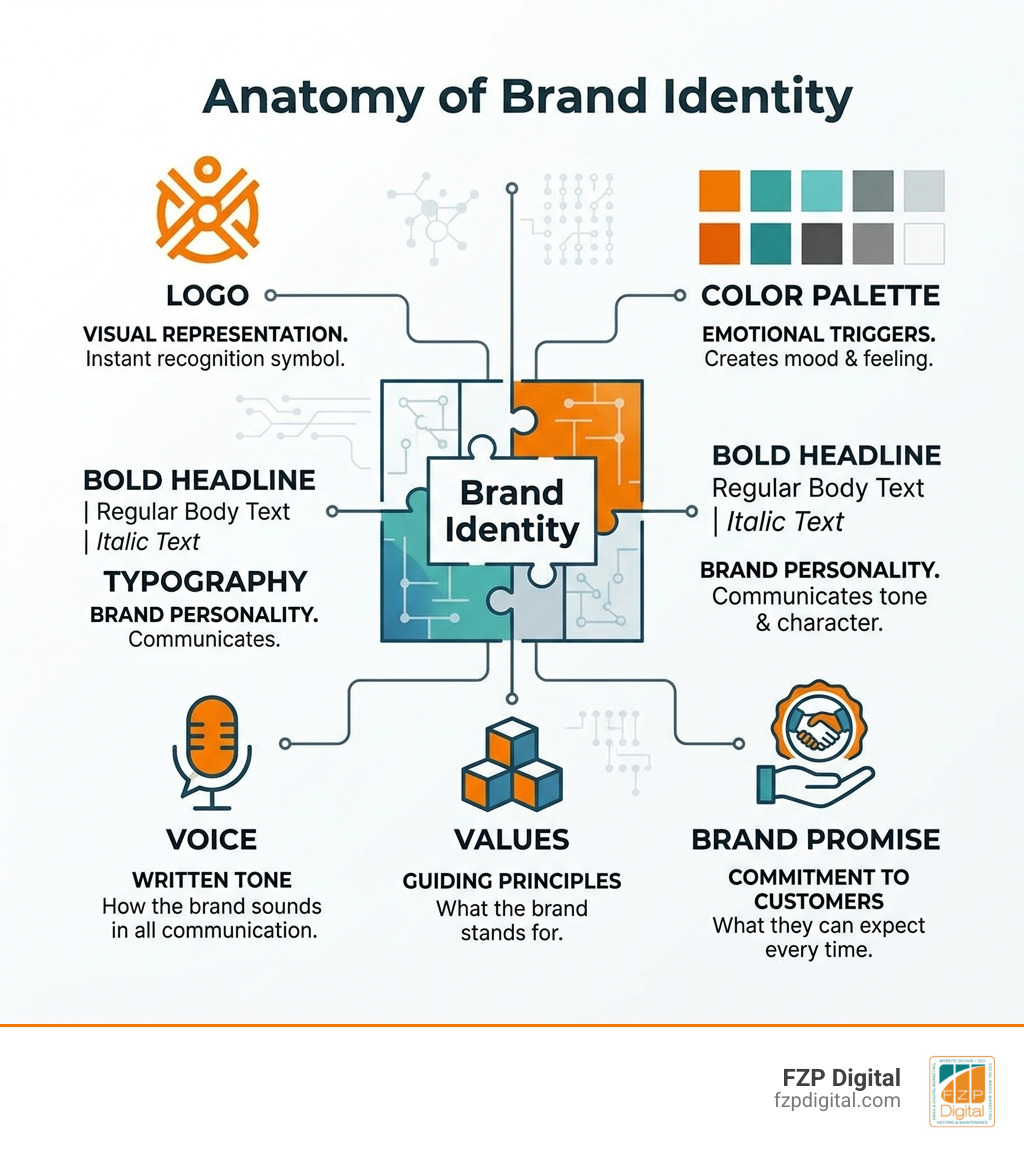
The key elements of brand identity include:
- Logo — the visual symbol that represents your brand at a glance
- Color palette — the specific colors used consistently to trigger emotion and recognition
- Typography — the fonts that communicate your brand’s personality
- Brand voice and tone — how you sound in writing and conversation
- Core values — the principles that guide every business decision
- Brand promise — the commitment you make to every customer
- Brand name — your primary verbal identifier and the anchor of customer memory
- Tagline or slogan — a short phrase that captures your brand’s essence
Think of it this way: if your business were a person, brand identity would be everything that makes them them — their appearance, their personality, the way they speak, and what they believe in.
And here’s something worth pausing on. A whopping 94% of first impressions are design-related. That means before a potential customer reads a single word about your business, they’ve already formed an opinion. Your brand identity is doing the talking before you ever open your mouth.
Consistent branding isn’t just about looking polished, either — it can increase revenue by 10 to 20 percent. That’s real money on the table, just from showing up the same way every time.
I’m Fred Z. Poritsky, founder of FZP Digital, and my background spans nonprofit financial management, web design, and digital marketing — giving me a unique left-brain-meets-right-brain perspective on what is brand identity and how it connects to real business growth. In this guide, I’ll walk you through everything you need to know to build a brand that actually works for your Philadelphia-area business.
Easy what is brand identity glossary:
What is Brand Identity and Why Does It Matter?
When we talk about what is brand identity, we’re talking about the “spirit” of your company. It’s the intentional path you carve out to make sure people see you exactly how you want to be seen. In our branding complete guide, we often explain that while you can’t control every thought a customer has, you can control the tools you use to influence those thoughts.
So, why should you care? Beyond just looking “cool,” a strong identity is a massive engine for revenue growth. Think about it: when you walk into a store in Newtown or browse a local Philadelphia service site, you’re looking for a reason to trust that business. A cohesive identity signals professionalism and stability. It tells the customer, “We’ve put thought into who we are, so you can trust we’ll put thought into how we serve you.”
It’s also your greatest tool for differentiation. In a crowded market, your identity acts like “tinted glasses” for your customers, coloring how they value your products. If everyone is selling the same thing, your personality becomes the deciding factor. Are you the high-energy, “disruptive” tech startup, or the reliable, “warm” family-owned shop in Richboro? Your identity makes that clear instantly.

The Core Elements: What Makes Up Your Brand?
Understanding what is visual identity and branding in design requires looking under the hood at the specific “parts” that make the machine run.
Logo Design and Brand Marks
Your logo is like a country’s flag. It doesn’t tell the whole story, but it represents the entire ethos. It needs to be scalable (looking just as good on a tiny favicon as it does on a billboard on I-95) and timeless. A great logo often hides subtle meanings—like the famous arrow in the FedEx logo or the “31” hidden in Baskin Robbins—to reinforce a brand’s promise without saying a word.
Color Palette and Typography
Colors aren’t just for decoration; they are psychological triggers. Blue often evokes trust and stability (think big banks), while red can trigger excitement or appetite. Similarly, your typography—the fonts you choose—speaks volumes. A sleek, sans-serif font feels modern and “techy,” while a classic serif font feels authoritative and established.
Brand Voice and Core Values
How do you talk to your customers? Is your tone formal and expert-led, or is it conversational and full of humor? This “voice” should be rooted in your core values. These aren’t just words on a wall; they are the principles that guide your decisions. If one of your values is “sustainability,” your brand identity should reflect that through eco-friendly imagery or a grounded, natural tone.
The Brand Promise and Sensory Identity
Your brand promise is the “holy grail” of your identity. It’s the specific benefit you commit to delivering every single time. To take it even further, some brands use sensory identity. While most common in retail (think of the specific smell of a high-end hotel or the “jingle” of an Intel processor), even digital brands can use specific sounds or “tactile” website interactions to create a multi-sensory bond.
Brand Identity vs. Brand Image: Clearing the Confusion
This is where many business owners get tripped up. According to Investopedia, there is a distinct line between what you send out and what the public takes in.
| Feature | Brand Identity (Internal) | Brand Image (External) |
|---|---|---|
| Source | Created by the business | Perceived by the audience |
| Control | High (you choose the logo/voice) | Low (it’s based on customer experience) |
| Components | Visuals, values, mission, tone | Feelings, associations, memories |
| Goal | To guide perception | To reflect reality |
Think of it like this: Brand Identity is the suit you put on for a job interview in Downtown Philly. You chose the tie, you polished the shoes, and you rehearsed your answers. Brand Image is what the interviewer thinks of you after you leave the room. If your identity says “I am professional” but your image (based on your behavior) says “I am late and disorganized,” you have a “brand gap.” Successful businesses use feedback loops to make sure their identity and image stay in sync.
How to Build a Strong Brand Identity for Your Business
Building an identity isn’t a weekend project; it’s a strategic process. It requires a mix of deep research and creative “aha!” moments.
A Step-by-Step Guide to Creating Your Brand Identity
If you’re wondering how to develop a unique brand identity, we recommend a structured 9-step approach:
- Market Research: Look at your competitors in Bucks County and Philadelphia. What are they doing? Where is the “white space” they’re missing?
- Audience Personas: Who are you talking to? A busy parent in Newtown has different needs than a young professional in Center City.
- Mission Statement: Why do you exist (besides making money)?
- SWOT Analysis: Be honest about your Strengths, Weaknesses, Opportunities, and Threats.
- Value Proposition: What is the one thing you do better than anyone else?
Designing Your Visual Assets
Once the strategy is set, it’s time for brand identity design. This is where you turn abstract values into concrete visuals. You’ll want to focus on logo scalability—ensuring your mark works on everything from a business card to a truck wrap. You’ll also develop an iconography style and an imagery style (e.g., do you use bright, airy photos or moody, high-contrast ones?). This ensures that even if someone doesn’t see your logo, they “feel” your brand just by looking at a photo on your Instagram.
Keeping the Spark Alive: Consistency and Evolution
A great brand identity is like a garden; if you don’t tend to it, it gets messy.
Staying Consistent with Your Identity
Consistency is the “golden rule.” In our look at brand identity design services, we emphasize that even a slight deviation in color or font can erode trust. This is why we create brand style guides. These are the “rulebooks” for your brand, covering everything from how much space to leave around the logo to the specific words your customer service team should use.
Training your employees is just as vital. They are your brand ambassadors. If your identity is “friendly and local,” but your staff is cold and distant, the identity fails. We also help clients understand brand identity design service costs, showing that an upfront investment in a solid guide saves thousands in “re-do” costs and lost revenue later.
When to Evolve Your Identity
While consistency is key, you shouldn’t be a statue. Markets change. On average, companies undergo a refresh every 7 to 10 years. This doesn’t always mean a full rebrand; often, it’s about incremental updates—tweaking a font to look more modern or updating your imagery to reflect current trends like sustainability or AI personalization. Understanding the brand identity designer’s impact means knowing when to stay the course and when to pivot to stay relevant to the next generation of customers.
Frequently Asked Questions about Brand Identity
How does brand identity differ from a logo?
A logo is a component of your identity—it’s the visual shortcut. Your brand identity is the entire ecosystem, including your voice, your values, your customer service style, and the “vibe” of your physical or digital space. A logo is like your face; your identity is your whole personality.
Why is consistency so important for revenue?
Consistency creates brand equity. When a customer sees the same colors and hears the same “voice” across your website, social media, and storefront, it triggers a “recognition response” in the brain. This familiarity breeds trust, and trust is what allows you to charge premium prices. In fact, consistent branding can boost revenue by up to 20%!
How often should a brand evolve its identity?
Most brands should do a “health check” annually to see if their messaging still resonates. However, a major visual or strategic evolution usually happens every 7 to 10 years. If you notice your engagement dropping or your competitors looking significantly more modern, it might be time for a refresh.
Conclusion
At the end of the day, what is brand identity? It’s your promise kept. It’s the way you show up for your customers in Philadelphia, Richboro, and beyond, ensuring that every interaction leaves them with a clear, positive impression of who you are.
At FZP Digital, we don’t just “make things look pretty.” We use a collaborative “Develop . Design . Deliver” process to ensure your brand identity is rooted in strategy and built for growth. Whether you’re a startup in Newtown needing a best logo design or an established firm in Downtown Philly looking for a full branding design, we’re here to help you navigate the complexities of the digital landscape.
Ready to build a brand that stands the test of time? Let’s chat. We’d love to help you tell your story.