

What Kind of Nonprofit Are You Anyway?
What Counts as a Nonprofit? Your Quick Guide to Examples and Types

Examples of nonprofit organizations are everywhere — from the hospital that treated you last year to the little league your kid plays in on Saturdays.
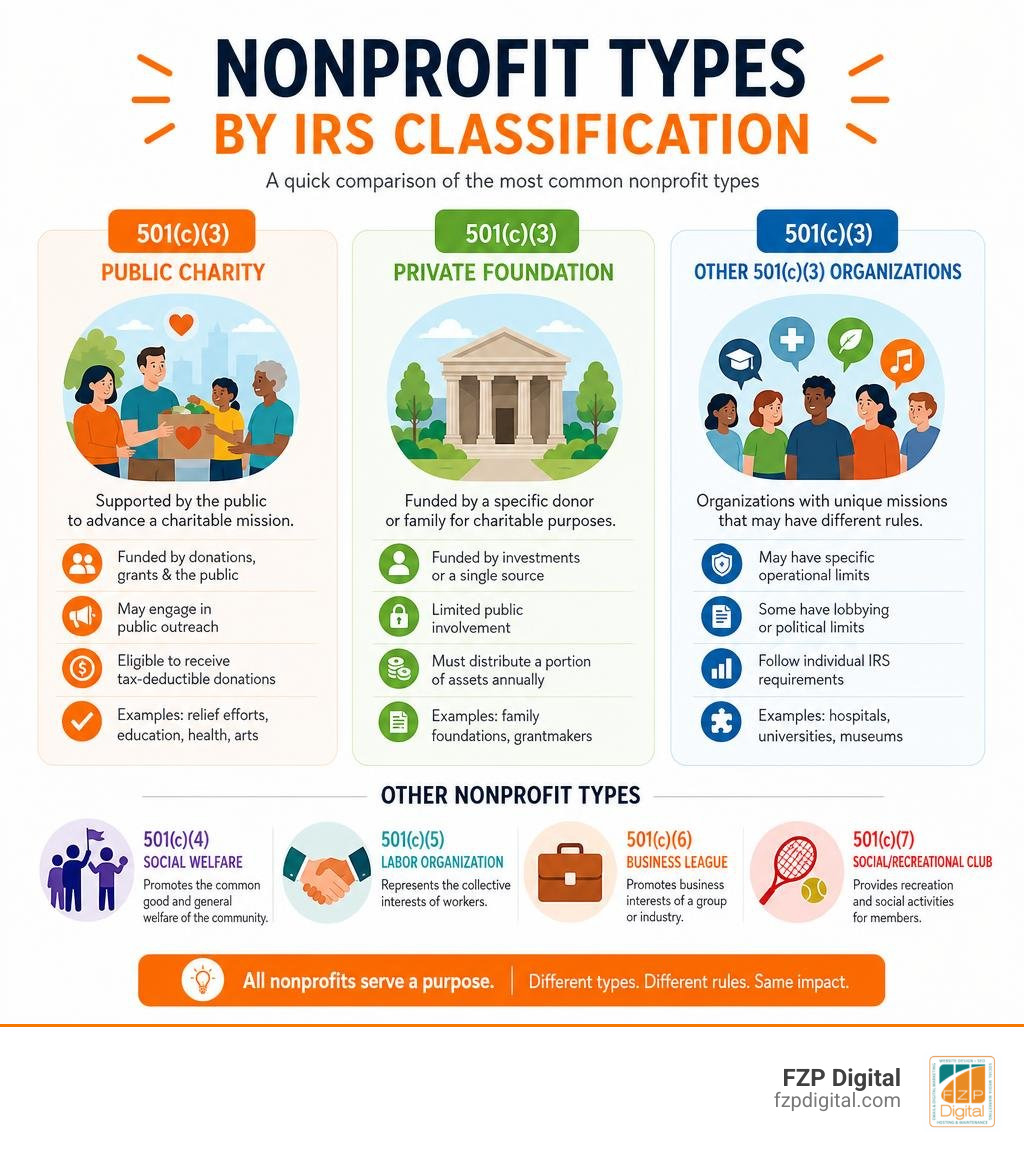
Here’s a quick snapshot of the most common types, so you can orient yourself right away:
| Nonprofit Type | IRS Classification | Real-World Example |
|---|---|---|
| Public Charity | 501(c)(3) | Doctors Without Borders |
| Private Foundation | 501(c)(3) | Bill & Melinda Gates Foundation |
| Social Welfare Org | 501(c)(4) | Local civic league |
| Labor Organization | 501(c)(5) | Trade union |
| Business League | 501(c)(6) | Chamber of Commerce |
| Social/Recreational Club | 501(c)(7) | Community tennis club |
There are more than 1.5 million nonprofit organizations registered in the United States alone. That’s a staggering number — and it tells you that nonprofits aren’t just soup kitchens and bake sales.
Some of them generate billions in annual revenue. Kaiser Foundation Health Plan, for instance, brought in $82.49 billion in revenue in 2024 — and it’s still a nonprofit.
So what actually makes an organization a nonprofit? And what are all the different shapes and sizes they come in?
That’s exactly what this guide breaks down — in plain language, without the legal jargon.
I’m Fred Z. Poritsky, founder of FZP Digital, and I spent decades in nonprofit financial management before launching this agency — which means I’ve seen examples of nonprofit structures, budgets, and compliance challenges up close. That background gives me a pretty unique lens for explaining how these organizations actually work, and I’m excited to walk you through it.
Quick examples of nonprofit definitions:
- nonprofit website design best practices
- digital marketing for nonprofits
- WordPress development for nonprofits
Nonprofit vs. For-Profit: What’s the Real Difference?
Have you ever wondered what actually happens to the money a nonprofit makes? It’s a common myth that nonprofits aren’t allowed to make a profit. In reality, they can—and often do! The real difference lies in what we call the non-distribution constraint.
In a standard for-profit business, any excess revenue (the profit) gets distributed to private owners, founders, or shareholders. If the business does well, the owners get richer. But in a nonprofit, that excess money cannot be pocketed by individuals. Instead, every single dollar must be poured right back into the organization’s mission.
This brings us to the concept of the double bottom line. While a for-profit business focuses almost exclusively on its financial bottom line, a nonprofit must balance financial sustainability with its social impact. It’s a delicate dance!
To understand how these missions translate into real-world structures, it helps to look at a variety of Non Profit Organization Examples that show how diverse this sector truly is. From global aid organizations to localized community trusts, the core engine remains the same: serving a public benefit rather than enriching private owners.
The Most Common Types and Examples of Nonprofit Organizations

When you look under the hood of the tax code, “nonprofit” is actually a broad umbrella. The IRS recognizes dozens of different tax-exempt classifications under Section 501(c) of the Internal Revenue Code.
To help you make sense of this alphabet soup, we can divide the most common types into two primary camps: public charities and private foundations.
- Public Charities: These organizations receive their funding from a broad base of the public, including individual donors, government grants, and corporate sponsors. Because they rely on the community, they are subject to intense public scrutiny and must regularly prove that they serve the public good.
- Private Foundations: Unlike public charities, private foundations are typically funded by a single major source—like an individual, a family, or a corporation (think of the Bill & Melinda Gates Foundation). Instead of running direct programs on the ground, they usually focus on distributing grants to public charities.
No matter which category an organization falls into, having a clear, accessible digital presence is vital for sharing their mission, attracting donors, and staying compliant. If you want to see how these legal structures translate into user-friendly digital hubs, check out our Nonprofit Website Design Complete Guide to see how the best in the business do it.
501(c)(3) Public Charities: Classic Examples of Nonprofit Impact
When most people think of a nonprofit, they are picturing a 501(c)(3) public charity. These are the heavy lifters in sectors like healthcare, education, and global aid. To show you just how much of an impact these organizations can have, let’s look at some remarkable real-world examples:
- Doctors Without Borders: This incredible global health organization provides independent, impartial medical humanitarian assistance in over 70 countries. They respond to active conflict zones, natural disasters, and disease outbreaks. Talk about financial efficiency: an astounding 84% of their funds go directly to their medical programs, while only 1% is spent on management and administration. In their latest reports, they conducted over 16.4 million medical consultations and admitted more than 1.6 million patients.
- Village Enterprise: Operating in rural Africa, this organization uses a highly effective “poverty graduation model” to equip first-time entrepreneurs with resources, business training, and savings groups. Rather than offering temporary aid, they help families build sustainable businesses. To date, they have trained 396,872 entrepreneurs, started 120,609 businesses, and transformed over 2.4 million lives, resulting in an average 145% increase in household income.
- Kakenya’s Dream: Founded by Dr. Kakenya Ntaiya, this grassroots nonprofit focuses on education, health, and leadership training for girls in rural Kenya. By establishing safe boarding schools and community clinics, they protect vulnerable youth and break traditional cycles of inequality.
- Harlem Children’s Zone: This is a prime example of a place-based, “cradle-to-career” model. Focusing on a specific 100-block neighborhood in New York, they support children from infancy through college graduation. Their holistic approach boasts a 97% college acceptance rate and serves over 20,000 scholars and adults annually.
- CodeWithPurpose: Proof that you don’t need a massive corporate budget to change the world, this is a 100% student-run nonprofit that provides completely free coding education to over 4,000 students across 130 countries. By utilizing fiscal sponsorship, they bypass heavy administrative costs to keep quality education accessible to everyone.
- GHESKIO: For 44 years, this dedicated global health organization has provided free medical treatment, clinical research, and social services in Haiti. Despite severe political instability and humanitarian crises, they have never closed their doors, serving over 189,000 patients in 2024 alone.
Building a platform to showcase these life-changing numbers requires a specialized digital strategy. If you’re looking to build an online home for a mission-driven group, our resource, The Ultimate Guide to NGO Website Development for World Changers, is a fantastic place to start.
501(c)(4) and 501(c)(7) Entities: Other Examples of Nonprofit Structures
While 501(c)(3) organizations get most of the spotlight, other structures play massive roles in our local communities.
- 501(c)(4) Social Welfare Organizations: These include civic leagues and local advocacy groups. Unlike 501(c)(3)s, they are allowed to participate in political lobbying and campaign activities, provided it isn’t their primary purpose. Because of this political freedom, donations made to 501(c)(4) organizations are generally not tax-deductible for the donor.
- 501(c)(7) Social and Recreational Clubs: Think of your local community tennis club, country club, or hobbyist group. These are member-benefit organizations. They exist for the mutual pleasure and recreation of their members, and they do not profit any individual owner.
If you look closer at our home turf in the Philadelphia and Bucks County areas, you’ll find incredible diversity among these structures. For example, you can explore local regional resources like the Newtown Yardley, PA Non-Profit Organizations directory or look up community groups through the Non-Profit Organizations – Hometown Chamber of Commerce portal.
For a broader look at how local organizations are driving change in our region, check out this list of 14 Outstanding Philadelphia Nonprofits Shaping Society, or review the official Nonprofit partners | Programs and initiatives | City of Philadelphia page. You can even check out directory listings such as Nonprofits and Charities in Richboro, PA | GreatNonprofits and Nonprofits and Charities in Newtown, PA | GreatNonprofits to see how deep the local ecosystem runs.
How Do Nonprofits Generate Revenue and Measure Success?

How does an organization keep the lights on when “making money” isn’t the primary goal? It all comes down to funding diversification.
Healthy nonprofits don’t put all their eggs in one basket. They secure capital through a combination of:
- Individual Donations: One-off gifts or recurring monthly donations.
- Government Grants: Federal, state, or local funding allocated for specific community programs.
- Corporate Sponsorships: Businesses partnering with charities for mutual community benefit.
- Fee-for-Service Models: Charging tuition, ticket prices, or hospital fees (which is how massive healthcare and educational institutions remain self-sustaining).
When it comes to measuring success, nonprofits don’t look at stock prices or profit margins. Instead, they focus on non-financial Key Performance Indicators (KPIs) and social impact metrics. For instance, a food bank measures success by the number of families fed; a shelter measures success by the number of people transitioned into permanent housing.
To attract these diverse funding streams, your digital presence has to be top-tier. If you want to convert casual website visitors into lifelong supporters, take a look at our guide on Charity Website Design Best Practices 2025 to learn how to design seamless donation flows and impactful storytelling pages.
The Legal Roadmap and Real-World Challenges of Running a Nonprofit
Starting a nonprofit is a noble pursuit, but it’s also a highly regulated business venture. First, you must incorporate at the state level by filing articles of incorporation and drafting formal bylaws. Only after you are recognized by the state can you apply to the IRS for federal tax-exempt status. Once approved, you must maintain transparency by filing annual information returns, most notably the IRS Form 990, which details your organization’s revenue, expenses, and executive compensation for the public to see.
Running a nonprofit also comes with unique, real-world operational challenges:
- Financial Mismanagement: Without strict internal controls, even well-meaning organizations can fall victim to accounting errors, budget deficits, or regulatory scrutiny.
- Founder’s Syndrome: This happens when a passionate founder struggles to hand over control or decision-making power as the organization grows, creating bottlenecks and limiting the nonprofit’s potential.
- Labor Exploitation and Retention: Because nonprofits often operate on razor-thin margins, they can struggle to offer competitive private-sector salaries. This can lead to overworking passionate staff and high turnover rates. Finding the right balance between paid staff and a dedicated volunteer workforce is a constant challenge.
We love seeing local organizations overcome these operational hurdles to achieve lasting success. For a real-world look at how local leadership and smart management come together right here in our community, check out our Case Study: Bucks County Opportunity Council to see how they maximize their community impact.
Frequently Asked Questions About Nonprofit Structures
Can a for-profit company own a nonprofit?
A for-profit company cannot directly “own” a nonprofit in the traditional sense, because nonprofits do not have private owners or stock. However, a for-profit corporation can establish a separate corporate foundation (which is a private foundation). To maintain tax-exempt status, there must be strict legal separation, an independent governing board, and “arms-length” transactions to ensure the nonprofit’s assets are never used to improperly benefit the for-profit company.
What is the difference between a nonprofit and a not-for-profit?
While people often use these terms interchangeably, they have distinct legal meanings in the US:
- Nonprofit: Operates exclusively for the collective, public, or social benefit (like a public charity or hospital). Donations to these organizations are typically tax-deductible.
- Not-for-Profit: Exists for the mutual benefit of its members (like a local recreational sports club or social group). It does not operate to make a profit for any single owner, but it does not necessarily serve the public at large. Consequently, donations to these groups are generally not tax-deductible.
What is the largest nonprofit in the United States?
The largest nonprofits in the US are actually massive healthcare networks and university systems. The single largest nonprofit by annual revenue is Kaiser Foundation Health Plan, which brought in $82.49 billion in revenue in 2024. Close behind is its sister organization, Kaiser Foundation Hospitals, which holds the title of the largest nonprofit by total assets, boasting $87.39 billion in assets in 2024.
Conclusion
Whether you are running a local youth sports league in Newtown, managing a historic preservation society in Richboro, or launching a global medical initiative from Downtown Philadelphia, understanding your nonprofit structure is the first step toward long-term success.
But once you have the legal framework in place, how do you tell your story to the world? How do you turn local interest into actual donations and volunteer hours?
That is where we come in. At FZP Digital, led by myself, Fred Z. Poritsky, we specialize in helping nonprofits and community-focused organizations amplify their voices. We don’t just build websites; we partner with you through our collaborative “Develop . Design . Deliver” process to create premium, responsive WordPress website designs, craft memorable logos, and supercharge your organic search rankings.
We know that managing a website can feel like a daunting challenge—especially when you’re already busy changing the world. That’s why we frame digital marketing as a collaborative journey where having the right guide makes all the difference. To keep your site running smoothly and securely, we highly recommend top-tier managed WordPress hosting solutions, and we officially partner with and recommend GoDaddy and WP Engine for ultimate peace of mind.
If you are ready to take your digital presence to the next level and drive real, measurable impact for your cause, we would love to chat. Let’s build something beautiful together. Explore our Web Design and Development services today and let’s get started!