

Why Email Marketing Strategies Still Outperform Every Other Channel
Effective email marketing strategies are the difference between a business that quietly builds loyal customers and one that keeps chasing cold leads on rented platforms.
Here’s the quick answer if you’re short on time:
The most effective email marketing strategies in 2026, ranked by impact:
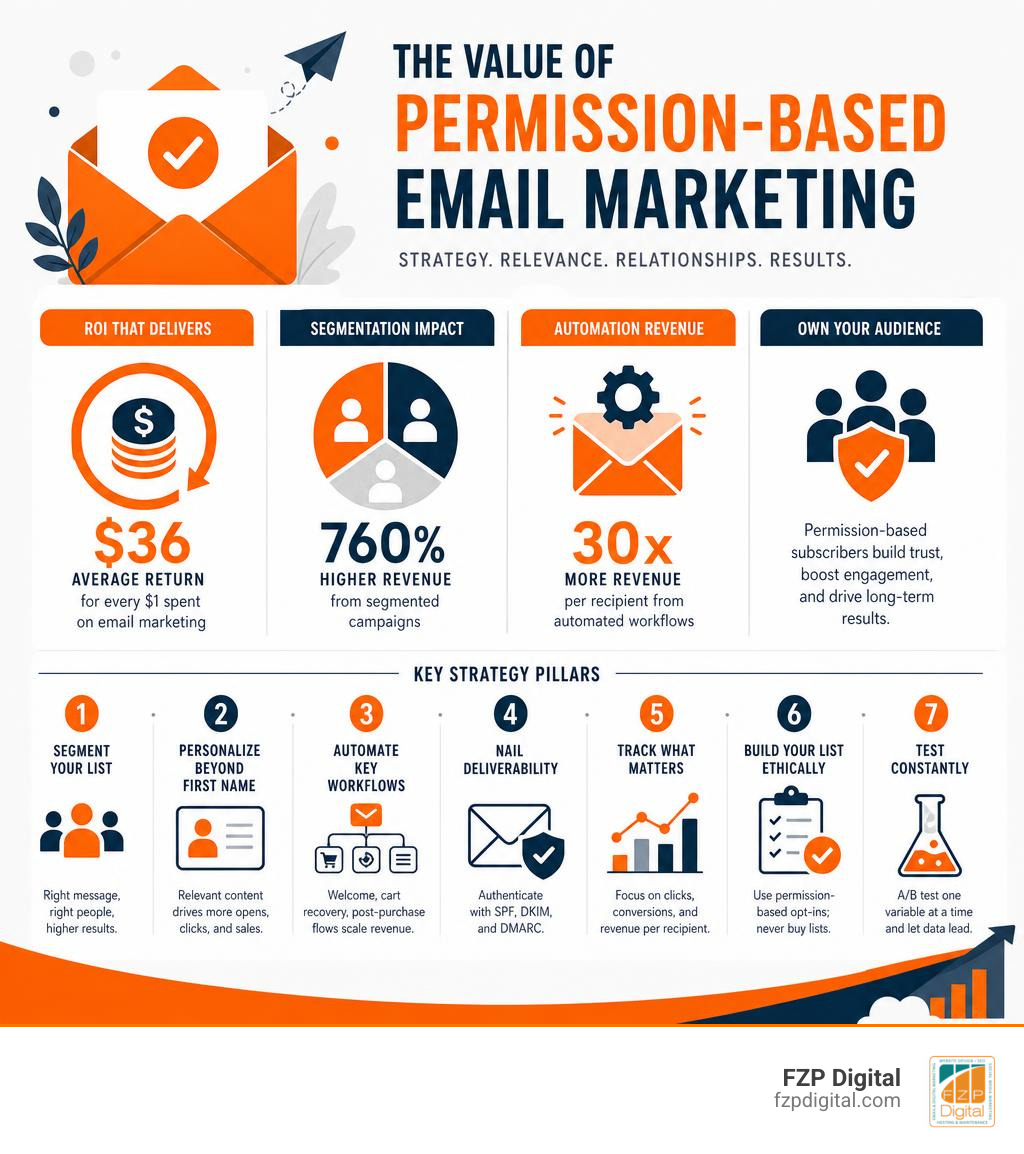
- Segment your list — Marketers who segment see up to 760% higher revenue
- Personalize beyond first name — Personalized campaigns drive 6x more transactions than generic blasts
- Automate key workflows — Welcome, abandoned cart, and post-purchase flows generate up to 30x more revenue per recipient than standard campaigns
- Nail deliverability first — Authenticate with SPF, DKIM, and DMARC before anything else
- Track what matters — Focus on click-to-open rate, conversion rate, and revenue per recipient, not just open rates
- Build your list ethically — Use permission-based opt-ins; never buy lists
- Test constantly — A/B test one variable at a time and let data drive decisions
That’s the short version. But if you want to actually execute these strategies without accidentally landing in spam folders or annoying your subscribers into oblivion, keep reading.
Here’s something worth sitting with for a second.
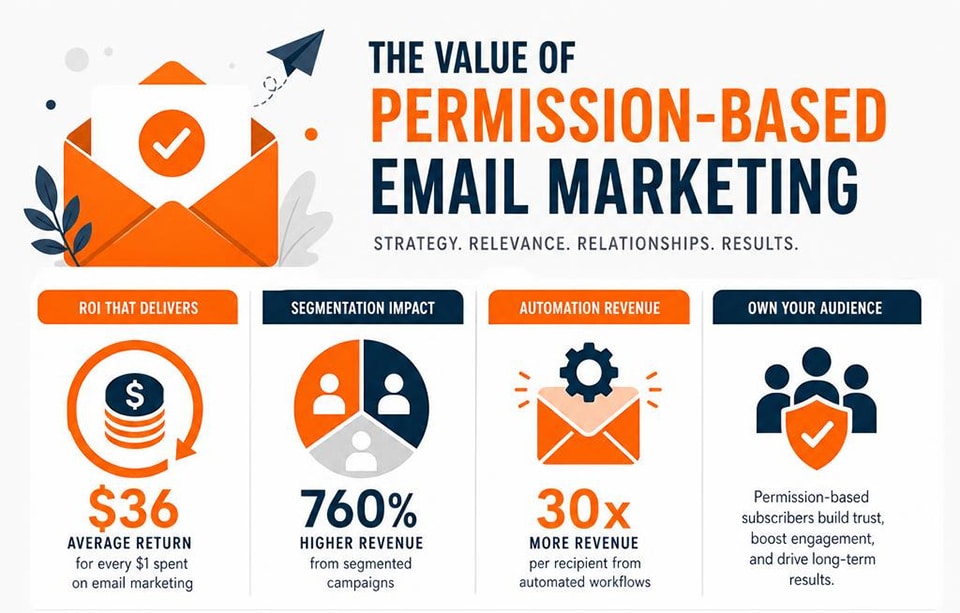
For every $1 you spend on email marketing, the average return is $36. Some businesses see as much as $42 or more. No other digital channel — not paid search, not social media, not display ads — comes close to that consistently.
And yet, so many small businesses in Philadelphia and beyond are either not using email at all, or they’re blasting their lists with generic promotions and wondering why their unsubscribe rates keep climbing.
The problem isn’t email. The problem is strategy — or the lack of one.
Email isn’t a megaphone. It’s a conversation. And when you treat it that way — with thoughtful segmentation, relevant content, and automated workflows that feel personal — it becomes one of the most powerful tools in your entire marketing toolkit.
Unlike social media, you own your email list. No algorithm can take it away overnight.
I’m Fred Z. Poritsky, founder of FZP Digital, and I’ve spent years helping businesses across Philadelphia develop and refine email marketing strategies that build real relationships, not just open rates — drawing on a career that spans nonprofit financial management, web design, and full-service digital marketing. Let’s walk through exactly how to do this the right way.
Handy email marketing strategies terms:
Designing High-Performing Email Marketing Strategies
To build a high-performing email system, you have to design for the way people actually read emails today. In 2026, over 70% of all emails are opened on mobile devices. If your email layout is clunky, slow to load, or hard to read on a smartphone screen, your subscribers will delete it in a heartbeat.
That is why we always advocate for a mobile-first design approach. Instead of complex, multi-column layouts that break on small screens, stick to a clean, single-column layout. Keep your text short and scannable, using plenty of white space, subheadings, and short paragraphs of 2 to 3 sentences.
Every single email you send should have one clear, primary Call to Action (CTA). Do not overwhelm your readers with five different links pointing to five different pages. If you want them to read your latest blog post, make that the star of the show. Use a large, thumb-friendly button (at least 44×44 pixels) with a high-contrast color so it is incredibly easy to click on a phone screen.
When you design with clarity and focus, you respect your subscriber’s time and attention. If you want a deeper look at setting up your baseline infrastructure, you can check out the 7 steps to build a savvy email marketing strategy in 2026 | Twilio to help you get started on the right foot.
Building a Clean, Compliant, and Segmented List
We have all been tempted by those offers to “buy a list of 10,000 local business leads.” Let us be completely honest with you: buying email lists is the fastest way to destroy your domain reputation, tank your deliverability, and land your brand in legal trouble.
Instead, you want to build a high-quality, permission-based email list organically. This means every single person on your list has explicitly raised their hand and said, “Yes, I want to hear from you.”
Here is how you do it:
- Use double opt-in: When someone signs up on your website, send a quick confirmation email asking them to click a link to verify their subscription. It feels like minor friction, but it is actually a shield that protects your list from fake addresses and spam bots.
- Maintain strict list hygiene: Clean your list at least once a quarter. Suppress hard bounces immediately and sunset subscribers who have not opened or clicked an email in over 180 days. A smaller list of highly engaged readers will always outperform a massive list of dead inboxes.
- Ensure legal compliance: Keep yourself safe by complying with regulations like CAN-SPAM, GDPR, and CASL. This means including a clear, one-click unsubscribe link in every email, displaying your physical business address, and being completely transparent about who is sending the message.
Once you have a clean list, you can unlock the real magic: behavioral segmentation. Instead of sending the same generic blast to everyone, group your subscribers based on their actions, purchase history, or preferences. Use zero-party data (information they willingly share with you via signup forms or quizzes) to deliver dynamic content that adapts to who they are. If you are starting from scratch, take a look at our step-by-step guide on How to Build an Email List from Scratch to lay a solid foundation.
Aligning Your Goals with Modern Email Marketing Strategies
You cannot measure success if you do not know what you are aiming for. Too many businesses send emails simply because “it is Tuesday and we always send an email on Tuesday.” That is a fast track to subscriber burnout.
Instead, define clear, SMART goals for your email campaigns. Are you trying to drive direct e-commerce sales, nurture cold leads, reduce cart abandonment, or increase customer lifetime value (CLTV)?
  Specific --> "Increase revenue from our welcome flow"
  Measurable  --> "Raise Revenue Per Recipient (RPR) to $2.00"
  Attainable  --> "Based on our current $1.50 RPR, this is realistic"
  Relevant --> "Directly boosts our overall digital marketing revenue"
  Time-bound  --> "Achieve this within the next 90 days"
By shifting your focus from vanity metrics (like open rates) to bottom-line business metrics like conversion rate and revenue per recipient (RPR), you can easily see which of your campaigns are actually driving growth. For small businesses looking to select the right tools to track these goals, we compared the top platforms in our review of the Best Email Marketing for Small Business: A 2025 Review and Comparison.
Tailoring Email Marketing Strategies for B2B, B2C, and Enterprise
Your email strategy needs to match the way your audience makes decisions. B2B, B2C, and enterprise audiences have vastly different expectations, and treating them the same is a recipe for low engagement.
- B2B Email Marketing: Your subscribers are looking for logic, efficiency, and return on investment. They want educational content, case studies, and clear solutions to their business pain points. The tone should be professional and authoritative, often coming from a real person’s name rather than a generic brand inbox.
- B2C Email Marketing: B2C buyers are driven by emotion, convenience, and direct value. They respond incredibly well to beautiful imagery, personalized product recommendations, limited-time discounts, and behavioral triggers like abandoned cart reminders.
- Enterprise Scale: When managing enterprise email programs, you are dealing with massive lists, complex database integrations, and strict compliance requirements. Security, deliverability monitoring, and multi-channel synchronization become just as important as the creative copy itself.
Understanding these nuances is key to crafting campaigns that actually resonate. To see how to apply this to a professional audience, read our deep dive into B2B Email Marketing Strategies and Examples for Success.
The Power of Automation and Triggered Workflows
If you are still manually sending every single email that goes out to your list, you are missing out on the most profitable part of email marketing. Automated, trigger-based emails are sent to individual subscribers based on specific actions they take (or do not take) on your website.
Because these emails are highly relevant and perfectly timed, they perform incredibly well. In fact, trigger-based emails generate 5x higher open rates and 15x more clicks than standard newsletter blasts. They turn your email program from a calendar-driven chore into an automated customer journey that runs 24/7.
When you design these workflows around the customer experience, they do not feel like spam—they feel like helpful, personal customer service. For a closer look at how modern brands use these automated journeys to scale their revenue, dive into the insights in Email Marketing Strategy in 2026: How Smart Brands Boost ROI .
Essential Automated Flows
You do not need dozens of complex workflows to see a massive lift in your revenue. Start by building and perfecting these five essential automated flows:
- Welcome Series (3-5 emails): Sent immediately after someone signs up. This is your chance to introduce your brand, set expectations, and deliver on whatever incentive or lead magnet you promised. Welcome emails routinely see the highest open rates of any campaign.
- Abandoned Cart Flow (2-3 emails): Triggered when a shopper adds items to their cart but leaves without buying. Sending a gentle reminder at 1 hour, 24 hours, and 48 hours can recover 10% to 15% of lost sales.
- Browse Abandonment Flow: Triggered when a subscriber views a specific product category or page but does not add anything to their cart. A helpful, non-pushy email highlighting the benefits of that category can guide them back.
- Post-Purchase Flow: Triggered immediately after a purchase. Use this to send order confirmations, product care tips, how-to guides, and eventually, a request for a review or a complementary product recommendation.
- Re-engagement / Win-Back Flow: Target subscribers who have gone quiet for 90 to 180 days. Offer an exclusive discount, showcase your latest updates, or direct them to a preference center where they can choose to receive fewer emails.
Embracing AI and Modern Email Trends
By the end of 2026, up to 70% of marketers predict that half of their email operations will be AI-driven. AI is no longer a futuristic concept; it is an everyday tool that helps smart marketers work faster and more efficiently.
However, there is a catch. Inboxes are being flooded with generic, fully AI-generated copy, and subscribers can smell it from a mile away. The key is to use AI to augment your work, not replace your human voice.
Use AI for data analysis, predictive segmenting, finding the optimal send time for individual subscribers, and generating subject line variations for A/B testing. At the same time, keep an eye on modular email design—using a centralized system of reusable content blocks to build consistent, beautiful emails in minutes. If you want to know how to keep your email program competitive in this new landscape, check out our guide on Why Your Emails Need an AI Brain to Survive 2026.
Optimization: Testing, Timing, and Tracking Metrics
Even the most beautiful email copy will fail if your messages never actually reach the inbox. In 2026, inbox providers like Gmail, Yahoo, and Microsoft are stricter than ever. If you want to stay out of the spam folder, you must master the technical foundations of email deliverability.
This starts with authenticating your sending domain. You need to set up three core DNS records:
- SPF (Sender Policy Framework): Specifies which mail servers are authorized to send email on behalf of your domain.
- DKIM (DomainKeys Identified Mail): Adds a digital signature to your emails, proving they were not altered in transit.
- DMARC (Domain-based Message Authentication, Reporting, and Conformance): Tells receiving servers how to handle emails that fail SPF or DKIM checks.
Without these records, your emails are highly likely to be blocked or sent straight to spam. If you want a highly practical, technical breakdown of how to audit and improve your deliverability, explore Email Marketing: The Practical Guide for 2026 .
A/B Testing and Deliverability Best Practices
The golden rule of email marketing is simple: always be testing. But if you test too many things at once, you will never know what actually caused the change in your results.
Always A/B test a single variable at a time. For example, send the exact same email to two halves of a segment, but use a different subject line for each to see which one gets more clicks. You can test your CTAs, your email layouts, your images, or your send times.
  [Your Subscriber Segment]


 [Group A] [Group B]
 Subject Line 1  Subject Line 2


  Analyze Click-To-Open Rate (CTOR)
To protect your sender reputation while testing, aim to keep your spam complaint rate under 0.05% (and absolutely below Google’s hard threshold of 0.3%). If you are launching a new sending domain or IP, make sure to warm it up slowly—starting with a few hundred emails to your most engaged subscribers and gradually scaling up over 2 to 3 weeks.
Metrics That Actually Matter in 2026
For years, marketers obsessed over open rates. But ever since Apple introduced Mail Privacy Protection (MPP)—which pre-fetches emails and inflates open rates by 2x to 4x—open rates have become highly unreliable.
Instead, focus on the metrics that directly impact your business:
- Click-to-Open Rate (CTOR): The percentage of people who opened your email and clicked a link. This is the truest measure of how engaging your content is.
- Conversion Rate: The percentage of recipients who completed your ultimate goal (like making a purchase or booking a consultation).
- Revenue Per Recipient (RPR): Total revenue generated by a campaign divided by the number of delivered emails. This is the cleanest way to measure the financial health of your email flows.
- Unsubscribe and Complaint Rates: Watch these weekly. A sudden spike is an immediate warning sign that your frequency is too high or your content is missing the mark.
Frequently Asked Questions About Email Marketing
We speak with local business owners in Philadelphia, Newtown, and Richboro every week, and we hear many of the same questions. Let us clear up some of the most common myths and uncertainties about modern email marketing strategies.

What is the best email marketing platform to use?
There is no single “best” platform—it entirely depends on your business model, your tech stack, and your budget.
If you run an e-commerce store, platforms like Klaviyo are incredibly powerful because they integrate deeply with Shopify and WooCommerce to track revenue and trigger highly specific behavioral flows. If you are a B2B service business or a local agency, platforms like ActiveCampaign, HubSpot, or Mailchimp offer fantastic CRM integrations and lead nurturing tools.
When choosing an Email Service Provider (ESP), prioritize deliverability rates, ease of automation setup, and how easily the tool connects to your existing website.
How often should I send marketing emails to my list?
There is no universal rule, but consistency matters far more than volume. Sending daily emails is a quick way to drive up your unsubscribe rate, while sending once every six months will make your subscribers forget who you are.
For most small businesses, starting with 1 to 2 high-quality emails per week to your engaged list is a safe, effective baseline. Watch your unsubscribe and click-through rates closely. If engagement drops, back off on the frequency.
Better yet, give your subscribers control. Set up a preference center where they can choose whether they want to hear from you weekly, monthly, or only when you have major product launches.
Can I combine email with other marketing channels?
Absolutely! In fact, email works best when it is part of a cohesive multi-channel strategy. You can use your social media channels to drive email signups, and use your email list to promote your offline events or local initiatives.
If you are looking for a highly tactile, premium way to stand out in a digital world, combining email with offline campaigns can yield incredible results. If you are curious about how to blend these two worlds, read our thoughts in The Ultimate Guide to Direct Mail Marketing Services.
Conclusion
At the end of the day, mastering email marketing strategies is not about chasing shortcuts or sending massive blasts to people who never asked to hear from you. It is about building a sustainable, owned marketing channel that respects your audience, delivers genuine value, and drives predictable, long-term revenue for your business.
But setting up the technical infrastructure, writing compelling copy, designing responsive layouts, and managing complex automated workflows can feel overwhelming when you are also trying to run your day-to-day business.
That is where we come in. At FZP Digital, we are a local Philadelphia and Bucks County digital marketing agency specializing in helping businesses in Richboro, Newtown, and Downtown Philadelphia build a powerful, authentic digital presence. Through our collaborative “Develop. Design. Deliver” process, we work right alongside you to design custom WordPress websites, boost your organic search rankings, and build high-ROI email strategies that feel completely natural and highly professional.
If you are ready to stop guessing and start building a real relationship with your subscribers, let us handle the heavy lifting.
Partner with FZP Digital for expert digital marketing services today, and let’s start growing your business together.