

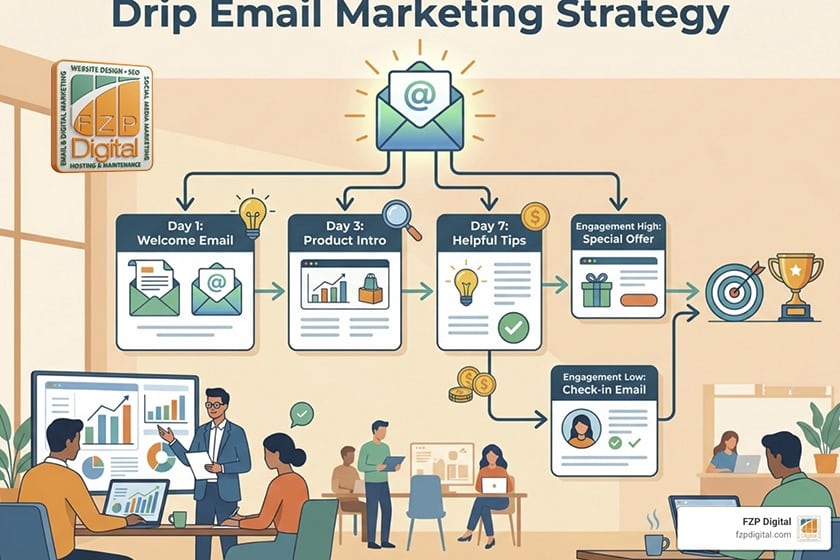
Why Your Business Needs a Drip Email Marketing Strategy Right Now
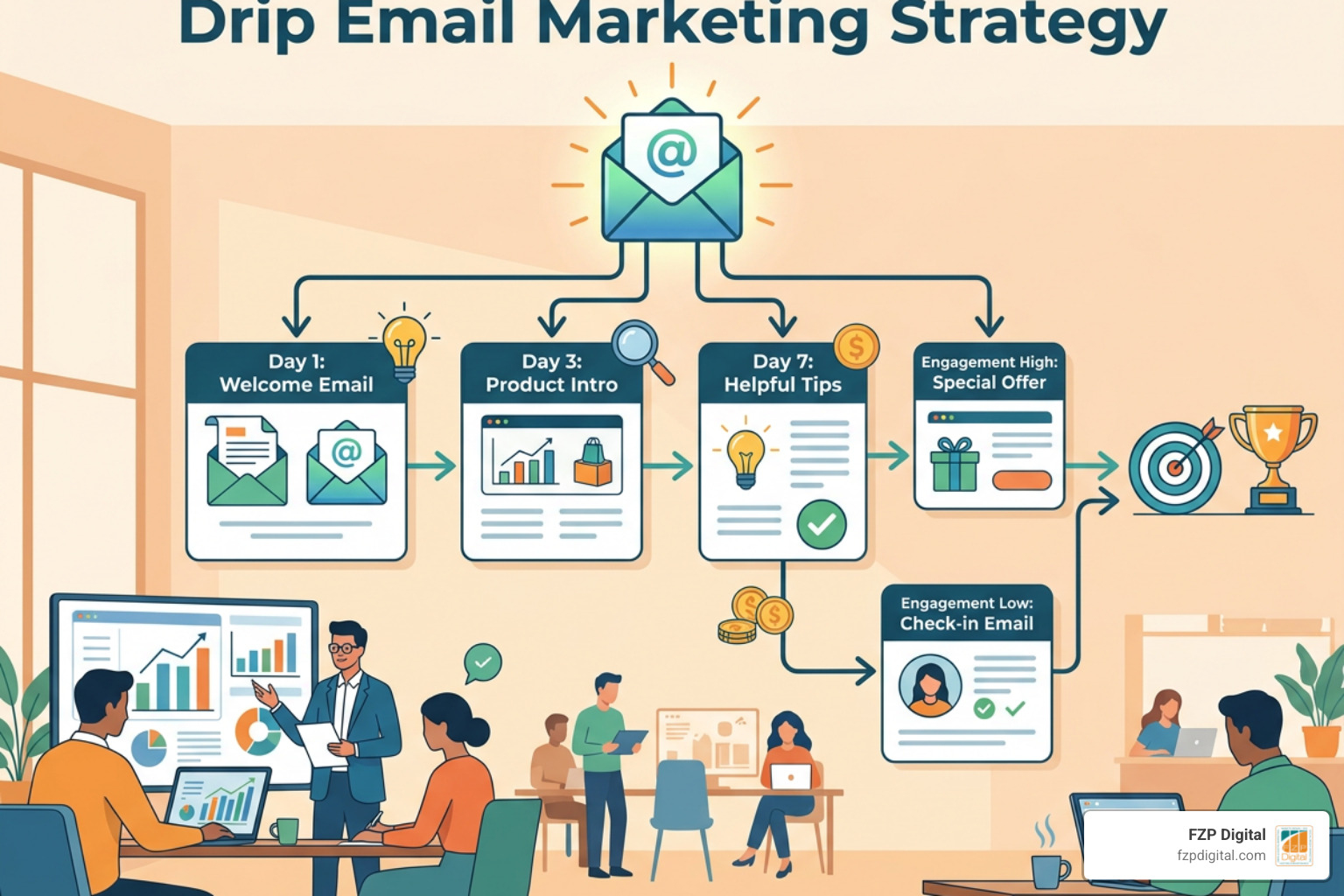
Why Drip Email Marketing Is the Smartest Move Your Business Can Make Right Now
Drip email marketing is one of the most powerful — and most underused — tools available to small and medium-sized businesses today.
If you’re trying to figure out whether it’s worth your time and which tools are right for you, here’s the quick answer:
What is drip email marketing? A series of automated, pre-written emails sent to subscribers based on their actions or a set schedule — designed to nurture leads, build relationships, and drive sales without manual effort.
Top drip email marketing platforms to evaluate:
| Platform | Best For | Starting Price |
|---|---|---|
| Drip | B2C eCommerce brands | Based on list size |
| Klaviyo | Data-rich eCommerce | Free up to 500 sends/mo |
| ActiveCampaign | Automation power users | ~$15/mo |
| Mailchimp | Beginners and solopreneurs | Free up to 500 contacts |
| Brevo | Budget-conscious teams | Free up to 300 emails/day |
Why it matters right now:
- Email accounts for 80% of all outbound messaging across marketing channels
- Businesses using smart audience segments earn 5x more revenue than those sending to everyone at once
- The average email marketing campaign delivers $36 back for every $1 spent
- Half of all consumers are constantly searching for products and content that fits their needs — drip campaigns meet them at exactly the right moment
The difference between a business that grows steadily through email and one that sends the occasional newsletter and wonders why nothing converts? Strategy. Specifically, the kind of automated, behavior-driven strategy that drip campaigns make possible.
Here’s the thing most business owners don’t realize: you don’t need a massive marketing team or a technical background to make this work. The right tools — and the right setup — do the heavy lifting for you.
I’m Fred Z. Poritsky, founder of FZP Digital, and after years of helping Philadelphia-area businesses grow their digital presence through smart email strategies, I’ve seen how a well-structured drip email marketing system can transform a quiet inbox into a consistent revenue engine. Let’s walk through everything you need to know to evaluate your options and build a strategy that actually works for your business.
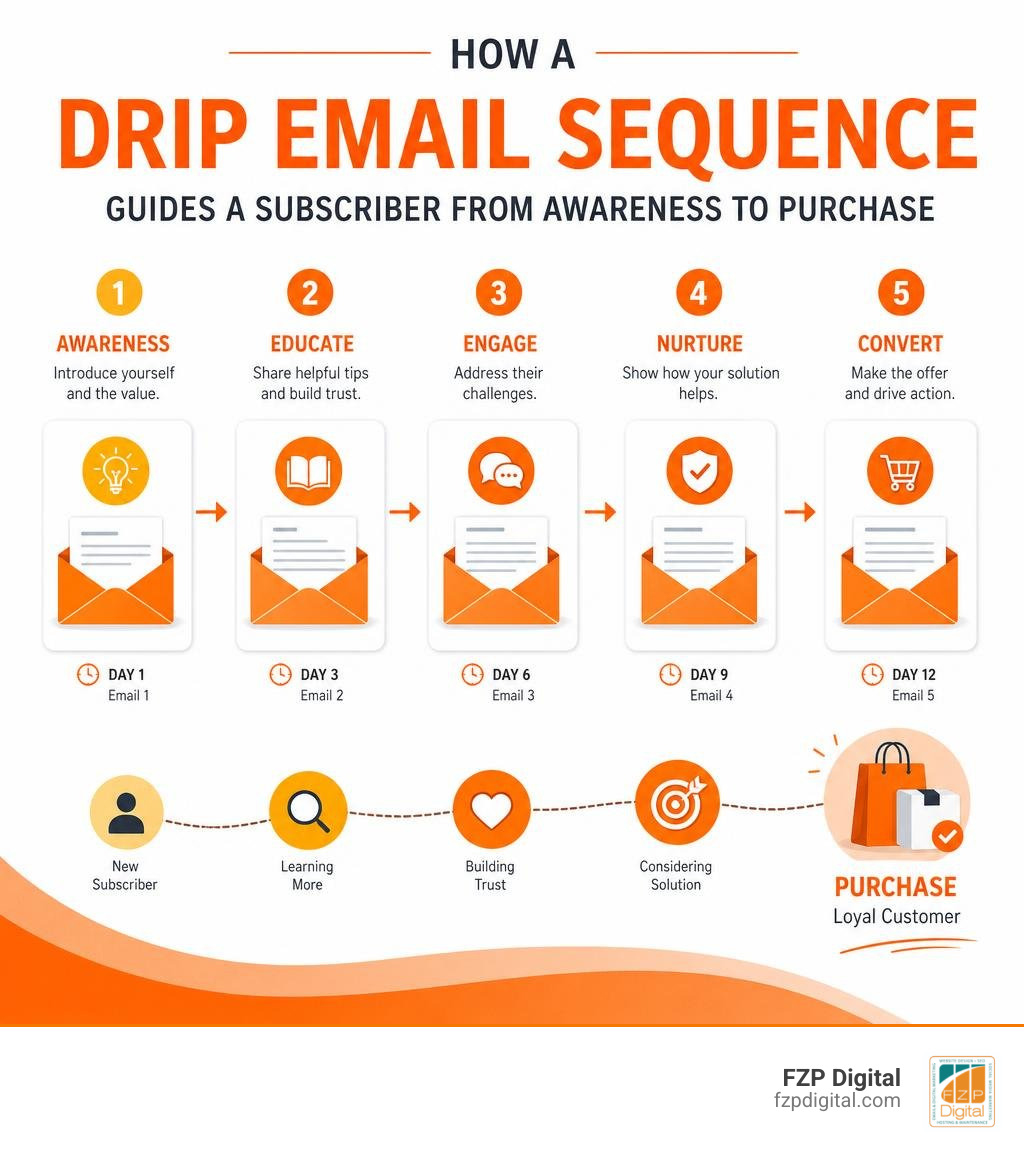
Drip email marketing word guide:
What is Drip Email Marketing and How Does It Work?
To understand drip email marketing, it helps to picture a literal drip. Instead of flooding your subscribers’ inboxes with a massive wave of information all at once, you release highly targeted, valuable messages slowly and steadily over time.
At its core, a drip campaign is a sequence of pre-written marketing emails sent automatically to specific groups of people. These campaigns don’t require you to manually hit “send” every time a new user signs up. Instead, they run quietly in the background of your business, guiding prospects step-by-step through your sales funnel.
Unlike broad marketing blasts, modern drip marketing relies heavily on behavioral triggers and automated sequences. This means the emails a subscriber receives are directly tied to how they interact with your website, products, or previous emails. For a deeper look into structuring these foundational efforts, check out The Best Direct Email Marketing Strategy Guide.
When you align your messaging with the customer’s journey, you ensure that you are always sending the right message at the absolute best moment. If you are curious about the step-by-step logistics of launching your very first sequence, the How to Set Up a Drip Email Campaign – U.S. Chamber of Commerce guide offers excellent foundational advice for small businesses starting from scratch.
The Core Mechanics of a Drip Email Marketing Campaign
How does a drip sequence actually function under the hood? It all comes down to three key elements: triggers, user actions, and preset schedules.
- The Trigger (User Actions): A trigger is the spark that starts the engine. This is a specific action taken by a website visitor or subscriber. For example, a user might sign up for your newsletter, download an ebook, abandon a shopping cart, or register for a webinar.
- The Preset Schedule (Delays): Once a trigger occurs, the automation platform schedules the first email. You define the exact timing windows. You might send the first email immediately, wait 24 hours for the second, and delay the third by four days.
- Behavioral Logic: Modern platforms allow you to create forks in the road. If a user opens the first email and clicks a link, they might go down “Path A.” If they don’t open it, they might receive a gentle reminder down “Path B.”
This level of automation allows you to map out complex customer journeys effortlessly. Platforms like Steady demonstrate how easily these triggers can be tied directly to membership status changes, subscriptions, and even cancellations, as outlined in How to use Email Drip Campaigns on Steady | Steady Help Centre.
Drip Campaigns vs. Traditional Broadcast Newsletters
Many business owners ask us: “Can’t I just send a weekly newsletter and get the same results?”
While traditional newsletters have their place for sharing company-wide updates or holiday promotions, they are fundamentally different from automated drip campaigns. Newsletters are sent manually to a static list at a single point in time. Drip campaigns, on the other hand, are dynamic, continuous, and highly personalized based on individual subscriber behavior.
| Feature | Automated Drip Campaigns | Traditional Broadcast Newsletters |
|---|---|---|
| Sending Method | Fully automated based on triggers | Manually scheduled and sent |
| Audience Scope | Highly segmented, dynamic lists | Broad, static, “send-to-all” lists |
| Timing | Delivered at the perfect individual moment | Sent at a single date and time for everyone |
| Content Relevance | Tailored to the user’s specific actions | General updates, news, or broad sales |
| Lifecycle Stage | Mapped to the subscriber’s buying journey | Treats all subscribers the exact same way |
By moving away from a “one-size-fits-all” approach and embracing dynamic updates, you respect your subscribers’ time and attention, which naturally leads to higher engagement.
The Major Benefits of Automated Email Journeys for B2C and B2B Brands

Whether you run a local boutique in Bucks County or a B2B professional services firm in Downtown Philadelphia, automated email journeys offer massive advantages. The beauty of automation is that it provides “leverage”—it allows you to scale your relationship-building efforts without scaling your working hours. For B2B companies navigating complex sales cycles with multiple stakeholders, these sequences are essential for keeping leads warm over several months. You can explore tailored B2B strategies in our guide on B2B Email Marketing Strategies and Examples for Success.
Boosting Sales and Average Order Value (AOV)
The primary goal of any marketing strategy is to grow your business, and drip campaigns are incredibly efficient at driving revenue. By sending targeted product recommendations, exclusive discounts, and helpful tutorials, you can easily guide first-time buyers toward making repeat purchases.
In fact, the data speaks for itself. Niche customer segmentation can boost email revenue by up to 27%. Even more impressive, brands utilizing advanced segmentation and automated workflows have seen their overall revenue increase by 77% in just a couple of months, while simultaneously driving up to 122% higher Average Order Values (AOVs). Because these systems rely on first-party data—which users willingly share as they interact with your brand—you don’t have to worry about changing privacy laws or the death of third-party tracking cookies.
Building Trust Without Over-Communicating
One of the biggest fears business owners have is coming across as a spammer. You don’t want to inundate your list and watch your unsubscribe rates climb.
Drip marketing solves this problem by focusing on relevance rather than volume. Because the emails are triggered by the user’s own actions, the content feels highly personal and helpful rather than intrusive.
Maintaining a consistent brand voice across a slow, steady sequence allows you to educate your audience, share your values, and build deep trust over time. You are no longer just pitching products; you are offering solutions. To ensure you strike the perfect balance between staying top-of-mind and respecting the inbox, read our best practices on How to Master Email Marketing Strategies Without Being a Spammer.
High-Converting Types of Drip Sequences to Implement Today
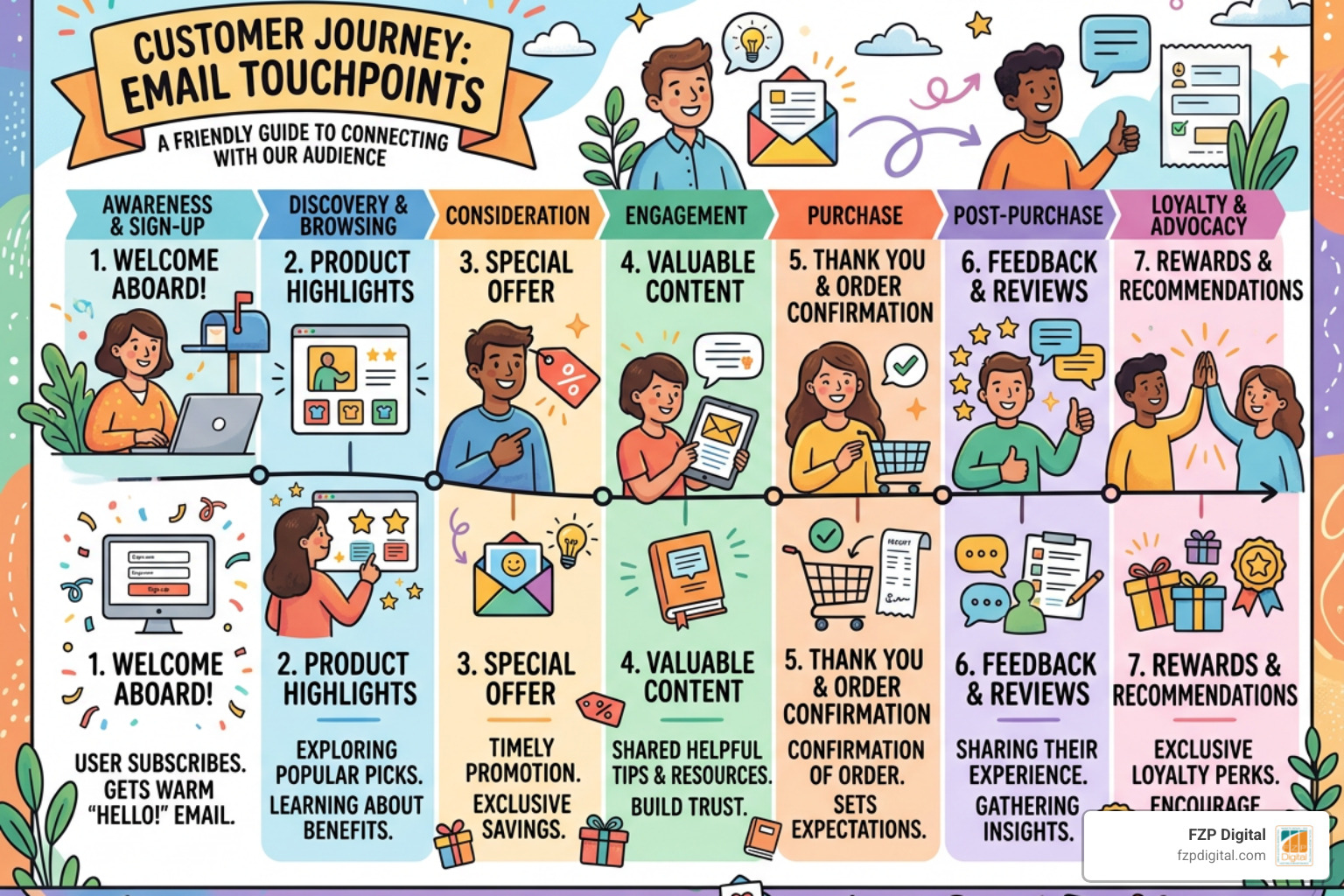
To get the most out of your email marketing, you should set up a few core sequences that address different stages of the customer lifecycle. By mapping your emails to the customer journey, you can capture attention when intent is highest. Of course, before you can nurture subscribers, you need to get them onto your list in the first place. If you are starting from scratch, take a look at our practical guide on How to Build an Email List from Scratch.
The Welcome and Onboarding Series
The welcome series is your digital handshake. It has the highest open rates of any email you will ever send, making it your single best opportunity to make a great first impression.
When someone joins your list, they are actively interested in your brand. A solid 3-to-4-part welcome sequence should introduce who you are, set expectations for future emails, share your best educational content, and deliver any incentive (like a discount code or free guide) you promised during signup. For software or service-based businesses, this series easily transitions into an onboarding sequence, guiding users step-by-step through how to get the most value out of your offer.
Abandoned Cart and Browse Recovery
For eCommerce brands, abandoned cart emails are absolute goldmines. When a shopper adds an item to their cart but leaves before checking out, their purchase intent is incredibly high.
An automated abandoned cart drip sequence can gently remind them of what they left behind. Using dynamic product blocks, you can display the exact items remaining in their cart directly inside the email. A typical 3-step sequence might look like this:
- Email 1 (Sent after 1 hour): A helpful reminder that their cart is saved.
- Email 2 (Sent after 24 hours): A customer testimonial or FAQ answering common objections about the product.
- Email 3 (Sent after 48 hours): A limited-time incentive, like free shipping or a small discount, to encourage them to complete the checkout.
Re-engagement and Win-Back Campaigns
Over time, it is natural for a portion of your email list to go quiet. Dormant subscribers can hurt your overall deliverability rates if they continuously ignore your emails.
A re-engagement or win-back drip campaign is designed to wake up these inactive users. You can trigger this sequence automatically when a subscriber hasn’t opened an email or made a purchase in 90 days. Send a friendly “We miss you” message, ask for feedback on how you can improve, or offer an exclusive incentive to win them back. If they still don’t engage after a few attempts, you can cleanly remove them from your active list to keep your deliverability healthy.
Advanced Strategies for Optimization and Compliance
Once your basic sequences are up and running, the real magic happens through continuous optimization. By monitoring key performance indicators like open rates, click-through rates, and direct revenue attribution, you can make data-driven adjustments that yield compounding results over time.
Best Practices for Segmenting and Personalizing Your Drip Email Marketing
If you want to maximize your email revenue, you must move past static lists. The most successful brands rely on dynamic segmentation—a system where customer profiles automatically update in real-time based on purchase history, website browsing behavior, and email engagement.
To get started, we recommend dividing your audience into four core dynamic segments:
- Potentials: Subscribers who have signed up but have not yet made their first purchase.
- Casuals: First-time buyers whom you want to nurture into repeat customers.
- Core: Consistent, reliable buyers who love your brand.
- Champions: Your highest-spending, highly engaged VIPs who deserve exclusive perks and early access.
By targeting these distinct groups with specific offers, you avoid sending irrelevant emails. For example, you should never send a “first-time buyer discount” to a Champion customer. If you are trying to decide which automation platform has the best segmentation tools for your specific business size, check out our comparison of the Best Email Marketing for Small Business: A 2025 Review and Comparison.
Navigating Compliance, Deliverability, and AI Automation
Building a massive email list doesn’t matter if your messages end up in the spam folder. To protect your deliverability, you must follow strict compliance standards like CAN-SPAM and GDPR. This means always securing explicit opt-in consent, keeping your list clean of invalid addresses, and ensuring that every single drip email contains a clear, functioning unsubscribe link.
Additionally, the landscape of email automation is changing rapidly thanks to artificial intelligence. Today’s AI tools go far beyond simple scheduling; they can analyze subscriber behavior to predict purchase likelihood, write highly engaging subject lines, and dynamically optimize send times for each individual subscriber.
To stay ahead of the curve in 2026, we highly recommend exploring The Best AI Email Marketing Tools to Automate Your Success and reading our deep dive into Why Your Emails Need an AI Brain to Survive 2026.
Frequently Asked Questions About Drip Campaigns
How many emails should be in a standard drip sequence?
There is no single magic number, as the ideal sequence length depends entirely on your campaign goal. A standard welcome series typically performs best with 3 to 4 emails spaced over a week. An abandoned cart sequence is highly effective with 2 to 3 well-timed reminders. For complex B2B sales cycles or educational lead-nurturing funnels, a longer sequence of 5 to 7 emails spread across 4 to 6 weeks is often necessary to build trust and address common sales objections. The key is to ensure every single email provides standalone value.
How do I measure the ROI of my automated campaigns?
To accurately measure the financial impact of your drip campaigns, you should look beyond vanity metrics like open rates. Focus on conversion rates, click-through rates, and direct revenue attribution. Most modern email marketing platforms integrate directly with your eCommerce store or CRM, allowing you to track exactly how much revenue is generated from a specific email link. By comparing the lifetime value of customers nurtured through your drip sequences against the cost of your software, you can easily calculate your direct return on investment.
Can I update an active drip campaign without disrupting current subscribers?
Yes, absolutely. High-quality email automation platforms allow you to make real-time updates to your active workflows. When you modify an email’s content, subject line, or delay timing and save the changes, the updates will apply immediately to any subscriber who triggers that step in the sequence moving forward. If you are making major changes to the structure of a live workflow, we always recommend running a system test with a test profile first to ensure the timing and conditional paths function exactly as intended.
Conclusion
Implementing a drip email marketing strategy is one of the smartest, most sustainable ways to grow your business. It allows you to build genuine relationships with your audience, recover lost sales, and drive consistent revenue on autopilot—all while you focus your energy on running your day-to-day operations.
But we also know that setting up complex visual workflows, integrating your online store, and designing beautiful, high-converting templates can feel overwhelming when you are already wearing ten different hats.
That is where we come in. At FZP Digital, we are a Philadelphia and Bucks County digital marketing agency specializing in helping local businesses succeed online. Through our collaborative “Develop. Design. Deliver.” process, we don’t just build premium, responsive WordPress websites—we also design the smart, automated email systems that turn those website visitors into lifelong customers.
Whether you are based in Richboro, Newtown, or Downtown Philadelphia, we are here to handle the technical details and creative strategy so you can watch your business grow. Ready to turn your email list into your hardest-working asset? Partner with FZP Digital for Expert Marketing Services today, and let’s build something great together.