

How to Master Link Building Outreach Strategies in 5 Easy-to-Follow Steps
Step 1: Target Prospecting and Role-Based List Segmentation

To master link building outreach strategies, you need a structured 5-step approach: qualify relevant prospect lists, choose high-ROI tactics like editorial insertions, set up technical email deliverability (SPF, DKIM, DMARC), send concise Context-Value-Ask pitches with a 3-touch cadence, and build long-term relationships through multi-channel networking.
When conducting modern outreach, mass emailing thousands of random webmasters simply does not work. Instead, successful campaigns start with a fit-first shortlist. You want to identify websites that share an overlapping audience with yours without directly competing for your exact commercial keywords.
A great place to start is reverse-engineering your top-performing search rivals. By executing a thorough SEO competitive analysis: a 7-step plan to steal their rankings, you can uncover the exact publications, industry resource lists, and editorial directories that already link to content similar to yours.
When our team at FZP Digital, led by founder Fred Z. Poritsky, qualifies potential link targets, we look at several core health metrics:
- Topical Relevance: Does the website publish content closely aligned with your niche or geographic community?
- Real Organic Traffic: Does the target domain receive steady search traffic (ideally 500+ monthly visits)? A domain rating metric means nothing if search engines don’t actually send real visitors to the site.
- Editorial Standards: Does the website feature active human authors, a clean editorial style, and reasonable outbound linking patterns?
- Freshness: Has the blog or resource section been updated within the last 3 to 6 months?
Segmenting Outreach Messaging by Recipient Role and Authority
Once you have a qualified list, you need to find the person who actually possesses the authority to edit a page or publish new content. Sending a technical pitch to a company founder or a high-level business proposal to an entry-level copywriter is a recipe for silence.
Let’s break down how to tailor your communication based on recipient roles:
- SEO Specialists and Digital Marketing Managers: These professionals care about metrics, technical accuracy, topical depth, and search intent alignment. When writing to an SEO manager, be direct. Point out specific content gaps, propose exact placement suggestions, and highlight how your asset strengthens their page’s comprehensive value.
- Content Editors and Blog Managers: Editors are focused on readability, fresh data, storytelling, and audience engagement. Show them that you have read their work. Reference a recent article they wrote, highlight a unique angle your resource provides, and explain how it makes their existing guide more helpful to their readership.
- Founders and CEOs: Founders at small-to-midsize businesses care about brand authority, referral leads, and strategic partnerships. Keep your email under 100 words, eliminate deep technical jargon, and emphasize mutual business value or collaborative opportunities.
Beyond job titles, segment your prospect list by domain authority tiers. For high-authority publications, reserve high-touch, fully manual pitches that reference unique data or original interviews. For mid-tier niche blogs, use semi-automated frameworks that let you insert customized observations quickly while preserving an authentic, human voice.
Step 2: Selecting High-ROI Link Building Outreach Strategies
Not all link acquisition tactics are created equal. Some strategies take massive effort for minimal returns, while others deliver high-quality editorial backlinks that continuously compound your search rankings.
| Outreach Strategy | Placement Speed | Average Conversion Rate | Long-Term Search Engine ROI | Best Use Case |
|---|---|---|---|---|
| Editorial Link Insertions | Fast (1–3 weeks) | Moderate (8%–15%) | Very High | Adding value to existing, high-ranking articles |
| Listicle Outreach | Fast (1–2 weeks) | High (12%–20%) | High | Getting your product, service, or tool included in buyer guides |
| Original Data & Digital PR | Moderate (3–6 weeks) | High (15%–25%+) | Maximum | Earning natural press coverage from news outlets and journalists |
| Unlinked Brand Mentions | Very Fast (3–7 days) | Very High (20%–35%) | High | Reclaiming existing editorial goodwill and brand citations |
| Guest Post Outreach | Slow (4–8 weeks) | Moderate (5%–12%) | Moderate to High | Establishing thought leadership and introducing new concepts |
| Broken Link Building | Slow (3–6 weeks) | Very Low (1%–3%) | Low to Moderate | Replacing dead URLs on older, neglected resource pages |
High-Converting Link Building Outreach Strategies for Editorial Insertions
Editorial link insertions—sometimes called niche edits—represent one of the highest-yield tactics in modern search optimization. Instead of asking an editor to review, draft, and publish an entirely new 2,000-word guest blog, you ask them to add a relevant reference or link to an established, top-ranking article that is already driving organic traffic.
To make editorial insertions work, you must support them with a robust content SEO strategy. Your target asset needs to offer something genuinely distinct, such as an original calculation, a proprietary data study, an interactive tool, or a downloadable checklist. As outlined in Hunter.io’s link building outreach guide, around 80% of top-tier backlinks come from sustained editorial relationships rather than one-off transactional requests.
A fascinating finding from content research reveals that “tangential content”—content that covers broader industry themes rather than directly pitching your commercial offerings—generates 30% more backlinks and 77% more social shares than purely promotional pieces. Furthermore, studies by Moz analyzing hundreds of outreach campaigns demonstrated that emotionally engaging, story-driven content earned 70% more links than neutral, purely technical copy.
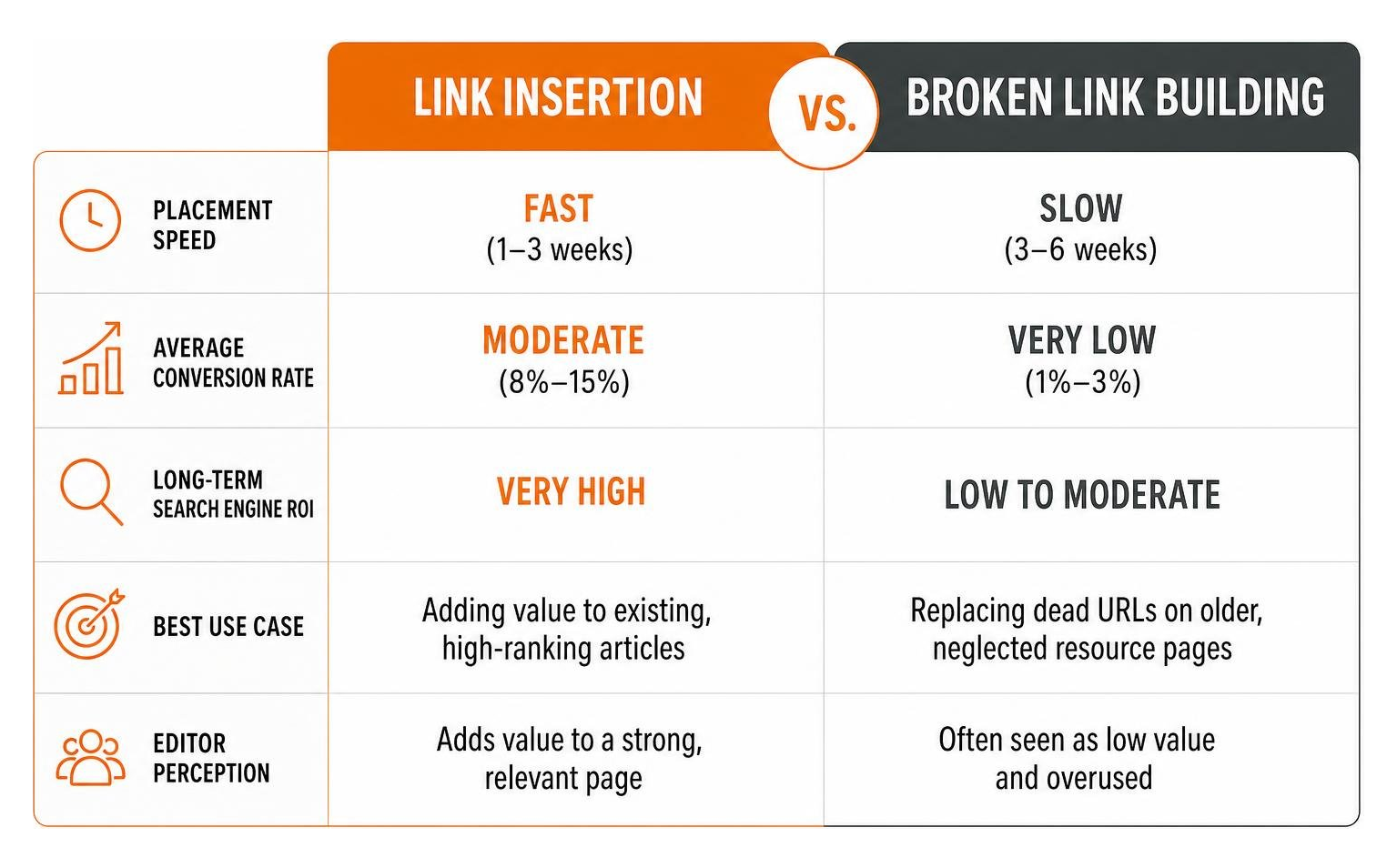
Many older guides encourage beginners to lean heavily on broken link building or basic skyscraper outreach. However, in today’s environment, editors receive dozens of cut-and-paste broken link emails every single week. Unless you are identifying a major industry hub with hundreds of dead resources, broken link prospecting often yields lower reply rates than targeted editorial insertions or unlinked brand reclamation.
Step 3: Configuring Technical Deliverability and Domain Infrastructure
Even the most brilliant, personalized pitch will fail if it lands in the recipient’s spam folder. In recent years, major email providers like Google Workspace and Microsoft 365 have implemented strict spam filtering rules. If you skip technical email setup, your outreach will never be seen.
Before sending your first outreach campaign, ensure your technical infrastructure is rock-solid:
- SPF (Sender Policy Framework): A DNS text record that specifies which mail servers are authorized to send email on behalf of your domain.
- DKIM (DomainKeys Identified Mail): An encrypted digital signature attached to every outbound message, proving that the email was not tampered with in transit.
- DMARC (Domain-based Message Authentication, Reporting, and Conformance): A governance policy telling receiving mail servers how to handle messages that fail SPF or DKIM checks.
- Custom Tracking Domains: If you use outreach software to track opens and clicks, configure a custom subdomain to align tracking URLs with your sender address.
Just as a comprehensive technical SEO audit ensures search engine crawlers can index your website without errors, your email DNS records ensure mailbox filters trust your outreach domain.
For growing campaigns sending more than 30 emails per day, we strongly suggest purchasing a dedicated secondary domain (e.g., yourcompanyoutreach.com) rather than sending mass cold pitches directly from your primary business domain. This protects your core brand reputation and ensures your everyday client communications remain pristine.
When launching a new outreach domain, warm it up gradually. Start by sending 5 to 10 manual emails per day during the first week, slowly scaling up to 20 to 30 personalized messages per day over a four-week period. Never blast hundreds of emails from a cold domain overnight.
Step 4: Crafting High-Converting Pitches and Multi-Touch Cadences
When writing link outreach emails, simplicity wins. Most editors take less than ten seconds to evaluate an email on their phone. If your pitch looks like a wall of text or an impersonal form letter, they will hit delete without a second thought.
We recommend using the battle-tested Context to Value to Ask structure:
- Context (1–2 sentences): Establish immediate relevance. Mention a specific, checkable detail from their article—such as a recent argument they made or a case study they shared—to prove you actually read it.
- Value (1–2 sentences): Explain clearly what is in it for them and their readership. How does your resource update an outdated fact, fill a missing viewpoint, or expand upon a complex concept?
- Ask (1 sentence): Make a polite, low-friction request. Rather than demanding a link outright, ask if they would be open to taking a look at the guide or collaborating on a quote.
Keep your total email body between 60 and 120 words. Use clear, specific subject lines that reference the article topic rather than sensational clickbait. Subject lines like “Quick note on your [Topic] guide” or “Feedback on your [Topic] article” consistently outperform flashy sales hooks.
Don’t give up after the first email. Research consistently reveals that 66% of all positive outreach replies come from follow-ups, not the initial pitch.
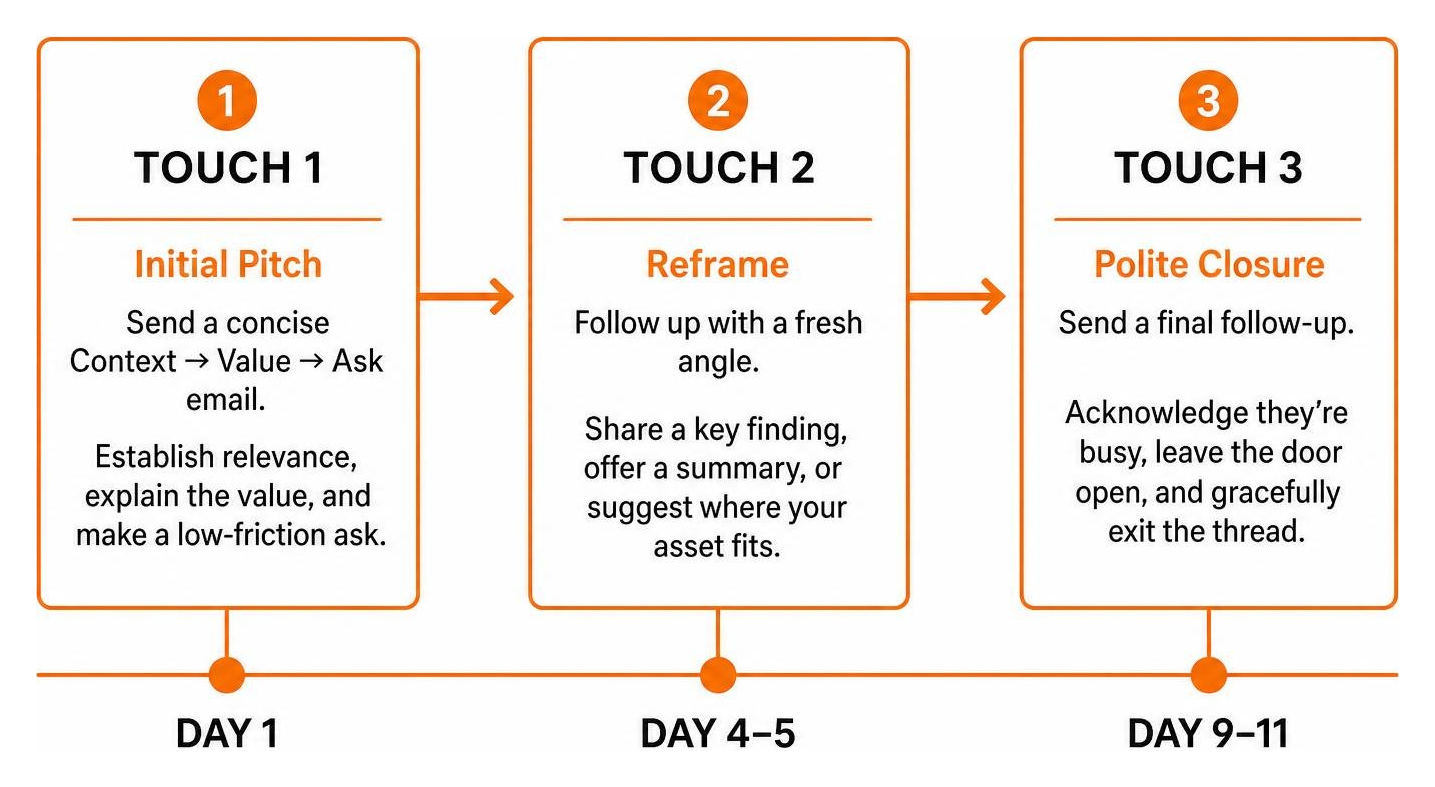
A winning three-touch cadence looks like this:
- Touch 1 (Day 1): The initial, concise Context-Value-Ask pitch.
- Touch 2 (Day 4–5): The Reframe. Provide a fresh angle, offer a quick summary of a key finding, or suggest a specific paragraph where your asset fits seamlessly.
- Touch 3 (Day 9–11): The Polite Closure. Acknowledge that they are busy, leave the door open for future collaboration, and gracefully exit the thread.
Essential Tools to Streamline Link Building Outreach Strategies
To execute outreach efficiently while maintaining personalized quality, smart marketers use a modern stack of specialized tools:
- Prospecting & Competitor Intelligence: Platforms like Ahrefs and Semrush help you identify content gaps, analyze competitor backlink profiles, and spot fresh publishing opportunities.
- Contact Finding & Verification: Tools like Hunter.io, Snov.io, and NeverBounce allow you to discover direct editorial email addresses while filtering out invalid mailboxes to keep bounce rates below 2%.
- Outreach & Pipeline Management: Platforms such as Pitchbox, BuzzStream, and Respona help organize sequences, manage prospect communication, and track placement statuses.
While automation is helpful for scheduling and tracking, never automate your judgment. Manual review is what turns cold outreach into real partnerships. If managing this multifaceted process sounds overwhelming, partnering with experienced specialists who provide dedicated off-page SEO services can help you secure high-tier links while saving your internal team dozens of hours each month.
Step 5: Multi-Channel Nurturing and Starting From Scratch
What if you are starting with a brand-new website and zero established industry relationships?
You do not need an existing massive network to win great backlinks. You just need to be willing to give value before you ask for anything in return.

If you are a founder or small business owner, check out our beginners guide to link building for small businesses for foundational local strategies. Then, adopt these practical habits to build authority from scratch:
- Engage on LinkedIn First: Connect with niche editors, content strategists, and marketing managers on LinkedIn. Leave thoughtful comments on their posts for a couple of weeks before sending a link pitch. When your name is already familiar, email open and reply rates jump significantly.
- Quote Industry Leaders in Your Content: When creating guides on your blog, cite reputable experts and link out to their best work. Once published, send them a quick note letting them know you featured their insights. They will often share your article on social media or reference it in future pieces.
- Provide Testimonials and Case Studies: Reach out to the software vendors, suppliers, and service providers you happily use every day and offer a detailed testimonial. Most companies have dedicated customer story pages and will gladly link back to your business.
- Join Niche Communities and Masterminds: Participate actively in relevant Slack groups, Discord servers, and local business associations across Philadelphia and Bucks County. Peer networking regularly opens doors to podcast interviews, panel invitations, and collaborative digital PR opportunities.
Over time, these individual conversations compound into an active network of marketing peers. Instead of starting from scratch with cold pitches on every campaign, you will have a trusted circle of collaborators who gladly exchange insights, quotes, and editorial coverage.
Frequently Asked Questions About Link Building Outreach
What is a realistic conversion rate for link building outreach?
Across the SEO industry, a standard benchmark for cold email outreach is a 1.3% prospect-to-backlink conversion rate. That means for every 1,000 highly qualified prospects you contact, you can reasonably expect around 50 replies (a 5% reply rate), roughly 25 positive conversations, and approximately 13 published backlinks.
However, when you implement deep personalization, verify email deliverability, and target niche-relevant publications, reply rates often reach 10% to 18%, significantly lowering the total volume of emails you need to send to hit your growth goals.
How many follow-up emails should be sent in an outreach sequence?
A three-touch sequence (the initial email plus two polite follow-ups) is the optimal standard. Sending fewer than two emails leaves more than half of your potential links on the table, as data shows that 66% of positive replies happen on the follow-ups.
Conversely, sending four or more emails provides diminishing returns and drastically increases the risk that an annoyed recipient will mark your message as spam, damaging your domain reputation. Space your follow-ups 3 to 5 business days apart, and always introduce new context or value rather than sending a passive “just checking in” reminder.
Why are broken link building and skyscraper outreach declining in performance?
Both broken link building and original skyscraper techniques were wildly effective when first introduced, but their widespread automation has led to heavy editor fatigue. Today, webmasters receive dozens of robotic skyscraper pitches daily saying, “I noticed you linked to X; mine is 10 times longer!”
Longer content is not inherently better content. In modern SEO, search algorithms and editors favor concise, user-focused answers, fresh data, and multimedia assets over bloated text. To earn links today, focus on solving specific content gaps, offering proprietary data studies, or establishing direct collaborative relationships rather than relying on outdated volume-based templates.
Conclusion
Mastering link building outreach does not require spamming thousands of inboxes or spending countless hours on gimmicky shortcuts. By focusing on deep relevance, respecting the editor’s time, maintaining clean email deliverability, and building genuine human relationships, you can steadily build an unshakeable moat of digital authority around your brand.
At FZP Digital, we believe that organic search growth works best when technical excellence meets authentic communication. Whether you are looking to refresh your responsive WordPress site, refine your content marketing strategy, or expand your online visibility, our collaborative team is here to help.
Ready to take your search rankings and online reach to the next level? Explore our affordable SEO services and let’s build a customized roadmap to grow your business together.