

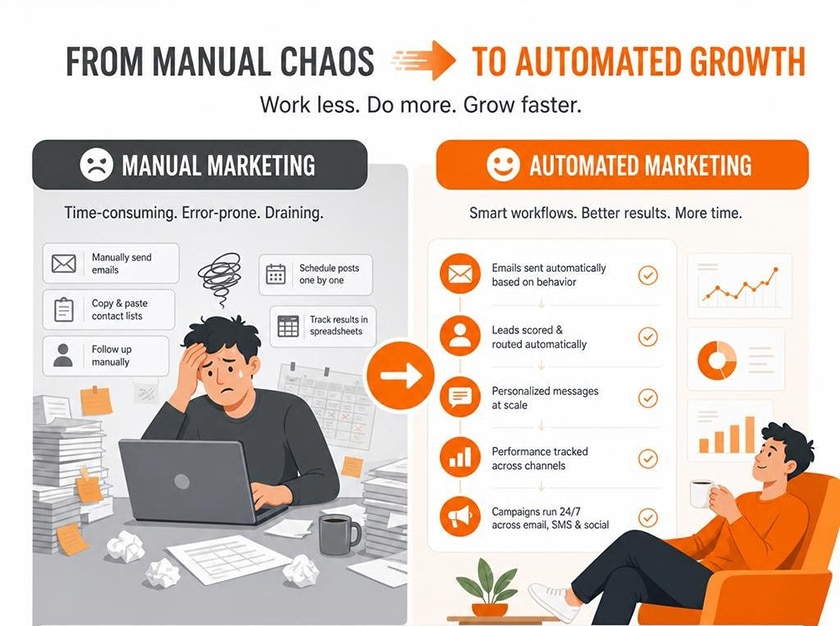
Automated Marketing Services: Why Your Manual Workflow Is a Nightmare

Your Manual Marketing Workflow Is Quietly Killing Your Growth
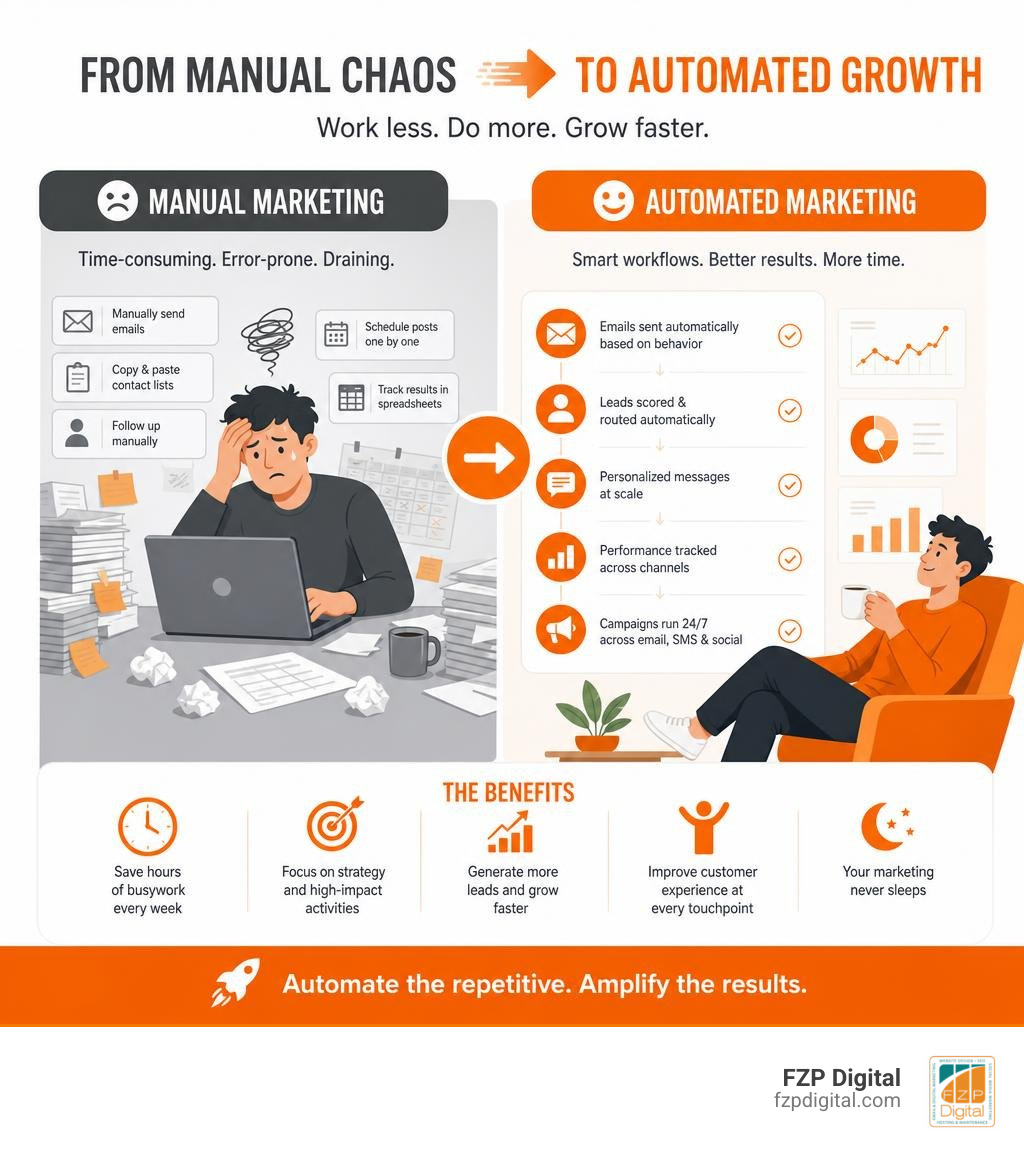
Automated marketing services are software platforms and tools that use AI and rules-based logic to handle repetitive marketing tasks — like sending emails, following up with leads, and posting to social media — automatically, without you having to do it by hand every time.
Here’s a quick breakdown of what that means in practice:
| What It Does | How It Helps You |
|---|---|
| Sends emails based on customer behavior | No more manually hitting “send” or forgetting follow-ups |
| Scores and routes leads automatically | Your best prospects get attention first |
| Personalizes messages using customer data | Every contact feels like you wrote just for them |
| Tracks performance across channels | You see what’s working without digging through spreadsheets |
| Runs campaigns 24/7 across email, SMS, and social | Your marketing never sleeps, even when you do |
Here’s an uncomfortable truth: if you’re still managing your marketing manually — copying and pasting email lists, scheduling posts one by one, chasing leads in a spreadsheet — you’re not just wasting time. You’re actively falling behind businesses that have already automated those exact same tasks.
Research shows that businesses using automation software generate twice as many leads as those that don’t. That’s not a small gap. That’s a competitive disadvantage that compounds every single month you wait.
And it’s not just about leads. It’s about the hours. ActiveCampaign reports that users of their autonomous marketing tools save an average of 13 hours of marketing busywork every single week. That’s nearly two full workdays handed back to you.
Think about what you’d do with that time.
I’m Fred Z. Poritsky, founder of FZP Digital — a Philadelphia-based digital marketing agency where I’ve helped businesses and nonprofits of all sizes move away from chaotic manual processes and toward smarter, more effective automated marketing services. My background spans decades in accounting, nonprofit management, and digital marketing, which means I understand both the business logic and the creative side of getting automation to actually work for you.
Automated marketing services further reading:
What Are Automated Marketing Services and How Do They Work?
Have you ever felt like you’re spinning too many plates at once? One minute you’re trying to post an update on social media, the next you’re trying to remember which lead requested a quote yesterday, and in the background, you’re worrying if your monthly newsletter actually went out. It’s exhausting, right?
That is where automated marketing services step in to save your sanity.
At their core, these services are designed to handle the heavy lifting of your marketing campaigns. Instead of you sitting at your desk manually typing out individual emails, checking off boxes, and updating spreadsheets, a centralized software platform does it for you. It relies on a concept called workflow orchestration—which is just a fancy way of saying it coordinates different tasks across multiple departments and platforms automatically so they work together seamlessly.

When you implement these systems, they look at your entire customer lifecycle. Instead of treating every interaction as a one-off event, the platform maps out the journey a customer takes from the moment they first discover your brand to the moment they become a loyal, repeating advocate. This software acts as the “brain” of your marketing stack, connecting your website, your customer relationship management (CRM) system, your advertising accounts, and your communication channels into one unified powerhouse.
Traditional Automation vs. Modern Autonomous Marketing
To really understand where we are in June 2026, we have to look at how much this technology has evolved.
For years, traditional marketing automation relied entirely on rules-based triggers. You had to sit down and build rigid “if/then” pathways. For example: If a user downloads our ebook, then wait three days and send Email A. If they open Email A, then send Email B. If they don’t, send Email C. While this was a massive step up from sending emails manually, it still required an incredible amount of manual setup, constant monitoring, and regular troubleshooting. It was stiff, and it couldn’t adapt when a customer did something unexpected.
Today, we’ve entered the era of the modern autonomous marketing platform.
Instead of relying on rigid, pre-written rules, autonomous platforms use real-time adaptation and predictive analytics to make decisions on the fly. These systems don’t just follow instructions; they learn from customer behavior. They look at billions of historical data points to predict what a customer is likely to do next and adjust the campaign instantly. For example, if the system notices a user prefers reading messages on their phone during their lunch break, it will automatically shift its delivery channel and timing to match that exact pattern.
This means your drip email marketing strategy is no longer a static sequence of emails. It becomes a living, breathing conversation that adapts to every click, scroll, and purchase.
The Core Channels of Automated Marketing Services
One of the biggest mistakes we see local businesses in Philadelphia, Richboro, and Newtown make is thinking that automation is only for email. While email automation is certainly a huge piece of the puzzle, modern platforms allow you to build a true omnichannel marketing automation strategy.
Here are the primary channels you can automate today:
- Email Automation: This is your foundation. From welcoming new subscribers to recovering abandoned carts, automated email systems ensure that the right message lands in the inbox at the perfect moment.
- SMS Messaging: Text messages boast incredibly high open rates. Automating SMS allows you to send time-sensitive offers, appointment reminders, or shipping updates directly to your customers’ pockets.
- WhatsApp Business: Especially popular for building two-way conversational experiences, automating WhatsApp allows you to answer customer inquiries, share product catalogs, and send personalized updates instantly.
- Social Media Ads: Instead of manually adjusting your ad budgets and audiences on Meta or Google, automation tools can run continuous audits, shift budgets to high-performing ads, and build lookalike audiences automatically.
By weaving these channels together, your business can engage prospects across multiple touchpoints without your team having to lift a finger. This is incredibly valuable when executing a sophisticated B2B email marketing strategy, where buyers require multiple highly personalized touchpoints before they’re ready to speak with a sales representative.
The Game-Changing Benefits of Letting AI Handle the Busywork
Let’s talk about what really happens when you stop doing everything by hand and let technology do what it does best. The benefits of automated marketing go far beyond simply saving time—they completely transform your business’s bottom line.
First, let’s look at lead generation. When you rely on manual follow-ups, leads fall through the cracks. It’s human nature. You get busy, an email gets buried in your inbox, and by the time you reply three days later, the prospect has already hired one of your competitors. Automated systems never forget. They capture, score, and nurture leads the exact second they show interest, which is why automated platforms can help businesses generate twice as many leads.
Second, your operational efficiency skyrockets. Instead of your team spending hours exporting CSV files, cleaning lists, and manually scheduling campaigns, they can focus on high-level strategy and creative work.
Third, customer retention becomes effortless. Automated systems can track when a customer hasn’t purchased in a while and automatically send a personalized “we miss you” offer, keeping your brand top-of-mind and driving repeat business.
To make this crystal clear, let’s compare how manual marketing tasks stack up against automated AI execution:
| Marketing Task | Manual Execution (The Nightmare) | Automated AI Execution (The Dream) |
|---|---|---|
| Lead Follow-Up | Writing and sending individual emails hours or days after a form is filled out. | Instantly sending a personalized email or SMS the second the form is submitted. |
| Data Hygiene | Manually scanning spreadsheets to remove duplicates, bounces, and inactive contacts. | Using tools like a “contact washing machine” to clean and update databases in real-time. |
| Ad Optimization | Logging into ad managers daily to manually adjust bids, budgets, and creative assets. | Continuous AI monitoring that shifts budgets to winning ads and flags creative fatigue. |
| Send Time Optimization | Blasting your entire email list at a single time and hoping for the best. | Analyzing individual user behavior to deliver emails at each recipient’s peak engagement hour. |
| Reporting & Analytics | Spending hours pulling data from different platforms to build a weekly report. | Real-time, interactive dashboards that track cross-channel attribution down to the dollar. |
How AI-Powered Features Supercharge Your Campaigns
The secret sauce of modern automated marketing services lies in their artificial intelligence capabilities. These aren’t just basic robots following rules; they are highly sophisticated tools designed to make your marketing smarter and more human.
One of the most powerful features is predictive sending. Instead of sending a blast email to your entire list at 9:00 AM on a Tuesday, AI analyzes when each individual recipient is most likely to open their emails based on their historical habits. It then schedules the email to go out to that specific person at their optimal time. This feature alone has been shown to increase click-through rates by up to 17%.
Then there is content generation. Modern AI email marketing tools can draft personalized email copy, subject lines, and SMS messages based on simple, plain-English prompts.
But what about brand consistency? You might worry that AI-generated content will sound robotic or off-brand. Fortunately, tools like ActiveCampaign’s Active Intelligence features include built-in AI Brand Kits. These kits remember your brand’s unique voice, color palette, logos, and style guidelines. Once you set your custom instructions, the AI automatically applies them across every single campaign, ensuring your messaging always sounds like you.
How to Choose the Right Automated Marketing Services for Your Business
With so many options on the market, choosing the right platform can feel overwhelming. To make the best decision for your business, you need to understand how these platforms are priced and structured.
Most automated marketing services use contact-based pricing. This means your monthly fee is determined by the size of your email list or the number of contacts you actively message each month. When evaluating plans, look closely at the feature tiers. Some platforms offer very cheap starter plans but lock crucial features—like advanced workflow building, split testing, or CRM integrations—behind expensive premium tiers.
You also need to consider onboarding and support. Implementing a new marketing system has a learning curve, and having access to expert guidance can make or break your success. When you’re designing a direct email marketing strategy, you want a platform that integrates seamlessly with your website and existing tools without requiring you to write complex code.
At FZP Digital, we always look at your business’s specific goals before recommending a platform. For example, if you’re running a local service business in Philadelphia, you might need a tool that focuses heavily on lead nurturing and CRM integration. If you’re running an e-commerce store, you’ll want a platform with robust cart abandonment and product recommendation features.
Key Considerations: Data, Compliance, and Integrations
Before you jump headfirst into automation, we need to talk about the foundation that makes it all work: your data. An automation system is only as good as the information you feed into it.
That is why a robust customer data platform (CDP) and CRM integration are absolutely vital. Your marketing automation tool needs to talk directly to your website, your online store, and your sales pipeline. When a customer makes a purchase, updates their contact info, or books a consultation, that data must sync instantly across your entire stack. If your tools are siloed, you run the risk of sending embarrassing, irrelevant messages—like emailing a discount code for a product the customer bought at full price five minutes ago.
You also need to prioritize compliance. Data privacy is not something you can afford to take lightly. Your automated systems must comply with strict regulations, including:
- GDPR (General Data Protection Regulation): If you have subscribers or customers in Europe, you must ensure you have explicit consent to track their data and send them marketing messages.
- SMS Regulations (TCPA & 10DLC): Text message marketing is heavily regulated. You must get clear opt-in consent before texting customers, and your messages must always include an easy way to opt-out (like replying “STOP”).
- Data Hygiene: To protect your email sender reputation, your platform should automatically clean your list by removing bounced addresses, spam traps, and unengaged subscribers who haven’t opened an email in months.
By setting up clean data flows and using tools like lead generating chatbots to gather compliant, first-party data directly from your website visitors, you can build a highly effective marketing machine that respects your audience’s privacy and keeps your business safe.
Frequently Asked Questions about Automated Marketing
We get a lot of questions from business owners in the Greater Philadelphia area who are curious about automation but hesitant to take the plunge. Here are the answers to some of the most common concerns we hear.
How do automated marketing services differ from traditional email tools?
Traditional email tools are built for one-way outreach. You write a single email blast, hit send, and it goes to everyone on your list at the exact same time, regardless of their interests or relationship with your business.
Automated marketing services, on the other hand, are built for two-way conversations and customer journey orchestration. Instead of blasting your list, these platforms use behavioral triggers to send highly personalized messages based on what a user actually does. If a visitor views a specific service page on your website three times in one week, the system can automatically trigger a targeted email offering a free consultation for that exact service. It is dynamic, relevant, and infinitely more effective.
Will implementing automated marketing replace my existing team?
Absolutely not. We like to say that AI and automation don’t replace marketers—they give them superpowers.
Think of automation as an assistant that handles all the administrative busywork. By automating repetitive tasks like data entry, list segmenting, and campaign scheduling, your team is freed up to focus on what humans do best: creative strategy, high-level copywriting, and building genuine relationships with your clients. You maintain complete strategic oversight with a human-in-the-loop approach, approving campaigns and guiding the overall direction while the software handles the execution.
How long does it take to see a return on investment (ROI)?
While every business is different, many of our clients start seeing noticeable improvements in lead quality and conversion rates within the first 30 days. Because automated systems follow up with leads instantly and nurture them consistently, you’ll stop losing prospects to slow response times.
Over the long term, the ROI of automated marketing comes from building stronger, highly personalized customer relationships at scale. By staying top-of-mind with your audience without adding to your daily workload, you’ll drive higher customer lifetime value and steady, predictable revenue growth.
Conclusion: Say Goodbye to Manual Workflows
Managing your marketing manually is a recipe for burnout, missed opportunities, and stalled growth. In today’s digital world, trying to handle every email, lead follow-up, and ad adjustment by hand is a nightmare you don’t have to live through.
At FZP Digital, led by Fred Z. Poritsky, we believe that your digital presence should work for you, not against you. We specialize in premium responsive WordPress website design, local SEO, and helping businesses across Richboro, Newtown, and Philadelphia implement smart, stress-free automated marketing services.
We emphasize a collaborative “Develop . Design . Deliver” process. We don’t just hand you a piece of software and wish you luck. We take the time to audit your existing tools, map out your customer journeys, build out your custom workflows, and ensure your systems are fully integrated and compliant. Whether you need to connect a high-performing CRM, launch automated campaigns, or set up premium managed WordPress hosting (where we highly recommend industry leaders like GoDaddy and WP Engine), we are here to guide you every step of the way.
Are you ready to cut the busywork, win back your hours, and start generating the leads your business deserves?
Let’s chat. Explore our digital marketing services today, or get in touch to schedule a friendly, no-pressure consultation. We’ll help you wake up from the manual marketing nightmare and build a system that grows your business on autopilot.