

A Practical Guide to Learning Link Building Through Guest Posting

Build Better Backlinks With Guest Posting
Link building guest posting works when you publish genuinely useful articles on relevant, well-maintained websites and earn a natural link to a page that helps their readers. Start by finding publications in your industry, vetting them for real traffic and editorial quality, pitching a specific topic, and using a branded or naturally worded anchor text link in the article.
For a Philadelphia business or nonprofit, the goal is not to collect the most links. It is to earn a small, steady stream of editorial mentions from sites your future customers, donors, and peers actually trust.
That matters because strong backlinks can support rankings, referral visits, brand recognition, and credibility. Pages in Google’s top position tend to have far more backlinks than pages ranking below them, but low-quality bulk placements are not the shortcut they may appear to be. A relevant link from a real industry publication is usually worth more than dozens of links from unrelated, thin-content sites.
Guest posting is also more than an SEO tactic. A useful article can put your expertise in front of a new audience, start a relationship with an editor, and send qualified visitors directly to your website.
I’m Fred Z. Poritsky, founder of FZP Digital. My experience building websites, content strategies, and search visibility for businesses and nonprofits informs this practical approach to link building guest posting: put audience value and editorial trust ahead of volume, then measure what actually grows your organization.
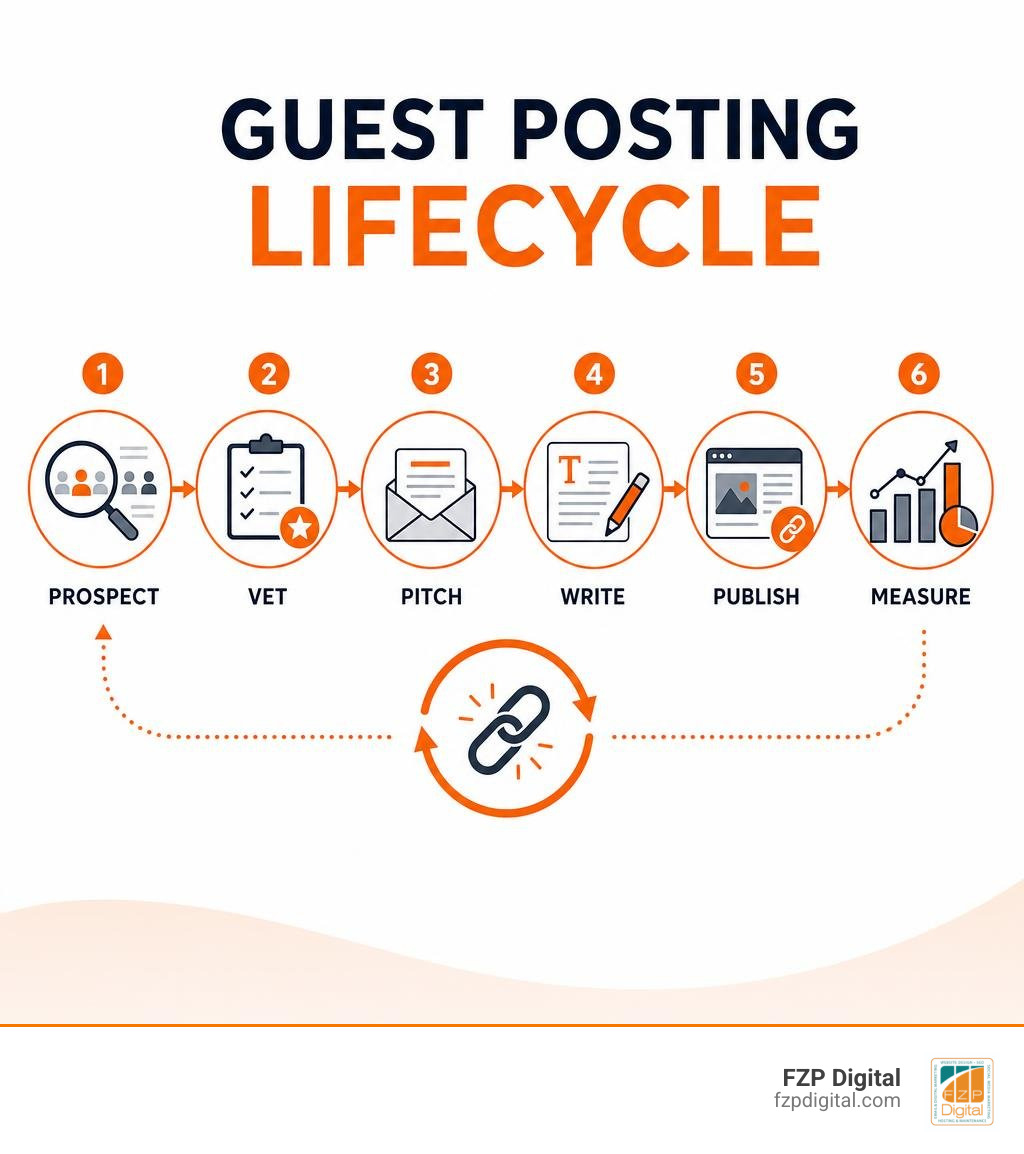
Link building guest posting definitions:
Fundamentals of Link Building Guest Posting in 2026
How do search engines actually evaluate the web today? At its core, search algorithms still rely on backlinks to map authority and trust. When one reputable website links to another, it acts as a vote of confidence, passing PageRank and establishing topical context across the internet.
In 2026, the digital landscape has expanded. We are no longer just optimizing for traditional blue links; modern AI search engines and answer engines (like ChatGPT, Perplexity, and Google AI Overviews) evaluate the web’s link graph to verify factual claims and choose source citations. In fact, 73% of link builders believe backlinks directly influence AI search visibility. If major publications in your industry cite your work, AI models are substantially more likely to feature your brand in generated answers.
However, not all links carry equal weight. According to Ahrefs data, 66.31% of web pages have zero backlinks, leaving them virtually invisible in organic search. Meanwhile, pages ranking in position #1 on Google possess an average of 3.8x more backlinks than positions 2 through 10. Building strong editorial connections is not optional if you want consistent search visibility.
Topical authority means demonstrating comprehensive depth in your subject area. Search engines analyze the surrounding content of your backlink to verify that the referring site matches your industry niche. If you run a commercial architecture firm, a backlink from a construction management journal holds vastly more topical authority than a random mention on a cooking blog. Starting with a solid guide to link building for small businesses helps frame how these early authority signals set the stage for your overall off-page growth.
Core Benefits of Link Building Guest Posting
While 48.6% of link builders view digital PR as a leading tactic, guest posting remains a powerhouse—utilized by 64.9% of professionals as their primary, repeatable engine for authority building. The reason is simple: you control the narrative, the educational value, and the context of the placement.
The benefits extend far beyond direct SEO metrics:
- Qualified Referral Traffic: An average high-quality guest post generates around 125 targeted referral visits per month. These are active readers already interested in your insights.
- Audience Extension & Brand Awareness: Industry research shows guest blogging allows up to a 174% audience extension, introducing your leadership to established communities.
- Professional Networking: Pitching and writing articles connects you directly with editors, journalists, and industry peers, opening doors for podcast invitations, joint webinars, and speaking opportunities.
- Contextual Trust: When readers see your practical insights on respected blogs, your brand authority naturally rises. As HubSpot highlights in their overview on using guest blogging for effective link building, providing genuine educational value to another platform’s readership creates an immediate trust bridge back to your own domain.
Dofollow, Nofollow, and Sponsored Link Attributes
Understanding how search engines interpret HTML link attributes prevents wasted outreach effort and keeps your site compliant with webmaster guidelines.
- Dofollow (
rel="dofollow"or standardtags): This is a standard link without restrictive rel tags. It passes full link equity (PageRank) and serves as an explicit editorial endorsement from the publishing site to yours. - Nofollow (
rel="nofollow"): Introduced by Google to combat comment spam, nofollow indicates that the publisher does not endorse the destination link for ranking purposes. However, Google treats nofollow as a “hint” rather than a strict directive. Nofollow links still drive real referral traffic, build brand awareness, and help AI search engines discover and cite your content. - Sponsored (
rel="sponsored"): Created specifically to label paid placements, advertising, or sponsored content. Using this attribute ensures full compliance with Google’s link spam policies whenever money or goods change hands for a placement. - User-Generated Content (
rel="ugc"): Applied to links created within comments, forums, or open contributor sections.
| Link Attribute | Primary Purpose | Passes PageRank Equity? | Primary SEO & Brand Value |
|---|---|---|---|
| Dofollow | Standard editorial reference | Yes (Full) | Maximizes search rankings and domain authority transfer. |
| Nofollow | Unendorsed link / contributor tag | Hint only | Drives referral visitors, brand visibility, and AI citations. |
| Sponsored | Paid placements & advertorials | Hint only | Complies with search engine guidelines while driving traffic. |
| UGC | Forum posts & comment sections | Hint only | Engages community discussions and drives niche discovery. |
How to Find and Prospect High-Authority Opportunities
Finding the right publications requires a deliberate prospecting system. Rather than blasting hundreds of generic blogs, you want to uncover active, authoritative sites with engaged readers.
A thorough prospecting framework involves a mix of advanced search operators, competitor backlink profiling, and industry gap analysis. By conducting a structured SEO competitive analysis, you can quickly see which industry blogs are already linking to your top-ranking competitors and target those exact platforms.
Google Search Operators for Target Discovery
Google search operators allow you to filter through millions of pages to find active contributor guidelines in seconds. Here are the most effective search strings to locate opportunities in your specific field:
[niche] intitle:"write for us"[niche] intitle:"guest post guidelines"[niche] inurl:contribute "submit"[niche] "become a contributor"[niche] inurl:guest-post "editorial guidelines"[niche] "guest author" -site:pinterest.com
You can refine these footprints further by combining negative keywords (-inurl:paid, -sponsored) to filter out pure pay-to-play link farms. For a deeper breakdown of advanced search parameters, explore this tutorial on how to find guest post opportunities using search operators.
Reverse Engineering Competitor Backlink Profiles
Your top competitors have already done extensive outreach legwork. By analyzing their backlink profiles using tools like Ahrefs or Semrush, you can identify the exact websites that accept guest contributions in your space.
- Export Referring Domains: Run your top 3–5 competitors through a backlink checker and export their referring domains.
- Filter by Contextual Placements: Look for pages with author bios, “contributor” tags, or editorial mentions in the main body text.
- Identify Recurring Authors: Track prolific writers in your niche. If an industry expert regularly writes for five or six authoritative blogs, add those target publications to your primary outreach database.
Vetting Guest Post Sites for Quality, Safety, and Authority
Not every site that offers to publish your article is worth your time. In fact, publishing on spammy websites or link farms can trigger search penalties or dilute your site’s reputation. A rigorous vetting process ensures your articles only appear on legitimate platforms.
When establishing comprehensive off-page SEO services, vetting standards must always prioritize human editorial oversight over vanity metrics.
Essential Quality and Relevance Metrics
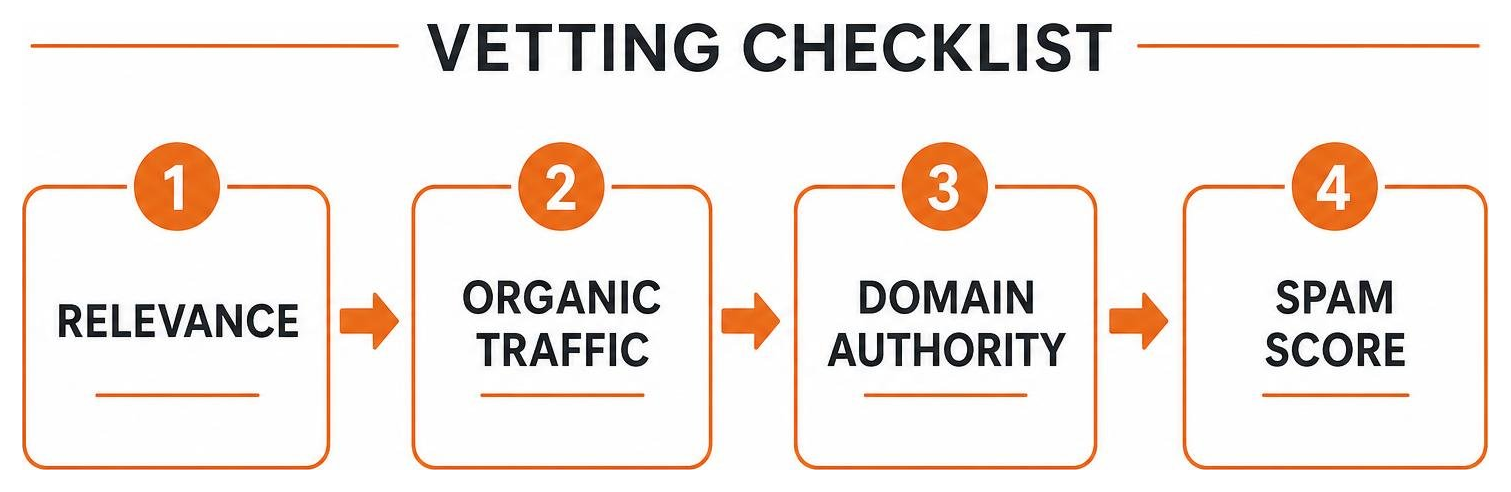
Before reaching out to any publication, run it through this four-step vetting checklist:
- Topical Relevance (The Golden Rule): Does the website naturally cover your industry? A DA 45 niche-specific blog will drive more meaningful SEO value and qualified leads than a generic DA 80 lifestyle site covering everything from lawnmowers to cryptocurrency.
- Organic Search Traffic Health: Use SEO tools to verify that the site receives steady, verified organic search traffic (ideally 1,000+ monthly visits minimum). A domain with high authority metrics but zero organic search traffic often indicates an expired domain repurposed as a link network.
- Domain Rating / Authority Baseline: Target websites with a Domain Rating (DR) or Domain Authority (DA) of 30+ for standard niche blogs, and 50+ for competitive industry publications.
- Spam Score & Link Profile: Keep the target site’s spam score under 5–7%. Inspect their outbound links: are they linking out to shady casinos, unvetted pharma sites, or essay writing services? If yes, walk away immediately.
Red Flags and Link Networks to Avoid
Google actively polices link spam and site reputation abuse. If a site exhibits any of the following warning signs, remove it from your prospect list:
- Instant, Guaranteed Dofollow Placements for a Fee: Legitimate editorial sites review content thoroughly before accepting. If they offer an instant, unreviewed placement via email for $30, it is a link farm.
- Bizarre Content Mashups: If a blog publishes an article on “Home Plumbing Tips” followed immediately by “Best Forex Brokers in London” and “How to Groom a Golden Retriever,” it lacks topical cohesion and serves solely as a link marketplace.
- Massive Discrepancies Between Authority and Traffic: Sites boasting a DR of 75 with fewer than 100 monthly organic visitors are red flags. This pattern typically points to artificial link manipulation or an algorithmic devaluation by search engines.
- Publishing Frequency Overload: Blogs publishing 15+ thin, low-effort guest posts every single day with no primary staff writers will not pass meaningful trust equity.
Crafting Pitches and Writing High-Impact Guest Articles
Editors at authoritative publications receive dozens of generic pitches every week. To stand out, your pitch must demonstrate genuine familiarity with their publication, solve a content gap for their readers, and show that you are an experienced professional who respects their editorial standards.
Mastering your outreach requires a structured communication process. Implementing proven link building outreach strategies ensures your emails achieve high open and acceptance rates.
Email Outreach Tactics That Editors Accept
Data from large-scale outreach studies shows that personalized subject lines can increase response rates by over 30%, while sending a polite follow-up can double your overall replies. In our experience at FZP Digital, founder Fred Z. Poritsky emphasizes that approaching editors as a collaborative contributor—rather than a transactional link builder—produces the highest long-term success.
- Keep It Concise: Keep your pitch under 150 words. Editors skim quickly.
- Reference Specific Content: Mention a recent article they published and explain why your proposed topic naturally builds upon that conversation.
- Pitch 2–3 Concrete Angles: Provide specific, benefit-driven working titles along with a two-sentence outline for each.
- Highlight Writing Samples: Include links to 2–3 previously published, high-quality articles that demonstrate your clarity and expertise.
For more frameworks on scaling high-converting outreach without sacrificing quality, review this detailed resource on guest posting for link building.
Content Creation and Anchor Text Distribution
Once your topic is accepted, deliver a piece of content that exceeds the quality of the host site’s existing posts. Align your writing with an intentional content SEO strategy to ensure the post provides standalone value while naturally integrating your link.
- Match Word Count & Tone: Most authority publications look for comprehensive articles between 1,200 and 2,500 words with clean subheadings and actionable examples.
- Contextual Link Integration: Place your backlink naturally within the body copy where it serves as a helpful, supplementary resource (such as linking to a study, tool, or in-depth guide). Never force an unnatural link into an opening sentence where it disrupts readability.
- Diversify Anchor Text: Google’s spam algorithms penalize aggressive exact-match keyword anchor text (e.g., using “best philadelphia web design” repeatedly). Follow a balanced distribution:
- Branded Anchors (40–50%): e.g., “FZP Digital”, “According to FZP Digital…”
- Natural / Sentence Anchors (25–35%): e.g., “this detailed guide”, “learn more here”, “view the research”
- Partial-Match / Topical Anchors (15–20%): e.g., “custom WordPress development strategies”, “local SEO execution”
- Exact-Match Anchors (<5%): Use sparingly and only when it reads as flawless English prose.
Campaign Execution, Cadence, and Measuring ROI
Building search authority is a marathon, not a sprint. Consistency and sustainable pacing will always outperform erratic, high-volume link bursts.
Contributing well-researched guest articles alongside contextual links has been shown to grow organic website traffic by 96.6% in as little as eight months. Real-world performance data also reveals that pages acquiring 3 or more high-quality backlinks typically experience a 40% to 80% increase in organic search traffic over time.
Determining Your Monthly Publishing Cadence
How many guest posts should your team actually publish each month?
For small businesses and growing brands, aiming for 3 to 5 high-quality guest post placements per month is the ideal sweet spot. Publishing five exceptional, well-vetted articles on legitimate industry platforms will outperform chasing fifty low-tier submissions on unmoderated websites every single time.
- Domains Under DA 40: Expect your Domain Authority or Domain Rating to grow by roughly 3–5 points per quarter with a steady cadence of 3–5 monthly placements.
- Domains Above DA 40: Expect authority growth of 1–3 points per quarter, as higher tiers require progressively stronger backlink signals to move the needle.
Measuring ROI for Link Building Guest Posting Campaigns
To determine whether your campaign is delivering a positive return on investment, monitor both leading and lagging indicators across a 90-to-180-day window:
- Referring Domain Growth: Track the steady increase of unique, high-trust referring domains in your SEO dashboard.
- Target Keyword Rank Lift: Measure the movement of your target URLs in organic search results. Look for keywords climbing from page 2–3 into the top 5 positions.
- Qualified Referral Traffic: Review your web analytics to see how many visitors arrive via guest post links and how long they stay on your site.
- Referral Conversions & Assisted Leads: Set up conversion tracking to identify users who discovered your brand through an article and subsequently subscribed to your newsletter or submitted an inquiry form.
Frequently Asked Questions About Guest Post Link Building
How many guest posts should I publish per month to see SEO results?
For most small-to-midsize businesses, publishing 3 to 5 high-quality guest posts per month provides steady authority growth without risking quality dilution. Newer websites need consistent link velocity to establish initial trust, while established brands can maintain competitive rankings with 2 to 4 authoritative placements each month.
Are paid guest posts safe according to Google guidelines?
Directly paying for links that pass PageRank violates Google’s Search Essentials. If a publication charges an editorial processing or placement fee, Google requires the backlink to include either rel="sponsored" or rel="nofollow". While these attributes do not pass raw PageRank, they keep your website completely safe from manual spam actions while still delivering referral traffic, brand awareness, and AI search visibility.
How long does it take for guest post backlinks to impact rankings?
While referral traffic can begin arriving the very day your article goes live, measurable SEO ranking improvements typically take 6 to 12 weeks. Search engines need time to crawl the host page, index the content, evaluate the surrounding topical relevance, and recalculate PageRank distributions across the overall link graph.
Conclusion
Sustainable link building through guest posting is one of the most reliable ways to expand your digital footprint. By focusing on genuine educational value, building real relationships with industry editors, and maintaining strict vetting standards, you protect your website from algorithmic penalties while creating enduring search visibility.
Are you looking to grow your organic visibility and elevate your brand’s digital presence? Whether you need a high-performing WordPress website, a refined content plan, or comprehensive search optimization, partnering with an experienced team makes all the difference. At FZP Digital, we guide businesses across Philadelphia, Bucks County, and beyond using our proven “Develop . Design . Deliver” approach.
Explore our affordable SEO services today to discover how our team—backed by founder Fred Z. Poritsky—can help you achieve lasting search rankings and steady business growth.