
Why the Best Nonprofit Organizations Websites Are Worth Stealing From
Nonprofit organizations websites are often the single most important tool a charity has for attracting donors, recruiting volunteers, and communicating its mission to the world.
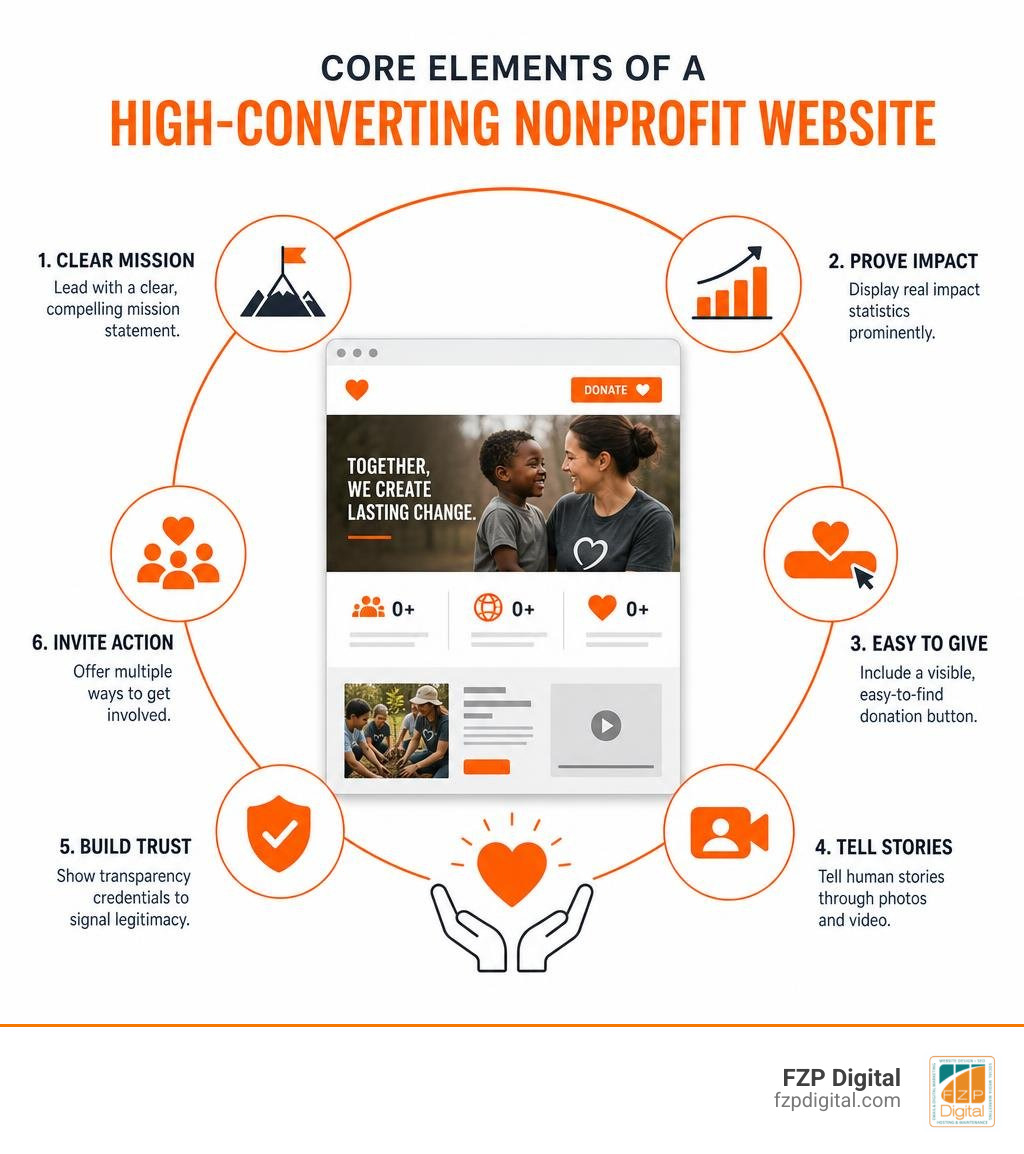
Here’s a quick look at what separates a high-performing nonprofit website from one that gets ignored:
| What Great Nonprofit Websites Do | Why It Matters |
|---|---|
| Lead with a clear, compelling mission statement | Visitors decide in seconds whether to stay |
| Display real impact statistics prominently | Builds credibility and donor trust |
| Include a visible, easy-to-find donation button | Reduces friction for giving |
| Tell human stories through photos and video | Creates emotional connection |
| Show transparency credentials (Candid, Charity Navigator) | Signals legitimacy to new visitors |
| Offer multiple ways to get involved | Captures donors, volunteers, and advocates |
And here’s the thing: you don’t have to figure this out from scratch.
Some of the world’s most effective nonprofits — from Doctors Without Borders to World Central Kitchen — have already done the hard work of building websites that convert visitors into supporters. Their designs, structures, and storytelling strategies are right there for you to study and learn from.
With 1.8 million registered nonprofits in the United States alone, the competition for donor attention is real. A great website isn’t a luxury — it’s a necessity.
That’s exactly why we put this guide together. Whether you’re running a Philadelphia-area nonprofit with an outdated site or you’re building one from the ground up, you’ll find practical, steal-worthy ideas here.
I’m Fred Z. Poritsky, founder of FZP Digital, and I bring a background in nonprofit financial management directly to my work helping organizations build better nonprofit organizations websites that drive real engagement and donor growth. That inside knowledge of how nonprofits operate — combined with years of hands-on WordPress web design and SEO — shapes everything we build at FZP Digital.
Explore more about nonprofit organizations websites:
What Makes the Best Nonprofit Organizations Websites Stand Out?
Did you know that 94% of consumers say their first impression of a brand is based entirely on its website’s design? When it comes to the nonprofit sector, that first impression doesn’t just impact a brand—it directly influences whether someone decides to support your cause or click away.
The best nonprofit organizations websites successfully balance visual appeal, seamless user experience (UX), and emotional storytelling. They don’t just look pretty; they function as highly efficient digital headquarters.

To truly stand out, your website needs to connect with your visitors on both an emotional and analytical level. You want to capture their hearts with storytelling while reassuring their minds with solid data and intuitive navigation. If you are looking to take your online presence to the next level, you can find more tips on nonprofit website design and learn about nonprofit website designs that are driving real-world change today.
Essential Features of Successful Nonprofit Organizations Websites
If you look at the most successful nonprofit websites, they all share a core set of essential features. These elements are strategically placed to guide visitors from passive readers to active supporters:
- An Unmissable Call to Action (CTA): Your “Donate” and “Volunteer” buttons shouldn’t blend into the background. They should be in a contrasting color, placed in the top right corner of your header, and remain sticky as users scroll.
- Streamlined Donation Forms: If your donation process takes more than a couple of steps, you are losing money. The best sites use embedded, distraction-free donation forms with pre-set giving tiers and the option for recurring monthly gifts.
- Clear Volunteer Pathways: Don’t make people search for how to help. Create a dedicated “Get Involved” hub that outlines exactly what you need, whether it’s local event support in Bucks County or digital advocacy.
- Optimized Mobile Responsiveness: More than half of your traffic is looking at your site on a phone. If your donation form is hard to tap on a mobile screen, your donor journey is broken.
Want to make sure your site is built on a rock-solid foundation? Be sure to discover nonprofit website design best practices to optimize these features for your audience.
How to Build Trust and Transparency on Nonprofit Organizations Websites
Trust is the ultimate currency in the nonprofit world. Donors want to know that their hard-earned money is actually reaching the front lines of your mission.
One of the fastest ways to build trust is by displaying third-party verification. Candid provides comprehensive data on 1.8 million IRS-recognized tax-exempt organizations, and their data powers over 230 websites, programs, and applications. Earning and proudly displaying a Candid Seal of Transparency (formerly GuideStar) on your homepage or footer immediately signals to visitors that you operate ethically.
Additionally, make sure your Employer Identification Number (EIN), annual reports, and financial breakdowns (like IRS Form 990s) are incredibly easy to find in your footer. When you make your financial health clear, donors feel secure in their investment. To see how top-tier organizations combine beauty with absolute transparency, explore stunning NGO website designs that do this flawlessly.
Real-World Inspiration: Top Nonprofit Websites to Learn From in 2026
When you are looking to upgrade your digital presence, there is no shame in looking at the industry leaders for inspiration. In fact, we highly recommend it! Let’s take a look at how some of the most successful global organizations structure their websites to drive massive engagement.

By analyzing these giants, you can extract valuable design, copy, and structural choices to apply to your own local organization. For a curated list of even more ideas, see top nonprofit websites to inspire your own.
Doctors Without Borders: Masterful Emergency Response and Impact Data
Doctors Without Borders does an incredible job of balancing urgent, real-time crisis reporting with undeniable impact data. When you land on their homepage, you are immediately met with raw, emotional storytelling from the field.
But they don’t just rely on emotion; they back it up with staggering statistics. The site clearly showcases their massive reach, highlighting that their humanitarian teams conducted 16,493,900 medical consultations and admitted 1,665,200 patients to hospitals or clinics.
They also build instant trust by showing exactly where their funding goes:
- 84% goes directly to programs that bring emergency medical care to those who need it.
- 15% goes to fundraising.
- 1% goes to management and general administrative expenses.
This clear financial breakdown removes any hesitation a donor might have. If you want to learn how to structure a complex, high-impact site like this, read our NGO website development guide.
Ocean Conservancy: Interactive Engagement and Environmental Action
The Ocean Conservancy website is a masterclass in interactive engagement. They don’t just ask for donations; they invite you to become a part of their massive community, which has already removed 400 million pounds of plastic and trash from our oceans with the help of 19 million volunteers.
One of their standout website features is the Wildlife Impact Calculator. This interactive tool translates complex scientific data into personal impact, showing users exactly how their individual actions and donations help marine life.
By gamifying advocacy and offering clear, tangible action steps—like writing to elected officials or joining a local beach cleanup—they keep visitors highly engaged. To learn how to build interactive elements like this into your own site, check out our non-profit site design guide.
PATH: Global Health Innovation and Strategic Clarity
For organizations that deal with complex, systemic issues, PATH provides a brilliant blueprint. PATH works across more than 70 countries to improve health for 64 million lives every single year. Because their work spans digital health, vaccine development, and policy, their website could easily become overwhelming.
Instead, they use a highly organized structure anchored by their “PATH Strategy 2030.” They break down complex global health innovations into digestible, visual stories.
By pairing clean typography with a professional, corporate-yet-warm color palette, they position themselves as global leaders. If your organization has a multi-faceted mission, finding the right layout is key. You can find the right charity website design company to help you translate complex missions into clean, user-friendly designs.
World Central Kitchen: Immediate Action and Community-Driven Storytelling
Founded by Chef José Andrés, World Central Kitchen (WCK) operates on a simple but powerful premise: food is a universal right, and when disaster strikes, the solution must be immediate. Having served over 600 million meals in communities impacted by crises, their website reflects this sense of urgency.
The WCK homepage uses bold, full-width photography and raw video footage of field kitchens in action. Their donation CTA is front and center because, as they famously state, “when you talk about food and water, people don’t want a solution one week from now… the solution has to be now.”
Their site is optimized for rapid-response fundraising and volunteer coordination, making it incredibly easy for supporters to jump in and help during a crisis. To see how you can harness this level of emotional urgency, learn about charity NGO websites and how they serve as gateways to real-world action.
Heifer International: Empowering Communities and Creative Giving Catalogs
Heifer International has supported more than 59 million families since 1944. Their website is famous for pioneering the “Gift Catalog” model, where donors can choose to fund specific, tangible items—like a goat, a flock of chicks, or clean water systems—for struggling farmers.
This creative approach to giving makes the donor feel directly connected to the outcome of their gift. Their website also places a massive emphasis on empowering women farmers, using beautiful, high-quality photography and personal stories to highlight how collective farming lifts entire communities out of poverty.
If you want to move away from generic “Donate” buttons and explore creative, catalog-style giving, see non-profit organization examples that have successfully adopted this approach.
Best Practices for Designing and Developing Your Nonprofit Site
Now that you’ve got plenty of inspiration from the world’s leading organizations, let’s talk about how to apply these concepts to your own website. Designing a great nonprofit site isn’t just about making it look modern—it’s about ensuring it is accessible, easy to navigate, and optimized for search engines.
Whether you are starting from scratch or planning a complete overhaul, keeping UX and accessibility at the forefront of your design is vital. To make sure you don’t miss a step, read about best practices for nonprofit website design and learn about charity website design best practices.
Reorganizing Complex Information Architecture
If your nonprofit has been around for a while, chances are your website has accumulated a lot of pages. It is incredibly common for nonprofit sites to grow bloated over time, making it difficult for users to find what they need.
Before you write a single line of code or design a new layout, you need to perform a thorough content inventory. Reorganizing your information architecture (IA) involves mapping out every single page, deleting outdated content, and grouping the remaining pages into an intuitive, shallow navigation menu.
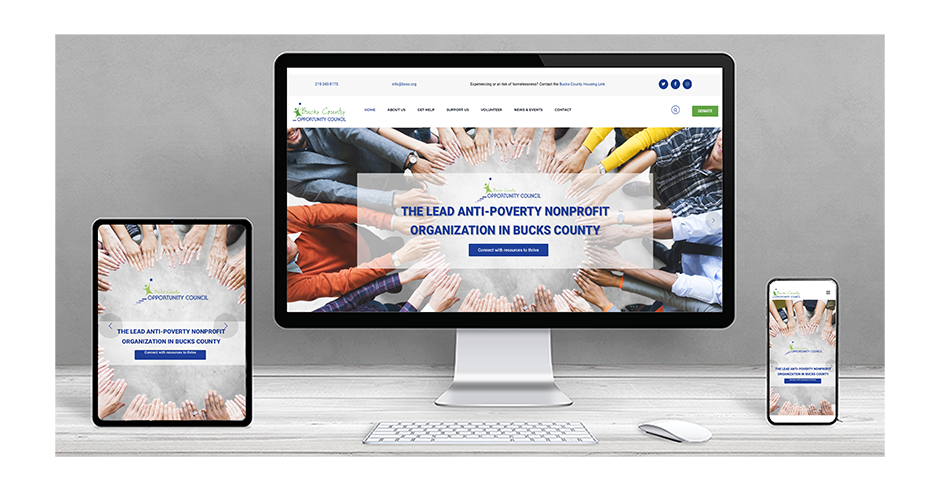
For example, when we work with local organizations, we focus on creating a reusable “component toolbox” so that adding new pages in the future doesn’t break the site’s logical structure. To see how we successfully reorganized a complex local network, read our Bucks County Opportunity Council case study to see how streamlined navigation can dramatically improve community engagement.
Choosing the Right Platform and Hosting
When it comes to building your site, we highly recommend WordPress. It powers over 40% of the internet for a reason: it is cost-effective, incredibly customizable, and easy for your internal team to update without needing a developer for every minor text change.
But a great platform is only as good as the hosting that powers it. If your website takes more than three seconds to load, visitors will leave before they even see your mission statement. That’s why choosing premium hosting is so important.
At FZP Digital, we recommend GoDaddy and WP Engine for managed WordPress hosting. They offer incredible speed, automatic backups, and top-tier security to protect your donor data. Ready to get started with the world’s favorite CMS? Learn how to launch a nonprofit website with WordPress and set your organization up for long-term digital success.
Frequently Asked Questions About Nonprofit Websites
What are the most critical elements of a nonprofit homepage?
Your homepage needs to answer three questions within three seconds of a user landing on it: Who are you? What do you do? How can I help?
To achieve this, your homepage must include:
- A clear, jargon-free mission statement above the fold.
- A high-contrast, sticky “Donate” button in the top right corner.
- Real impact statistics that prove your effectiveness.
- High-quality, authentic imagery of your work (avoid sterile stock photos whenever possible!).
How can a nonprofit website improve its search engine visibility?
Improving your organic search ranking is all about a dedicated SEO strategy. You need to target keywords that your local community is actually searching for, such as “volunteer opportunities in Newtown” or “food pantries in Philadelphia.”
By creating high-quality, helpful blog content around these topics, optimizing your image alt text, and building local backlinks, you can naturally climb the Google search results. For a complete digital roadmap, read our essential marketing guide for nonprofits.
Why should nonprofits avoid using image carousels on their homepages?
While image carousels (or sliders) used to be incredibly popular, modern UX studies show that they are actually conversion killers.
Here is why you should avoid them:
- Low Engagement: Users rarely sit and watch a slider rotate. Studies show that less than 1% of visitors ever click on a slide past the first one.
- Page Load Speed: Carousels require heavy scripts and multiple large images, which slows down your site.
- Accessibility Issues: Sliders are notoriously difficult for screen readers to navigate, making your site less accessible to users with disabilities.
Instead of a carousel, use a single, high-impact “hero” image or a short, optimized background video that instantly captures your mission.
Conclusion: Partnering for Digital Good
Building one of the best nonprofit organizations websites in 2026 doesn’t have to be an overwhelming challenge. By studying global leaders like Doctors Without Borders and World Central Kitchen, you can bring world-class design, trust-building transparency, and emotional storytelling to your local community.
But we also know that you have a nonprofit to run. You are busy organizing events, coordinating volunteers, and making a real difference in communities like Richboro, Newtown, and Philadelphia. You shouldn’t have to worry about technical SEO, database optimization, or responsive WordPress design.
That’s where we come in. At FZP Digital, led by Fred Z. Poritsky, we specialize in our collaborative “Develop . Design . Deliver” process. We don’t just build beautiful websites; we build digital engines that help your nonprofit grow, attract donors, and amplify your mission.
Ready to take your digital presence to the next level?
- Get expert web design and development services tailored to your budget.
- Find expert web designers for nonprofits who truly understand your cause.
- Hire the best for your nonprofit’s web development and let’s build something amazing together!